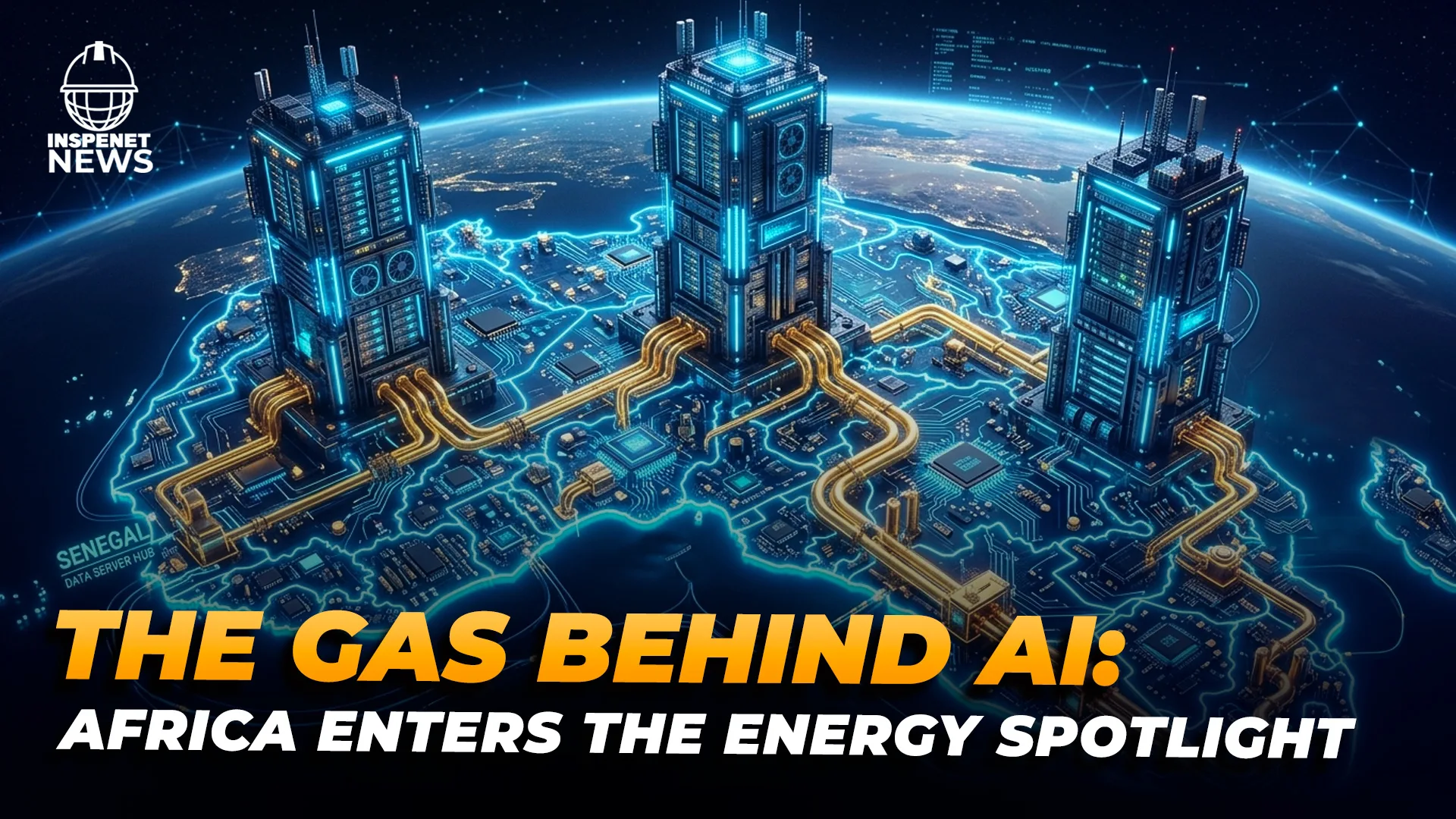
Natural gas and data centers: Africa’s bet in the face of the AI boom
As artificial intelligence accelerates the global digital transformation , the energy consumption associated with this technology is beginning to redefine economic and infrastructure strategies in various markets. In Africa, this scenario presents an opportunity directly linked to one of its greatest resources: natural gas.
Data centers, essential for training AI models and storing large volumes of information, require a constant and stable power supply. In a context of rapidly growing global energy demand , several African countries are beginning to explore how to leverage their gas reserves to strengthen their digital infrastructure and attract technology investment.
AI increases the pressure on power grids
Currently, data centers account for approximately 1.5% of global electricity consumption. However, the growth of artificial intelligence is accelerating that demand at a rate exceeding that of traditional energy consumption.
In Africa, the challenge is even greater due to historical limitations in electrical infrastructure and digital connectivity. Although the continent is home to nearly 20% of the world's population, it accounts for only 0.6% of global data center capacity.
Africa's installed capacity is around 1.2 GW, including both active and planned projects. Of that figure, only about 360 MW are currently operational. Even so, forecasts point to accelerated expansion in the coming years, driven by digital services, cloud computing, and artificial intelligence.
Natural gas strengthens data centers in Africa
In the face of the limitations of some intermittent energy sources, natural gas appears as an alternative capable of guaranteeing continuous supply for large-scale technological operations.
Baseline gas-powered energy allows data centers to maintain the operational stability they require 24/7. This feature is especially important in emerging markets where electrical grids have reliability issues.
Furthermore, the projected growth of the sector necessitates immediate solutions. The need for data centers in Africa could increase between 3.5 and 5.5 times by 2030, while the associated energy demand is expected to rise between 20% and 25% annually.
Nigeria, Mozambique and Senegal accelerate their digital expansion
Some of the continent's main natural gas producers are beginning to emerge as strategic players in this technological transition.
Nigeria holds one of Africa's largest gas reserves, with over 200 trillion cubic feet, and continues to expand its energy monetization plans. Mozambique, meanwhile, is developing large liquefied natural gas projects with a capacity exceeding 13 million tons per year.
Meanwhile, Senegal and Mauritania are making progress on new energy complexes that could serve both for export and for domestic consumption linked to digital industries.
The possibility of integrating power generation and data centers within industrial parks is emerging as an increasingly discussed strategy in the region.
Africa seeks to reduce external digital dependence
One of the main debates revolves around the disconnect between Africa's energy wealth and local access to digital services.
For decades, much of the gas production was geared towards exports. However, the growth of artificial intelligence is leading several governments and energy sector organizations to consider a change in approach.
The idea is to use some of those resources to promote industrialization, technological infrastructure, and specialized employment within the continent.
According to NJ Ayuk, CEO of the African Chamber of Energy, the combination of natural gas and digital infrastructure can become a high-impact economic tool for the region.
Infrastructure and regulation remain the main challenges
Despite the available energy potential, the development of data centers in Africa still faces significant obstacles.
Deficiencies in electricity grids, gas pipelines, and transmission systems continue to limit technological expansion. These are compounded by regulatory issues, financing difficulties, and energy price constraints.
Industry experts warn that without coordinated investments in energy and digital infrastructure, Africa could continue to export resources while relying on foreign sources for advanced technology services.
The race to power AI redefines Africa's energy role
The global expansion of artificial intelligence is changing investment priorities in energy and technology. In this context, Africa is seeking to position itself as a strategic supplier capable of combining natural resources with digital development.
The growth of data centers and the need for energy for artificial intelligence are opening a new stage for the continent, where natural gas could play a decisive role in the construction of large-scale technological infrastructure.
News of additional interest
Larger batteries are changing the energy market
energy storage industry is accelerating into a new era marked by more powerful batteries, modular systems, and solutions designed for artificial intelligence. At the ESIE 2026 trade show in Beijing, manufacturers and developers showcased cells with capacities exceeding 700 amp-hours, although the 587 and 588 Ah models are emerging as the new standard due to their balance between capacity and cost. These batteries allow for reduced infrastructure requirements and improved profitability in large-scale energy projects.
Another significant change lies in system design. Manufacturers are focusing on modular solutions and more compact containers to facilitate transport and increase energy density. The importance of electrical control systems capable of stabilizing networks and improving energy efficiency is also growing. At the same time, data centers for artificial intelligence are emerging as a new driver of demand due to their enormous electricity consumption and need for a constant and stable power supply.
EDP secures its electricity business in São Paulo
electricity distribution concession in the state of São Paulo for 30 years and will continue operating in 28 municipalities until 2058. The renewal was formalized in Brasília with the presence of President Luiz Inácio Lula da Silva and Brazilian energy sector officials. With this decision, the company will continue supplying energy to regions such as Guarulhos, Alto Tietê, Vale do Paraíba, and the northern coast of São Paulo.
The company also announced a 5 billion reais investment plan through 2030 to strengthen and modernize the electricity grid. The funds will be allocated to digitalization, automation, infrastructure, and improved customer service, as well as strengthening the system's resilience to extreme weather events. EDP also highlighted its social work in the communities where it operates, with projects focused on education, energy transition, and digital inclusion that have already benefited more than 500,000 people in recent years.
Mubadala enters the largest offshore wind farm
Mubadala announced a $325 million investment in Hornsea 3, Ørsted's massive offshore wind project under construction off the coast of Norfolk in the UK. The investment is being made in partnership with a consortium led by funds managed by Apollo and other institutional investors. When operational, Hornsea 3 will have a capacity of 2.9 gigawatts and will be able to supply renewable electricity to more than 3.3 million British homes.
Ørsted will retain a 50% stake in the project and continue to lead the development, construction, and operation of the wind farm. Hornsea 3 is part of the UK's strategy to rapidly expand offshore wind energy and move towards carbon neutrality. The UK aims to reach 50 gigawatts of offshore wind capacity by 2030 amid electricity demand that could more than double by 2060, driven by electric transport, heating, and digital infrastructure.
OEG extends offshore contract in Australia
OEG has secured a multi-million dollar contract extension to continue supporting offshore drilling operations in the Bass Strait, Australia, until 2036. The agreement with a global operator includes the manufacture and supply of 200 specialized cargo transport units for offshore platforms from its facilities in Victoria. The company will also be responsible for inspection, maintenance, and lifting services to ensure the continuous operation of the equipment.
With this expansion, OEG will reach nearly 700 operating units supporting offshore activities in the region. The company emphasized that long-term contracts help improve operational planning, reduce unforeseen failures, and maintain project efficiency until field closure. The Bass Strait has been one of Australia's main oil and gas producing areas for decades and remains key to the country's energy security.