The expansion of offshore wind energy continues to advance in Europe, along with new strategies to reduce its environmental impact. Now, Vestas is participating in a study to determine whether red blades can help seabirds better detect offshore wind turbines and avoid potential collisions.
The trial is taking place in the Netherlands and is part of a research project led by Ecowende in collaboration with Waardenburg Ecology, DHI, and Robin Radar Systems. Vestas is supporting the manufacturing, delivery, and installation of the modified blades.
Birds are already avoiding offshore wind turbines
Several studies conducted in recent years at offshore wind farms show that collisions between seabirds and turbines are infrequent. According to researchers, most species detect the rotor area and modify their trajectory before approaching.
Even so, the industry remains interested in developing new environmental mitigation measures to further reduce any potential risks. This approach is especially important as offshore wind capacity grows in Europe and other international markets.
Red was selected by Vestas based on technical criteria.
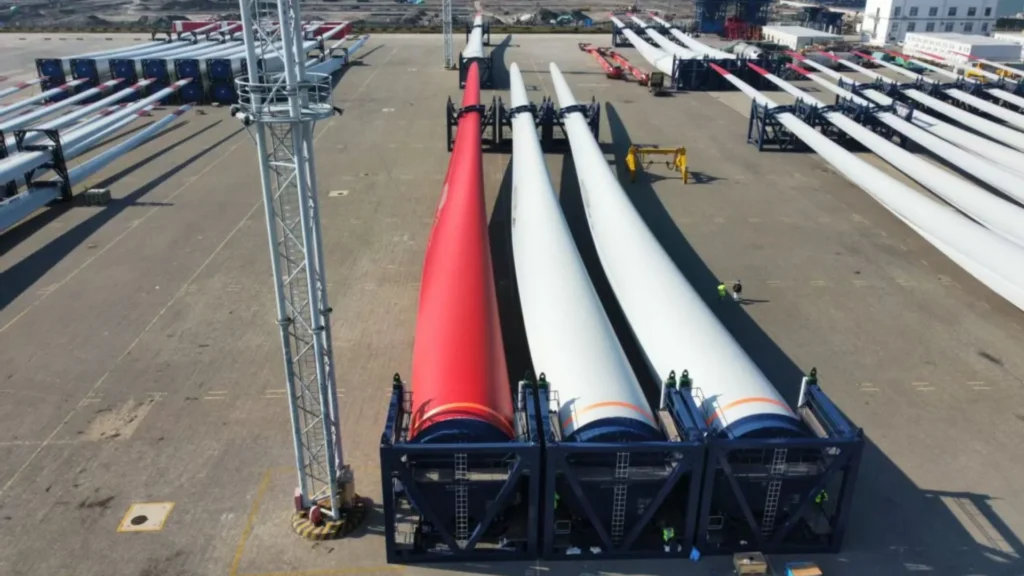
The test incorporates a 115.5-meter red blade on each of the seven V236-15.0 MW™ turbines installed for the study. Several sets of blades have already been shipped to the Netherlands to begin field evaluations.
Initially, different colors were analyzed. However, red was chosen after considering aspects related to durability, thermal performance, and heat management in offshore conditions.
The main objective is to verify whether increased visibility modifies the avoidance behavior of seabirds around rotation zones.
Offshore wind energy and biodiversity
The research also aims to strengthen the scientific basis for developing nature-inclusive wind farms. Furthermore, the study will gather information on the interaction between marine life and large offshore turbines.
Lisa Malmquist Ekstrand, Vice President of Sustainability at Vestas, explained that seabirds already show a natural tendency to avoid wind turbines. She indicated that this type of testing allows for a broader understanding of additional solutions to minimize environmental impacts within offshore wind energy.
The initiative reflects how turbine manufacturers and offshore developers are integrating environmental criteria into the design and operation of large-scale renewable projects.
Source and photo: Vesta vía Linkedln