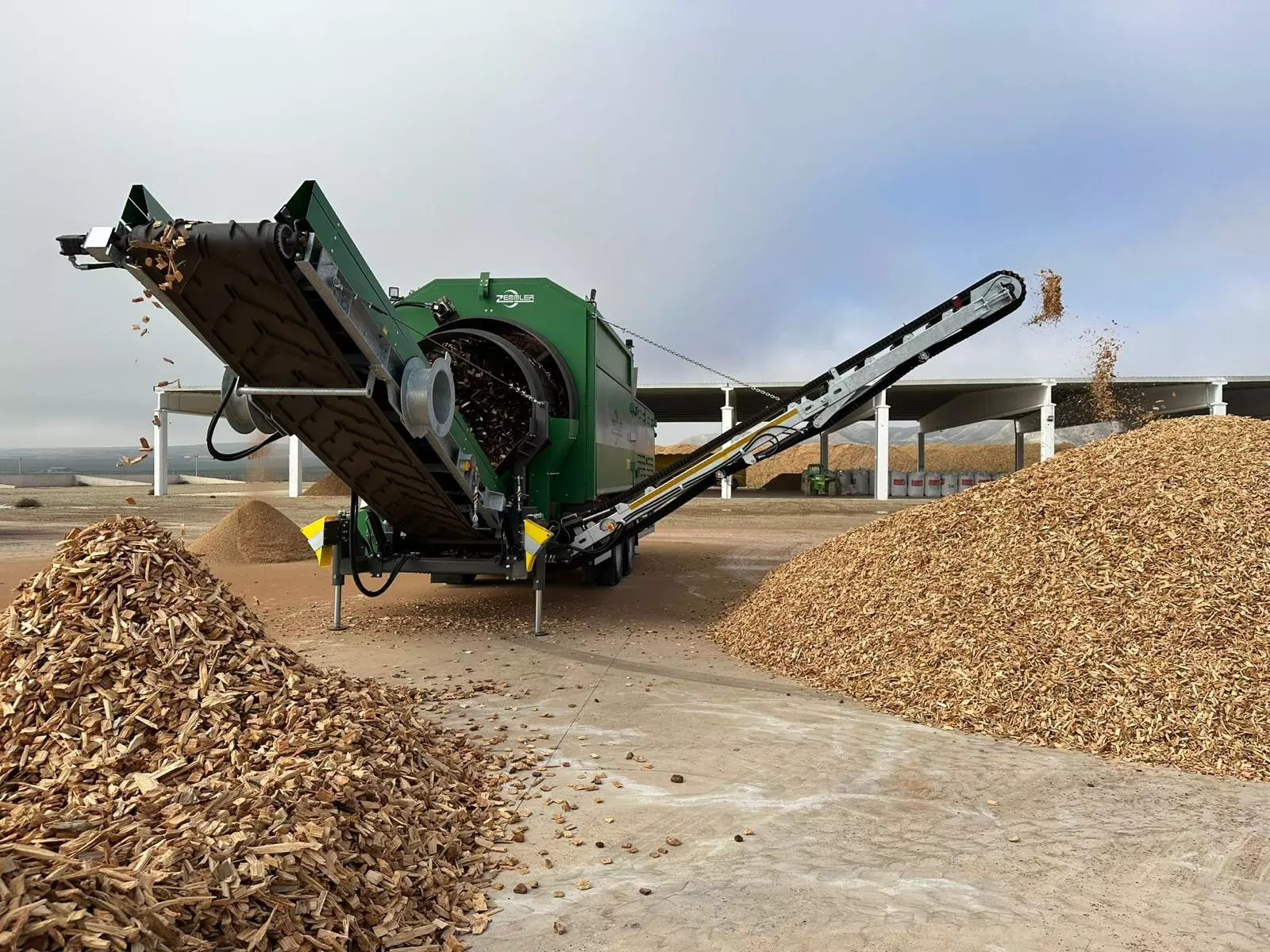
Veolia has inaugurated a new composting and biomass plant in Fuentes de Ebro, Zaragoza, a facility designed to transform organic waste, agricultural and forestry waste into value-added resources. The project reinforces the company’s commitment to the circular economy, decarbonization, and the sustainable use of local resources.
The new infrastructure integrates waste recovery processes and renewable energy production in a single facility, helping to reduce dependence on fossil fuels and strengthen Aragon’s sustainable development.
Veolia: A facility focused on waste recovery
The plant has a processing capacity of 27,000 tonnes per year of organic waste. To this end, it has two separate composting lines adapted to different types of materials.
One of them is intended for the treatment of wastewater treatment sludge suitable for agronomic use in accordance with Royal Decree 1310/1990. The second is dedicated to processing waste for the manufacture of fertilizers under the requirements established by Regulation (EU) 2019/1009.
Thanks to this capacity, materials that were previously considered waste can be reincorporated into the production cycle as useful resources for agriculture and other economic activities.
Biomass to generate renewable energy
In addition to the composting area, the facility includes a platform specialized in processing forestry and agricultural residues, with the capacity to handle up to 15,000 tonnes per year.
The system makes it possible to sort, shred, and condition these materials to produce natural solid fuels such as woodchips and pellets. These products are intended to supply industrial boilers and district heating networks seeking more sustainable energy alternatives.
Energy recovery from biomass represents a solution that helps reduce emissions associated with conventional fuels while making use of resources available in the local environment.
Environmental benefits and regional economic development
The commissioning of the plant represents progress for sustainable waste management in Aragon. By converting discarded materials into fertilizers and renewable fuels, it promotes a production model based on resource reuse and reduced environmental impact.
Likewise, the project supports the creation of specialized jobs and the strengthening of activities linked to the green economy. The initiative also drives new investment opportunities related to environmental innovation and the energy transition.
This approach makes it possible to improve regional competitiveness by incorporating sustainable solutions that generate economic and environmental value simultaneously.
The GreenUp strategy as a driver of ecological transformation
As explained by Miguel Ruiz-Gálvez, Director of Veolia Biomass, the new facility reflects the objectives of the company’s GreenUp strategy, aimed at accelerating ecological transformation through integrated solutions in water, energy, and waste.
The infrastructure has received financial support from public programs for sustainable investments promoted by the European Union and by the Department of the Presidency, Economy and Justice of the Government of Aragon.
These grants made it possible to finance approximately 40% of the cost of the equipment intended for the refining of fertilizers and biomass, strengthening the project’s viability and consolidating Veolia’s commitment to the environmental and economic development of the autonomous community.
With this new plant, Veolia strengthens its presence in the sustainable resource management sector and positions Aragon as a benchmark in the circular economy, waste recovery, and renewable energy production from local resources.
Source and photo: https://www.veolia.es/