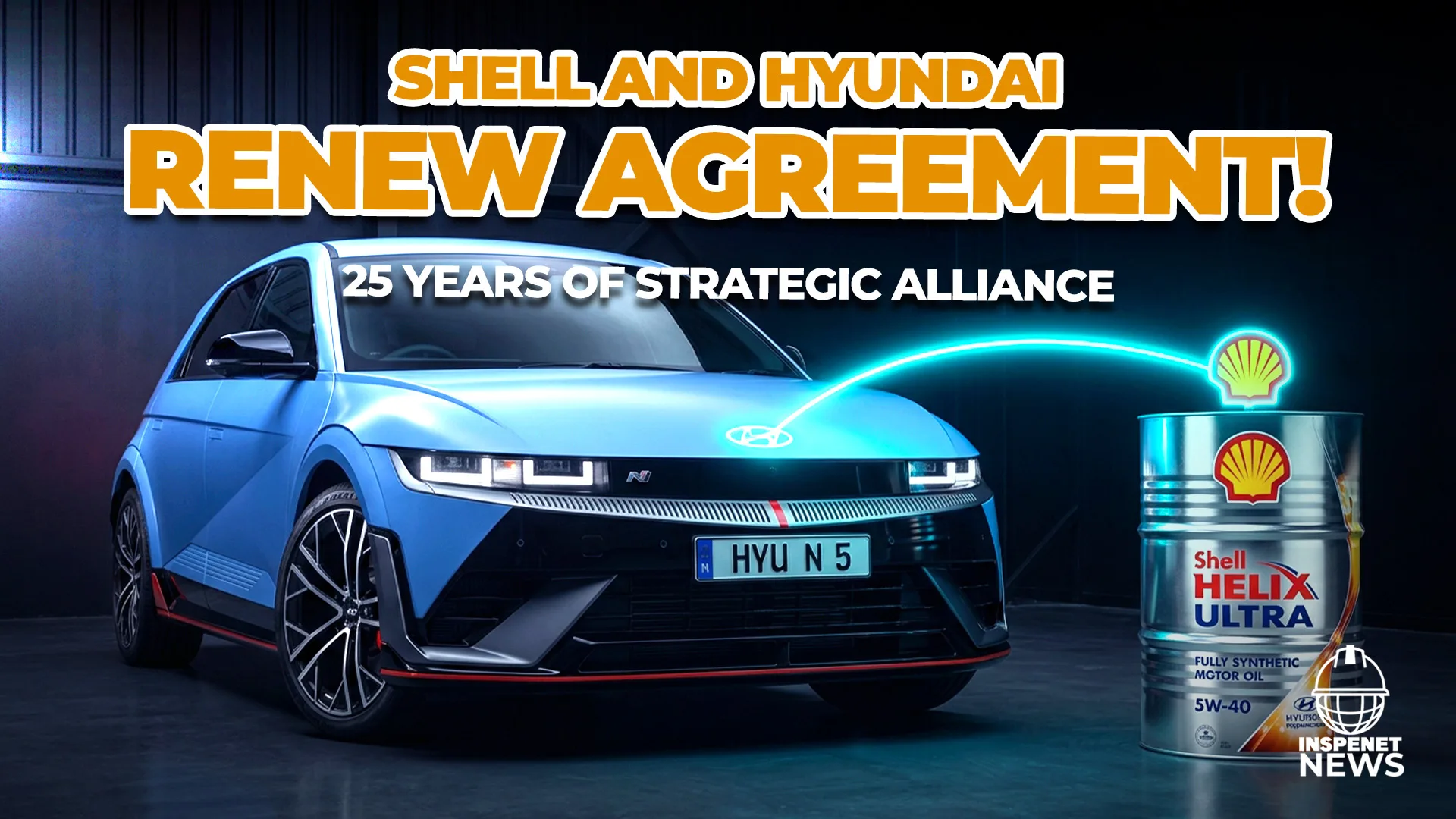
Shell and Hyundai expand their alliance into electric vehicles
Shell and Hyundai Motor renewed their global cooperation agreement for another five years , the extension continues a relationship that began in 2005 and has already accumulated more than two decades of work between the two companies.
Furthermore, this is the fifth renewal of the agreement; the relationship has encompassed product development, automotive engineering, and after-sales solutions for Hyundai customers in various markets.
Under the new agreement, Shell will continue as Hyundai Motor's recommended aftermarket lubricant supplier globally. Both companies will also maintain their joint development of lubrication technologies and support for programs related to high-performance vehicles.
Shell will maintain its supply of lubricants to Hyundai
Furthermore, Shell will supply its Shell Helix motor oils to Hyundai customers in various countries. This segment will remain a key commercial pillar of the relationship between the two companies.
The cooperation also includes expanding marketing programs related to after-sales services. With these initiatives, Shell and Hyundai aim to improve the customer experience and strengthen their presence in markets where this business has a significant share.
In this way, the agreement preserves traditional areas of collaboration while opening up space for technologies associated with the changes the automotive industry is undergoing .
Electric vehicles broaden the scope of the agreement
Furthermore, one of the main implications of the renewal is related to electric vehicles . Shell and Hyundai plan to expand their work on fluids for next-generation electric vehicles and thermal management solutions.
These developments reflect the evolution of an alliance historically associated with combustion engine oils . Electrification raises new needs related to temperature, efficiency, and the operation of the vehicle's various components.
Shell also anticipates joint projects in digitalization and high-performance mobility. This cooperation could encompass both current vehicles and technologies for new models that Hyundai incorporates into its mobility strategy.
Hyundai N and motorsport support technical development
At the same time, motorsport will continue to be a testing ground for collaboration; Shell has been an official sponsor of the Hyundai Shell MOBIS World Rally Team since 2014.
Participation in the World Rally Championship allows for testing technologies under demanding competition conditions. Some of the knowledge gained in this environment can later be transferred to the development of lubricants and other solutions for Hyundai customers.
The collaboration also extends to Hyundai N; both companies work on lubricants intended for both high-performance engines and electric vehicles , expanding the field of development beyond conventional automobiles.
Genesis Magma Racing extends its cooperation to the WEC
On the other hand, the relationship between Shell and Hyundai Motor Group also has a presence in Genesis; Shell recently expanded its collaboration with the luxury brand and will participate as a performance and development partner of Genesis Magma Racing .
The program is especially relevant because of Genesis Magma Racing's entry into the FIA World Endurance Championship in 2026. This competition offers another stage for working with technologies subjected to high-performance conditions.
Thus, rally, endurance, and production vehicles form different facets of the same technical relationship. The goal is to use the experience gained in competition to support the development of products applicable to other segments.
The Shell and Hyundai alliance adapts to electric mobility
Finally, the renewal demonstrates how the relationship between Shell and Hyundai is evolving in tandem with the automotive sector. Traditional lubricants and aftermarket services remain significant, but the agreement now incorporates areas related to electrification.
Fluids for electric vehicles, thermal management, and the development of solutions for high-performance models will gain prominence over the next five years. This allows both companies to maintain established lines of work while exploring needs arising from an increasingly electrified fleet.
After more than 20 years of cooperation, Shell and Hyundai are thus opening a new stage that combines aftermarket, motorsports and electric vehicles within their global agreement.
News of additional interest
Thailand is preparing 400 million circular bottles
Indorama Ventures, Suntory, Suntory PepsiCo Thailand, and Iwatani will combine their capabilities to produce recycled PET containers on a commercial scale in Thailand. The project will utilize Flake-to-Preform (FtoP) technology, which transforms used bottles directly into preforms for manufacturing new containers. The system aims to make recycling more efficient and reduce the use of fossil-based raw materials.
Production will be handled by Indovida Thailand, a joint venture between Indorama Ventures and Iwatani. It is expected to produce preforms equivalent to approximately 400 million PET bottles per year. Suntory PepsiCo Thailand will be the first commercial customer and will begin receiving them in 2028. This will also be the first commercial application of this technology in Southeast Asia.
Pipetech tests new tool for cleaning wells
Denholm Pipetech has completed the first in-well test of its DSR tool , developed in collaboration with the Net Zero Technology Centre in Aberdeen. The solution is designed to remove scale from inside wells and improve cleaning operations. During the trial, five test segments were run, and before-and-after images showed visible signs of cleaning and loosened debris.
The tool was designed to work with continuous pipe, although during testing, drill pipe compatible with 9-5/8 inch casing was used. The results showed that the DSR could be adapted to different operating conditions. While moving toward its commercial launch, Pipetech is also continuing its Aqua Milling technology for removing paraffin, corrosion, and scale from energy facilities in the UK.
The design defines the lifespan of underwater pipelines
The decisions made when designing subsea pipelines can determine their safety for decades. This is according to a Lloyd's Register (LR) study prepared for the Norwegian authority Havtil. The analysis reviewed industry data and failures and found that the performance of welded and mechanical connectors depends heavily on the design, manufacturing, installation, and testing carried out before operation.
The report recommends a rigorous evaluation of connectors and early involvement of their manufacturers to verify performance limits and design conditions. These measures are becoming increasingly important given the rise in energy activity off the coast of Norway. The country included 70 new exploration blocks in its 2026 APA licensing round, while Havtil is strengthening oversight of the safety of subsea infrastructure.
Batteries are gaining ground in the Australian grid
Battery storage is transforming Australia's electricity market . According to regulator AER, installed capacity in the National Electricity Market reached 6.1 GW by the end of 2025, up from just 261 MW at the beginning of 2021. This growth, along with increased solar and wind generation, helped reduce wholesale prices during 2025. Even so, evening and nighttime prices remained above pre-2022 levels.
Batteries also have a greater influence on the cost of electricity; in 2025, they played a role in wholesale pricing 16.3% of the time, compared to about 1% in 2021. Furthermore, around 80% of their revenue in the spot market already came from buying and selling energy. This shift will continue: an additional 6.5 GW of storage capacity is already committed, with another 11.3 GW planned.