Table of Contents
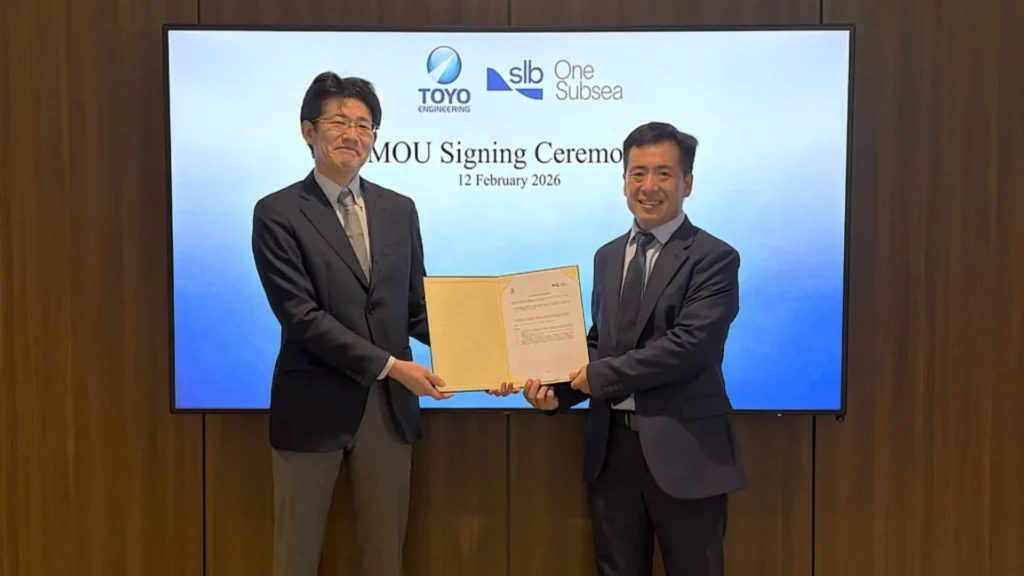
The Japanese company Toyo Engineering Corporation signed a memorandum of understanding with SLB OneSubsea to explore the joint development of subsea carbon capture and storage projects. The agreement aims to strengthen technological solutions in Japan and Southeast Asia.
In this context, both companies seek to combine capabilities in subsea engineering and technology to design integrated CO2 capture, transport, and injection systems. The collaboration will focus on optimizing geological storage projects beneath the seabed.
The initiative responds to the growing role of CCS as a key tool in reducing industrial emissions. Much of the formations suitable for storing carbon dioxide are located in offshore environments, driving the development of specialized subsea solutions.
On one hand, Toyo Engineering provides expertise in CCS project development and the design of onshore facilities. Furthermore, it possesses capabilities in system integration across the entire CO2 value chain.
On the other hand, OneSubsea contributes its track record in subsea production and processing systems. The company, backed by SLB, Aker Solutions, and Subsea7, has key technologies for offshore operations.
Challenges of carbon capture
Subsea carbon capture and storage projects face significant technical challenges. These include the safe transport of CO2, its injection into geological formations, and long-term operation in offshore conditions.
Both companies will evaluate optimized design strategies and commercial opportunities to address these complexities. The goal is to offer viable solutions at an industrial scale.
Initially, the collaboration will focus on projects in Japan and Southeast Asia, regions with growing interest in decarbonization technologies. The demand for CCS solutions continues to rise as governments and companies move toward carbon neutrality goals.
Source and photo: Toyo Engineering Corporation