Table of Contents
- Why wind turbine blades degrade?
- Operational stresses and environmental exposure
- Rain erosion and airborne particles
- Rain erosion mechanisms and leading edge damage
- Impact of erosion on wind turbine blades
- Leading edge protection for wind turbine blades
- Wind turbine blade repair strategies
- Regulations and standards for wind turbine blade protection
- Repair or replace: Key criteria
- Extending Wind Turbine Service Life
- Maintenance strategies
- Predictive inspection and monitoring
- Inspection and maintenance service ecosystem
- Advanced inspection technologies
- Engineering and O&M services
- What does this mean in practice for operators?
- Impact on OPEX, availability, and ROI
- Data driven operational decisions
- From erosion to asset integrity strategy
- References
- FAQ: Questions
Wind turbine blades operate under extreme environmental and mechanical loading conditions that directly affect their performance, durability, and aerodynamic behavior. Among the most critical degradation mechanisms, rain erosion on the leading edge can significantly reduce aerodynamic efficiency, energy production, and the service life of wind turbines.
To address this challenge, operators implement inspection and maintenance strategies, blade repair, and leading-edge protection systems. Defining when to intervene and how to optimize these actions is essential to preserve asset integrity, reduce downtime, and control operating costs.
Why wind turbine blades degrade?
Wind turbine blades are exposed to a combination of mechanical loads and severe environmental conditions that progressively affect their structural integrity and aerodynamic performance. As wind turbines operate in increasingly demanding environments such as offshore installations with high salinity or wind farms in desert regions with elevated particle loads, degradation mechanisms become more complex and accelerated.
This process not only compromises energy performance, but also directly impacts asset reliability, intervention frequency, and operating costs. In this context, understanding how and why wind turbine blades degrade is essential for defining effective inspection and maintenance strategies, as well as optimizing the selection of protection systems.
Operational stresses and environmental exposure
During operation, wind turbine blades experience continuous cyclic loads generated by rotation, wind shear, and turbulence. These conditions produce repetitive bending stresses along the blade, especially in large-scale wind turbines where greater blade lengths increase bending moments. Over time, this behavior leads to fatigue in composite materials, reducing their mechanical strength.
These stresses are compounded by environmental exposure, which acts as a deterioration accelerator. Ultraviolet radiation degrades polymer matrices, while moisture and thermal variations weaken protective coatings. In offshore environments, salinity intensifies chemical degradation, whereas in arid regions, the combination of extreme temperatures and particle abrasion reduces the durability of protection systems.
Rain erosion and airborne particles
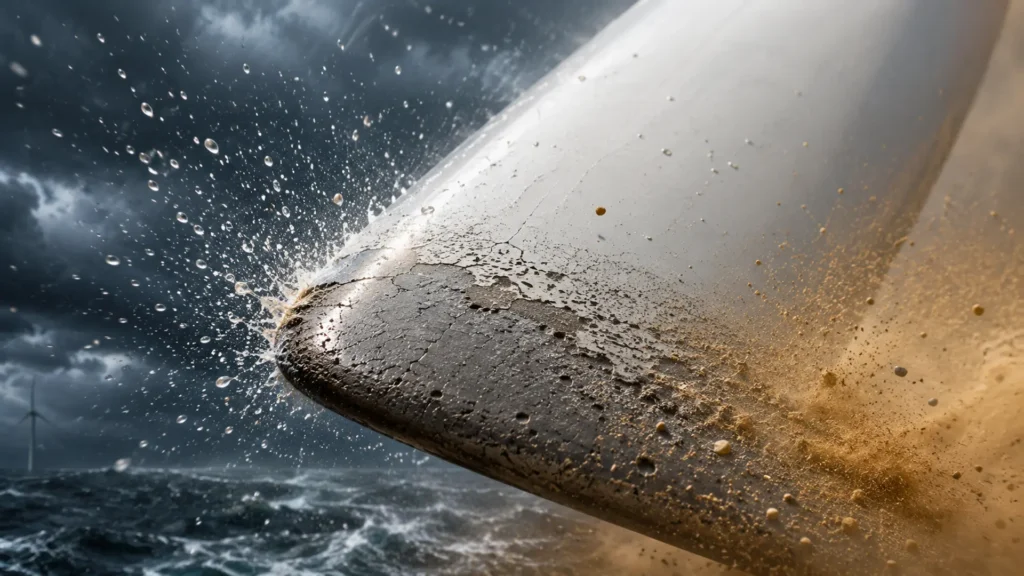
Among environmental factors, rain erosion represents one of the most critical degradation mechanisms affecting wind turbine blades. At high blade tip speeds, raindrops generate repetitive impacts that cause microcracking and progressive surface wear, especially on the leading edge.
Airborne particles such as sand, dust, and salt worsen this phenomenon through abrasive action. For example, offshore wind farms are continuously exposed to moisture and salinity, while wind turbines in desert areas face persistent sand erosion. In both scenarios, degradation may begin within the first 2–3 years if leading-edge protection systems are not properly applied.
Example: Environmental Exposure
Offshore wind farms are mainly affected by rain and salinity, while turbines in desert regions experience higher levels of sand erosion, generating different degradation patterns and maintenance requirements.
In high-exposure environments, early detection through inspection and maintenance allows intervention during initial stages, preventing damage from evolving into structural failures and significantly reducing long-term blade repair costs.
Rain erosion mechanisms and leading edge damage
Rain erosion is one of the most critical degradation mechanisms affecting wind turbine blades, especially on the leading edge, where aerodynamic exposure is greatest. Unlike uniform wear, this process results from repeated high-energy impacts that progressively weaken protection systems and underlying materials.
The severity of erosion on wind turbine blades depends on multiple variables, including blade tip speed, rainfall intensity, and the mechanical properties of the protection system. In regions with high rainfall, erosion may develop rapidly, while in marine environments, the combined effect of moisture and salinity accelerates material degradation.
Understanding how damage initiates and evolves is essential for defining inspection and maintenance strategies and preventing early-stage defects from becoming structural failures.
High blade tip speeds
At blade tip speeds exceeding 80–100 m/s, raindrops behave like high-energy projectiles. When impacting wind turbine blades, they generate localized pressure peaks and shock waves that propagate across the blade surface. These pressure pulses may reach several hundred MPa, causing repeated stress cycles in protective coatings.
Over time, this cyclic loading produces microcracks, especially in materials with limited elasticity or poor adhesion. Although individual impacts are not visible, the cumulative effect of millions of impacts significantly reduces the durability of leading-edge protection systems.
Progressive damage stages
Rain erosion develops through identifiable stages. Initially, slight surface roughness appears as coatings begin to degrade. This is followed by pitting and crack formation, leading to coating failure and localized loss of protection.
As degradation progresses, sections of the protection system may delaminate, exposing the substrate. At this stage, the composite material becomes highly vulnerable to moisture ingress, UV radiation, and mechanical wear, accelerating damage and increasing repair complexity.
In high-erosion environments, leading-edge damage may begin within the first 1–2 years of operation and, if not addressed in time, repair costs may increase exponentially as damage progresses from coating wear to structural exposure.
Impact of erosion on wind turbine blades
Erosion on wind turbine blades directly affects aerodynamic efficiency and overall turbine performance. As the leading edge degrades, even small changes in surface geometry alter airflow behavior, reducing the blade’s ability to generate lift efficiently.
These effects may seem insignificant during early stages, but become critical as damage progresses, affecting energy production and increasing operating costs.
Aerodynamic losses and increased drag
The performance of wind turbine blades depends on maintaining a smooth and continuous aerodynamic profile. When rain erosion increases surface roughness, laminar flow is disrupted and the transition to turbulent flow accelerates.
This change generates increased drag and reduced lift, decreasing aerodynamic efficiency. In addition, surface irregularities induce local turbulence that destabilizes airflow, particularly at high rotational speeds.
Decrease in energy production
Erosion may reduce annual energy production by between 3% and 20%, depending on damage severity and environmental conditions. This impact is especially relevant in large-scale wind farms, where small efficiency losses translate into major revenue reductions.
Additionally, turbulence generated by surface degradation causes uneven load distribution on the rotor, increasing wear on components such as bearings and gearboxes.
Blade Condition vs Aerodynamic Performance
| Blade Condition | Aerodynamic Efficiency | Energy Production | Surface Condition |
|---|---|---|---|
| Intact blade | High | 100% | Smooth surface |
| Mild erosion | Moderate reduction | 95–97% | Slight roughness |
| Severe erosion | Significant loss | 80–90% | High roughness |
A 5% reduction in aerodynamic efficiency may appear limited, but in large-capacity wind turbines it represents significant economic losses. Therefore, early detection through inspection and maintenance, combined with blade repair strategies, becomes an operational priority to preserve performance and wind turbine service life.
Leading edge protection for wind turbine blades
Wind turbine blades require leading-edge protection systems to withstand rain erosion and other wear mechanisms. These systems are designed to absorb impacts, preserve the aerodynamic surface, and reduce material degradation under demanding operating conditions.
The effectiveness of leading-edge protection depends both on material properties and proper selection according to the environment. Factors such as heavy rain, abrasive particles, temperature, and load cycles directly influence performance and durability.
In this context, selecting the appropriate system is not only a technical decision, but also a strategic one, since it impacts inspection and maintenance frequency, blade repair requirements, and wind turbine service life.
Coatings, tapes, and hybrid systems
Leading-edge protection technologies are mainly classified into three types: coatings, adhesive tapes, and hybrid systems. Each offers specific advantages depending on operating conditions.
Coatings, generally elastomeric or polyurethane-based, form a continuous layer that absorbs impacts. Adhesive tapes provide controlled thickness and easy installation, while hybrid systems combine both solutions to improve resistance in severe environments.
Example: System Selection
In offshore environments, elastomeric coatings or hybrid systems are preferred due to their ability to absorb repetitive high-energy impacts. In desert areas, abrasion-resistant materials are prioritized because of sand exposure.
Material performance and durability
The durability of leading-edge protection systems depends on properties such as elasticity, adhesion, and resistance to cyclic impacts. Materials must withstand repetitive stresses without losing integrity or adhesion.
Factors such as UV radiation, moisture, salinity, and thermal variations affect long-term performance. In high-exposure environments, poor selection may significantly reduce service life and increase wind turbine maintenance frequency.
In high-rainfall or offshore environments, inadequate selection of a leading-edge protection system may reduce its service life by more than 50%, increasing maintenance costs and blade repair interventions.
Protection system comparison
| System Type | Advantages | Limitations | Typical Application |
|---|---|---|---|
| Coatings | High flexibility | Sensitive to application quality | General protection |
| Tapes | Fast installation | Adhesion dependency | Quick repairs |
| Hybrid systems | High durability | Higher cost | High-erosion environments |
Operational Insight
In high-rainfall or offshore environments, selecting an inadequate leading-edge protection system can reduce effective service life by more than 50%, significantly increasing inspection and maintenance frequency and wind turbine lifecycle costs.
Wind turbine blade repair strategies
Blade repair is a fundamental part of wind turbine integrity management. Early interventions help minimize damage and avoid more costly repairs or even blade replacement. Damage to wind turbine blades may be caused by several factors, including abrasive particle impacts, rain erosion, and material fatigue.
The challenge for operators is determining when repair is more cost-effective than replacement. To make accurate decisions, it is crucial to consider the extent of damage, intervention frequency, and the impact on wind turbine energy efficiency.
Field repair processes
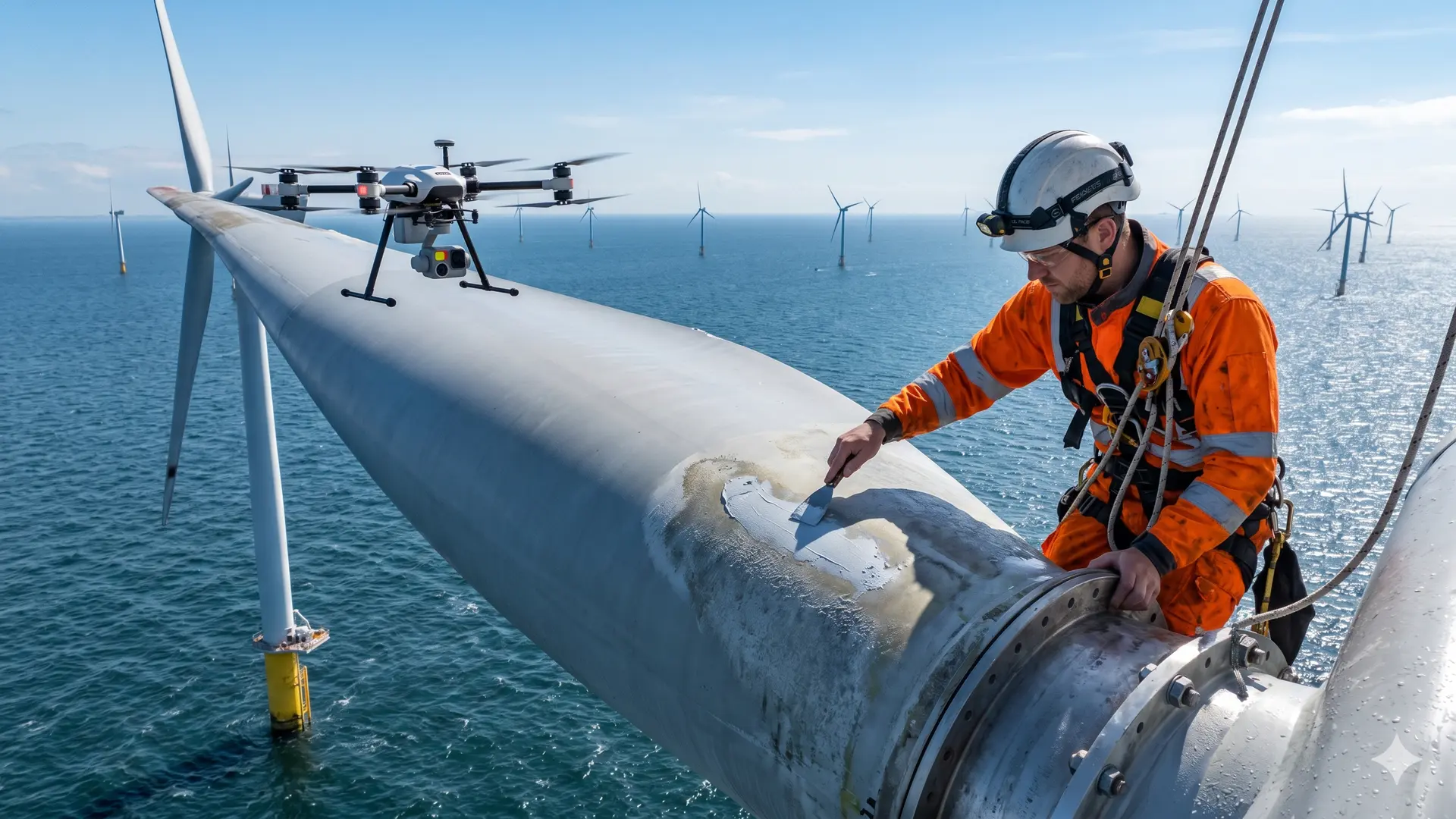
Blade repair is generally performed on-site using rope access or elevated platforms. The process begins with a detailed visual inspection or drone technology to identify damage. Afterwards, the surface is cleaned and prepared, ensuring that no moisture or contaminants remain that could affect adhesion of repair materials.
Once the affected area is prepared, resins, composites, or composite patches are applied to restore the blade’s structural integrity. These procedures are essential to ensure that wind turbine blades continue operating at maximum efficiency.
When repair is viable
In general, repairs are viable when damage is limited to surface layers or when structural integrity has not been compromised. Rain erosion and surface wear can be effectively addressed through standard repair techniques.
However, if damage deeply affects the composite material or previous repairs have repeatedly failed, replacement of the damaged blade section may become necessary. The decision to repair or replace should be based on a cost-benefit analysis considering both repair costs and the expected durability of the intervention.
Impact on energy efficiency
Timely repairs can significantly improve the energy efficiency of wind turbine blades, since they restore their ability to generate energy optimally. However, when damage is left unattended for too long, blade efficiency decreases, reducing power generation and increasing operational loads.
A proper repair may help restore up to 95–98% of original efficiency, whereas delayed repairs may not be sufficient to recover performance, making complete replacement more cost-effective.
Regulations and standards for wind turbine blade protection
To ensure the operational efficiency and safety of wind turbines, there are several international regulations and standards governing the maintenance, inspection, and protection of wind turbine blades. These standards ensure that inspection and repair practices are aligned with technical and safety requirements, minimizing operational risks and improving equipment reliability.
Relevant international standards
Below are some of the main regulations and standards that guide the inspection, maintenance, and protection of wind turbine blades:
| Standard | Description | Application |
|---|---|---|
| IEC 61400-23 | International standard for the design of wind turbine blades in specific environments. | Wind blade design and operation |
| ISO 9001 | Quality management system that ensures quality in manufacturing and maintenance processes. | Quality in manufacturing and maintenance of wind turbine components |
| ISO 18436 | Certification standard for wind turbine condition monitoring technicians. | Technical inspection and predictive maintenance |
| EN 50308 | European standard for wind turbine maintenance and safety. | Wind turbine maintenance |
| ASME B30.9 | Standard for installation and repair of wind energy equipment. | Wind turbine installation and repair |
Leading edge protection standards
In terms of leading-edge protection, manufacturers of blade protection systems must follow guidelines that ensure durability under high-exposure conditions, such as offshore or desert environments. This includes local and international standards covering the use of materials and repair techniques.
Operational guidelines include specifications regarding:
- Coating materials: Standards ensuring that the materials used are durable and effective in reducing erosion.
- Inspection frequency: Guidelines on the periodicity of wind turbine blade inspections according to operating conditions.
- Repair techniques: Standards dictating how and when repairs must be carried out to ensure safety and operational efficiency.
Regulatory Insight
Compliance with standards such as IEC 61400-23 and ISO 9001 not only ensures operational reliability, but also enables operators to access tax incentives and comply with sustainability and safety requirements for wind energy projects.
Repair or replace: Key criteria
Deciding whether to repair or replace a damaged wind turbine blade is one of the most important decisions for operators. The process depends on damage severity and economic analysis, since repairs are less expensive but may not always be viable in the long term.
Blade repair is ideal when damage is superficial or localized, while replacement is usually necessary when the damage affects the blade’s internal structure, compromising its integrity.
Damage severity thresholds
Repairs are viable when the damage does not deeply affect the structural material. In cases of rain erosion or superficial coating damage, repairs can restore aerodynamic efficiency without replacing the entire blade.
When the damage involves internal layers of the composite material or a series of failed repairs, the most cost-effective option may be to replace the blade or damaged sections. The key is defining a damage threshold beyond which repair becomes economically unfeasible.
Cost vs performance
The decision between repairing or replacing a blade depends not only on damage severity, but also on associated costs. Repairs are usually more economical in the short term, but if the damage is extensive or recurrent, repair costs may increase over time.
Replacement, although initially more expensive, may be more profitable in the long term, since it guarantees optimal performance and longer service life. Operators must balance intervention costs with energy efficiency and the remaining service life of the wind turbine.
Decision Matrix: Repair or Replace
| Damage Level | Recommended Action | Economic Impact | Recovered Energy Efficiency |
|---|---|---|---|
| Surface erosion | Repair | Low | High |
| Moderate damage | Repair + LEP | Medium | Moderate |
| Severe damage | Replacement | High | High |
Operational Insight
Waiting too long to replace a damaged blade may result in a significant increase in long-term maintenance costs, since continuous repairs will fail to restore original efficiency. In some cases, costs may be up to 30% higher than timely replacement.
Extending Wind Turbine Service Life
Extending wind turbine service life is a primary objective for operators seeking to maximize return on investment and ensure long-term asset reliability. Wind turbine blades are continuously exposed to mechanical stress and environmental degradation, so their service life depends on how effectively damage mechanisms such as erosion are managed.
For wind turbine blades, a lifecycle approach is essential. Instead of reacting to visible damage, operators must implement strategies that combine preventive maintenance, timely repairs, and continuous performance monitoring. This integrated approach not only reduces unplanned downtime, but also delays the need for costly component replacements.
Projects such as Thor demonstrate how innovation in materials, such as recyclable blades and low-emission structures, is becoming part of the lifecycle strategy in wind energy. This reinforces the importance of integrating performance, sustainability, and long-term asset management.
This integrated approach not only reduces unplanned downtime, but also delays the need for costly component replacements.
Maintenance strategies
Effective maintenance strategies focus on early detection and intervention. Preventive maintenance includes routine inspections, cleaning, and application or renewal of leading-edge protection systems before significant degradation occurs.
Corrective maintenance, such as blade repair, becomes necessary when damage progresses beyond the initial stages. Timing is critical: addressing erosion early can preserve aerodynamic performance and prevent structural problems. In high-exposure environments, maintenance intervals may need to be shortened to account for accelerated degradation rates.
A well-planned maintenance strategy balances operational availability with long-term cost efficiency, ensuring that minor issues do not become major failures.
Predictive inspection and monitoring
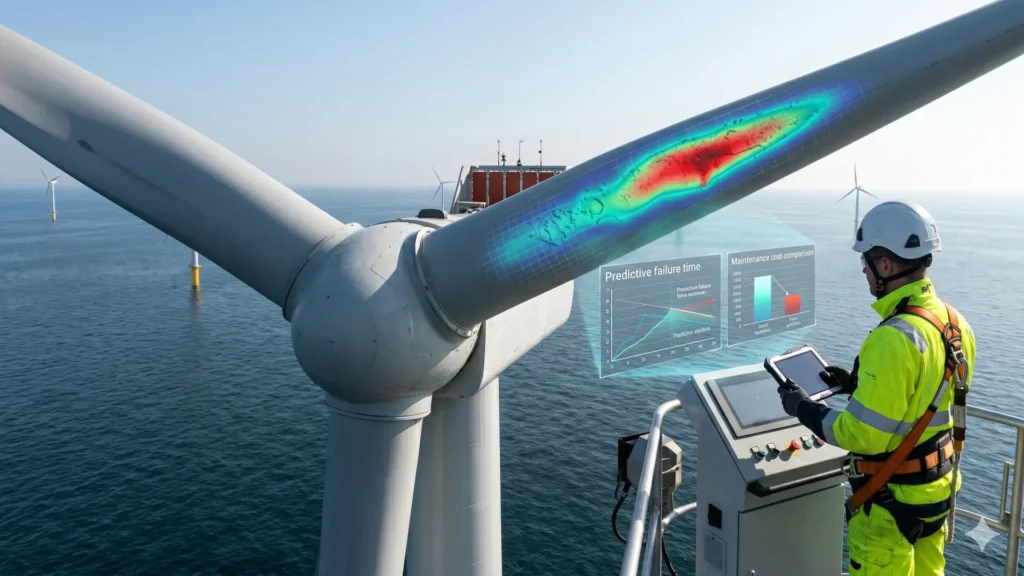
Advances in inspection technologies are transforming how operators manage wind turbine blade integrity. Drone inspections, combined with image analysis and artificial intelligence, enable rapid and accurate detection of surface damage.
Additionally, predictive monitoring systems use operational data to identify patterns associated with erosion and fatigue, enabling condition-based maintenance instead of fixed schedules. This approach improves decision-making and optimizes resource allocation.
By integrating inspection, monitoring, and maintenance into a unified lifecycle strategy, operators can significantly extend wind turbine service life while maintaining performance and reducing operational risk.
Wind farms adopting predictive inspection strategies and lifecycle-based maintenance can extend the service life of wind turbine blades by several years while reducing unplanned maintenance events and associated costs.
Inspection and maintenance service ecosystem
Effective management of wind turbine blades depends on a broad ecosystem of specialized inspection, engineering, and maintenance services. As erosion and structural degradation become more complex, operators increasingly rely on advanced technologies and experienced service providers to ensure asset integrity and performance.
Non-destructive testing (NDT) plays a fundamental role in evaluating blade condition beyond visible surface damage. Techniques such as ultrasonic testing and thermography allow detection of internal defects, including delamination and moisture ingress, which are critical for assessing the structural integrity of wind turbine blades.
Advanced inspection technologies
Drone inspections have become a standard tool for evaluating the condition of wind turbine blades quickly and safely. Equipped with high-resolution cameras and analytical software, drones enable detailed surface evaluations without the need for manual access, reducing downtime and operational risk.
In addition, digital tools and data analysis are increasingly used to process inspection results, helping operators prioritize maintenance actions and identify damage patterns at early stages.
Engineering and O&M services
Engineering services are essential for interpreting inspection data and defining repair or replacement strategies. These services support decision-making processes related to blade repair, leading-edge protection, and wind turbine lifecycle management.
Operation and maintenance (O&M) providers integrate inspection, repair, and protection services into comprehensive solutions that optimize turbine performance. Their role is critical in ensuring that maintenance strategies are executed efficiently, minimizing downtime and extending wind turbine service life.
Operational Insight
Wind farms integrating NDT, drone inspection, and engineering analysis into their maintenance strategy can significantly improve early defect detection and reduce long-term repair costs.
What does this mean in practice for operators?
For operators, managing rain erosion and protecting wind turbine blades is not only a technical challenge, but also a strategic decision that directly affects operational availability, operating expenses (OPEX), and return on investment (ROI). The way maintenance, repairs, and preventive interventions are managed will determine overall turbine efficiency and, therefore, the financial success of the operation.
From inspection and maintenance to the application of leading-edge protection solutions, every action taken has a direct impact on operating costs and the service life of wind turbine blades. Operators must understand when the right time is to intervene and how to efficiently plan maintenance tasks, avoiding unplanned interruptions that may reduce energy production.
Impact on OPEX, availability, and ROI
Proper management of wind turbine blades significantly reduces operating costs. The implementation of preventive maintenance, together with predictive monitoring, optimizes downtime and maximizes energy production. A well-managed inspection and maintenance system also improves turbine availability, increasing efficiency over time.
Wind turbine service life also plays a crucial role in ROI optimization. Extending the service life of wind turbine blades through proper maintenance reduces the need for costly replacements and improves long-term profitability. Early maintenance intervention also minimizes emergency repairs, which are far more expensive.
Data driven operational decisions
Inspection and maintenance data-driven decisions are fundamental for operators. The use of advanced technologies such as drones and non-destructive testing (NDT) helps identify problems at early stages, allowing operators to make informed decisions about when to repair and when to replace components.
Predictive monitoring systems and data analytics enable failure prediction before it occurs, optimizing maintenance scheduling and reducing costs. This strategy not only improves operational efficiency, but also ensures greater long-term reliability and performance.
Operational Insight
Improving operational availability and reducing OPEX costs through predictive maintenance can increase overall wind farm efficiency and reduce unplanned maintenance costs by up to 30%.
From erosion to asset integrity strategy
Managing erosion on wind turbine blades is no longer just a maintenance task, but a strategic component of asset integrity management. As wind turbines operate in increasingly demanding environments, the ability to detect, prevent, and repair leading-edge damage becomes essential to maintaining performance and reliability.
From understanding erosion mechanisms to implementing effective leading-edge protection systems, blade inspection, and repair, operators must adopt a comprehensive approach that combines technical expertise with operational decision-making. This shift from reactive maintenance to proactive lifecycle management is key to extending wind turbine service life.
Ultimately, the value lies in connecting engineering solutions with operational outcomes. By leveraging advanced inspection technologies, optimized maintenance practices, and specialized service providers, operators can reduce operating expenses (OPEX), improve availability, and maximize return on investment.
In this context, erosion management becomes a critical factor in ensuring long-term efficiency, sustainability, and competitiveness in the wind energy sector. Learn more about asset management on Inspenet TV.
References
- Repair techniques: Standards dictating how and when repairs must be carried out to ensure safety and operational efficiency.
- Repair techniques: Standards dictating how and when repairs must be carried out to ensure safety and operational efficiency.
- International Electrotechnical Commission (IEC). IEC 61400-23: Wind turbine blades – Part 23: Design requirements for rotor blades. IEC.
- International Organization for Standardization (ISO). ISO 9001: Quality management systems – Requirements. ISO.
- International Organization for Standardization (ISO). ISO 18436-1: Condition monitoring and diagnostics of machines – Requirements for qualification and assessment of personnel. ISO.
- European Committee for Standardization (CEN). EN 50308: Operation and maintenance of wind turbines. CEN.
- American Society of Mechanical Engineers (ASME). ASME B30.9: Maintenance, repair, and replacement of wind turbine components.
- Hendrix, S. The impact of leading-edge erosion on wind turbine performance. Wind Energy Journal, 35(2), 155-168.
- Thomas, M., & Green, J. Wind turbine inspection and maintenance technologies: An overview of current practices and innovations. Renewable Energy Review, 28(3), 345-360.
- Inspenet. (2023). Offshore wind turbine innovation and lifecycle approach [Video]. Inspenet TV.
FAQ: Questions
What causes erosion on wind turbine blades?
Erosion on wind turbine blades is mainly caused by high-speed impacts from raindrops, known as rain erosion, together with airborne particles such as sand, dust, and salt. These repetitive impacts generate microcracking and progressive wear, especially on the leading edge, where exposure is greatest.
How often should blades be inspected?
Inspection frequency depends on environmental conditions, but most operators perform visual inspections at least once a year. In high-erosion environments, such as offshore wind farms or desert locations, more frequent inspections are recommended, including drone-based assessments to detect damage at early stages.
Can leading-edge protection be replaced?
Yes, leading-edge protection systems can be repaired or replaced depending on the level of damage. In cases of localized wear or coating degradation, reapplication is generally sufficient. However, severe damage may require removal and installation of new protection systems.
How much does erosion affect energy production?
Erosion may reduce energy production by approximately 3% to 20%, depending on severity. Even slight surface degradation increases drag and turbulence, reducing aerodynamic efficiency and affecting overall turbine performance.
How long do blade repairs last?
The durability of wind turbine blade repairs depends on material quality, application conditions, and environmental exposure. Under optimal conditions, repairs may last several years, but in high-erosion environments, more frequent maintenance may be required.