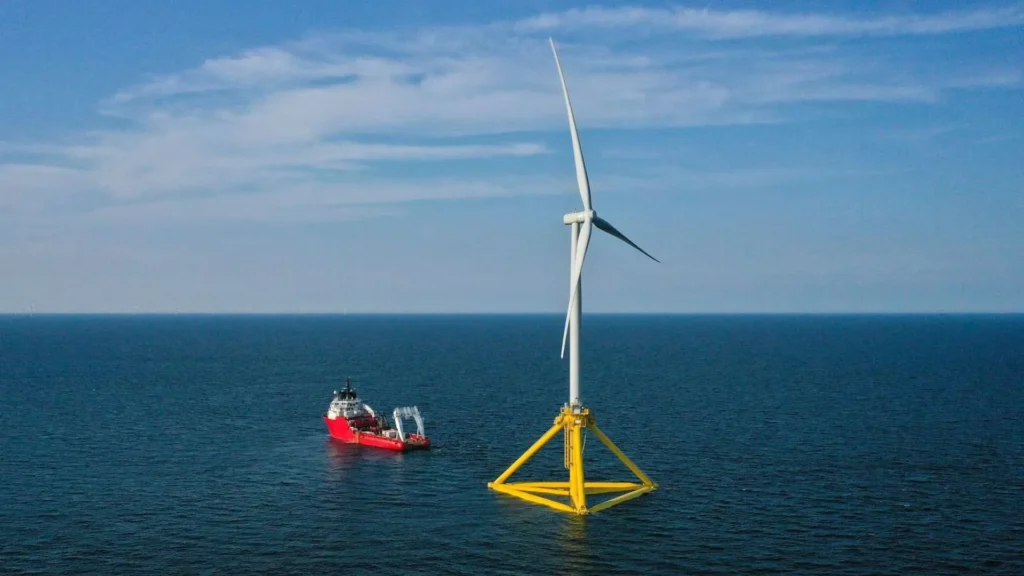
The TetraSpar demonstration platform completed its marine evaluation cycle after remaining moored for nearly five years at the Marine Energy Test Centre off the coast of Karmøy. Consequently, the floating structure was safely decoupled and towed to the Hanøytangen facilities near Bergen to begin the operational decommissioning process.
Deployment of the TetraSpar floating wind platform in Norwegian waters
The offshore campaign enabled end-to-end validation of the operational life cycle of a floating wind turbine. Specifically, the process covered everything from modular dockside assembly without welding to towing, deep-water connection, operation in severe weather, and subsequent technical decoupling.
Additionally, the performance reported by the 3.6-megawatt Siemens Gamesa turbine installed on the Stiesdal Offshore steel foundation exceeded standard offshore sector metrics. For this reason, the installation recorded an average availability of 98% along with a capacity factor of 51.4% during its service period at a depth of two hundred meters in the North Sea.
As a result, the platform injected approximately 70 million kilowatt-hours of clean electricity directly into Norway’s power grid. Likewise, the removal maneuver included the controlled lowering of the dynamic export cable to a seabed located at a depth of 210 meters, freeing up operational space for new prototypes.
Furthermore, engineering teams from Stiesdal Offshore, RWE, and TEPCO Renewable Power initiated detailed inspections of the submerged elements. Therefore, specialists are analyzing critical variables such as material fatigue, physical corrosion, and hydrodynamic wear accumulated after more than 40,000 hours of operation in real-world conditions.
Indeed, the collected data is being applied to the development of the TetraSub model, an infrastructure designed to support wind turbines exceeding 15 megawatts. Consequently, this industrialized technology has already been selected for implementation in the Pentland floating wind project in Scotland.
Source and photo: METCentre