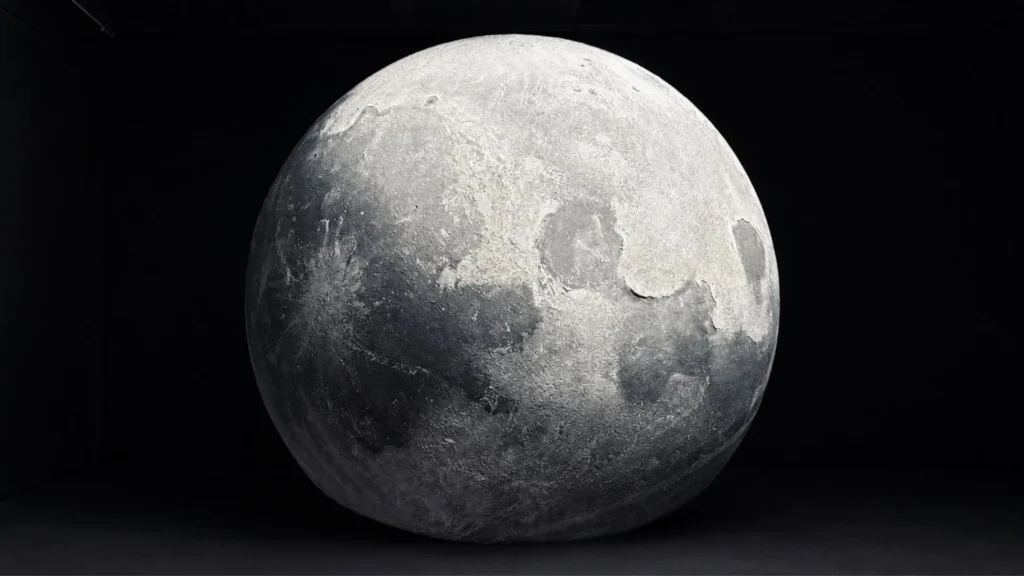
vRemains associated with a Falcon 9 they crashed into the lunar surface while astronomical observations detected signs of the material generated by the impact.
The remains of a SpaceX rocket they impacted the Moon at approximately 8,700 km/h on Wednesday, August 5, after spending months orbiting Earth. The collision once again raises questions about the behavior of space debris when it becomes uncontrolled.
According to available information, the structure measured approximately 12 meters and had been orbiting since January 2025. Over time, it drifted far enough from Earth to fall under the Moon’s gravitational influence. Ultimately, the debris struck the lunar surface at a speed close to seven times the speed of sound.
Telescopes detected signs of SpaceX’s impact on the Moon
Although the collision was not directly photographed, observations made from Chile provided evidence that the impact had occurred.
From the Paranal Observatory, instruments from the European Southern Observatory detected signals associated with the plume of material generated after the collision.
Specifically, the observations revealed gaseous sodium and lithium; the signals remained visible for approximately five to ten minutes after the impact.
Carl Schmidt, an astronomer involved in the observations, explained that the initial results still require analysis. The available data allows scientists to study the ejected material even though there is no direct image of the moment of the collision.
Furthermore, the impact occurred near the lunar terminator, the area that marks the separation between the part illuminated by the sun and the part illuminated by the Sun and the shadowed region. The collision raised a cloud of lunar dust that was briefly illuminated by sunlight.
Space debris raises questions once again
Furthermore, the incident has also raised questions about the management of debris generated by space missions. Bill Gray, who developed the astronomical software that predicted the impact, indicated that the collision did not pose a danger to people. However, he considered that the incident highlights problems related to the disposal of space debris.
The number of objects sent beyond Earth continues to increase due to new missions and satellite launches. This raises the importance of tracking the trajectories of spacecraft stages rockets and other objects that remain in space after completing their function.
SpaceX rocket and other impacts provide scientific data
Spacecraft collisions with the Moon have a history, such as in 1970, when NASA deliberately caused a Saturn V stage to crash into the Moon in order to study it. seismic instruments the consequences of a collision on the lunar surface.
Decades later, in 2009, another controlled impact allowed scientists to analyze the material ejected from the lunar surface. These observations helped detect traces of water ice.
Accidental collisions have also been recorded during moon landing attempts due to technical problems or errors during the missions.
The increase in missions poses new challenges
Now, the expansion of space activity presents a different scenario, more launches imply a greater number of vehicles, rocket stages, and components that must be tracked once their operations are complete.
The impact attributed to the SpaceX debris shows how an object that remains in space for months can end up under the gravitational influence of another celestial body.
For scientists, the event offers a limited opportunity to study the physical consequences of a collision with the Moon. For the space industry, it also serves as a reminder of the need for better management of the final trajectories of objects sent beyond Earth.
Source: Eleconomista.es
Photo: Shutterstock