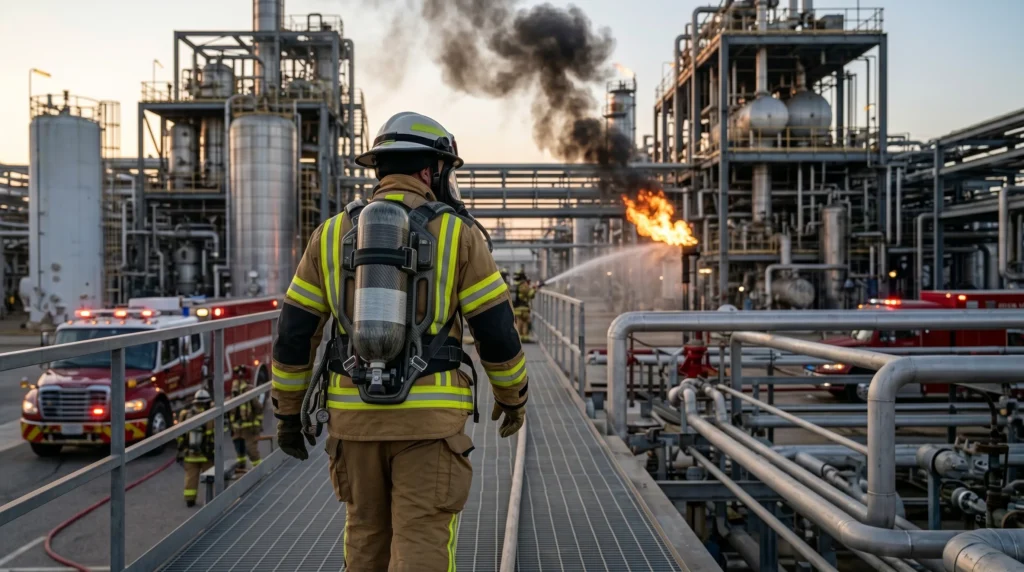
Self-contained breathing apparatuses are incorporating more resistant engineered materials to meet the demands of industrial firefighters and emergency brigades. Among recent innovations, Ultramid® A3XZC3 ESD stands out, a technical polymer designed to improve fire resistance, mechanical performance, and electrostatic safety in critical applications.
In sectors such as oil and gas, petrochemicals, biogas, chemical plants, and industrial terminals, self-contained breathing apparatuses are a critical barrier during fires, leaks, contaminated atmospheres, or interventions in confined spaces. Therefore, the selection of materials for structural components has ceased to be a secondary matter and has become part of the safety design of the complete equipment.
Self-contained breathing apparatuses respond to more demanding environments
Modern respiratory protection systems must withstand mechanical loads, thermal exposure, impacts, humidity, chemicals, and changing operational conditions. In an industrial emergency, the equipment must not only supply breathable air; it must also maintain its structural integrity while the user moves, climbs, evacuates, or rescues another worker.
One of the most sensitive points is the backplate or rear structure of the equipment, as it concentrates part of the cylinder’s weight, distributes the load over the user’s body, and can act as a grip point during rescue maneuvers. In this type of component, mechanical resistance, dimensional stability, and fire behavior are decisive.
The incorporation of technical plastics reinforced with carbon fiber allows for weight reduction without sacrificing rigidity, a relevant advantage for users who must operate for long periods or under high physical demand conditions. Furthermore, these materials can be designed with specific properties to limit the accumulation of electrostatic charges.
Ultramid® A3XZC3 ESD improves safety in EX zones
One of the most relevant technological advances in this evolution is the incorporation of Ultramid® A3XZC3 ESD, an engineering plastic developed for applications subject to high mechanical, thermal, and electrical demands. This material combines carbon fiber reinforcement, flame retardant behavior, and controlled electrostatic properties, characteristics that are especially important for self-contained breathing apparatuses used in refineries, petrochemical plants, biogas facilities, and other areas classified as explosion risk zones (EX).
Unlike conventional materials, Ultramid® A3XZC3 ESD is designed to offer high impact resistance without compromising the structural rigidity of the equipment. Additionally, its low surface resistivity helps reduce the accumulation of static electricity, decreasing the risk of spark generation in environments where flammable gases or vapors are present.
The application of these types of polymers also allows for the manufacture of lighter and more ergonomic structures, facilitating user mobility during prolonged emergency operations. In self-contained breathing apparatuses, this combination of mechanical resistance, thermal stability, and electrostatic safety represents a significant advance in improving the protection of industrial firefighters, emergency brigades, and operators working in high-risk facilities.
Industrial safety drives new engineering solutions
The evolution of self-contained breathing apparatuses reflects a broader trend within industrial safety: industrial safety systems, such as personal protection equipment, are ceasing to be passive elements and are becoming technical platforms designed with criteria of reliability, ergonomics, and performance in extreme conditions.
For manufacturers, operators, and industrial brigades, the challenge consists of combining lightweight materials, mechanical resistance, fire protection, electrostatic control, and compatibility with applicable safety standards. This integration is especially important in industries where thermal, chemical, and electrical risks may occur simultaneously.
The adoption of advanced materials in emergency equipment also opens opportunities for inspection, certification, performance testing, and life cycle management of safety assets. In an increasingly regulated industrial environment, having equipment capable of operating reliably under severe conditions will be a key factor in protecting personnel and strengthening the response to critical incidents.
Source: BASF