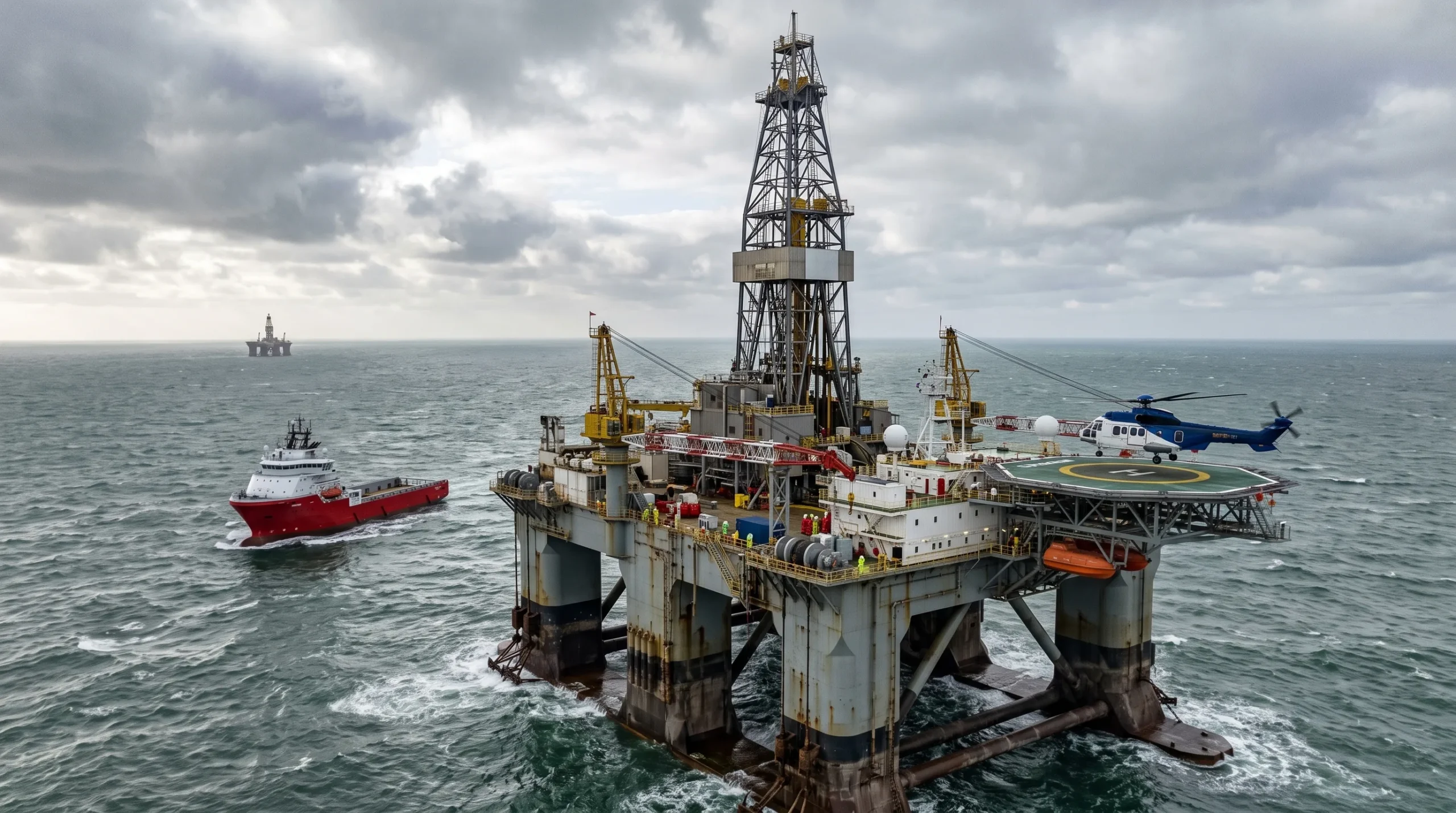
Offshore drilling in Norway continues to consolidate as one of the pillars of European energy security, driven by long-term investments in high-specification rigs capable of operating in the demanding conditions of the North Sea. The recent agreement between Equinor and Transocean to secure the availability of three semisubmersible rigs is an example of a broader trend: ensuring production continuity through infrastructure prepared to meet the technical and operational challenges of one of the world’s most important offshore provinces.
As Europe accelerates the diversification of its energy supply sources, the North Sea maintains a strategic role as a reliable supplier of oil and natural gas. This reality has strengthened demand for specialized drilling units capable of developing new wells, extending the service life of mature fields, and supporting the development of future exploration and production projects.
In this context, Equinor decided to secure multi-year programs for three Transocean semisubmersible rigs, a decision that reflects operators’ confidence in the continuity of Norwegian offshore activity and the need to keep drilling capacity available over the coming years.
Offshore drilling in Norway drives long-term investment
The Norwegian market has become one of the most resilient for offshore drilling companies thanks to a steady flow of projects and policies aimed at maximizing the use of resources in the North Sea and the Norwegian Sea.
Multi-year contracts allow operators and contractors to plan investments with greater certainty, optimize equipment utilization, and reduce costs associated with frequent mobilizations between different regions. At the same time, they provide stability to a supply chain made up of engineering, maintenance, logistics, inspection, subsea services, and technical support companies.
The continuity of these programs also encourages the adoption of new technologies aimed at improving drilling efficiency, reducing non-productive time, and strengthening operational safety.
Equinor and Transocean reflect an offshore market trend
The announced agreement includes the use of three harsh-environment semisubmersible rigs designed specifically to operate in Norwegian waters. These units will carry out multi-year drilling campaigns across different assets of the state operator, consolidating a contract portfolio of more than one billion dollars for Transocean.
Beyond the contract’s economic value, the decision highlights the priority operators are placing on the availability of specialized equipment capable of working year-round under complex weather conditions, characterized by low temperatures, heavy seas, and stringent regulatory requirements.
The Cat D rigs, originally conceived for Equinor’s operational needs, represent a generation of assets optimized to increase well efficiency, improve operational performance, and maintain high safety standards in highly complex offshore environments.
High-specification rigs sustain the North Sea’s competitiveness
The evolution of the offshore market shows that competitiveness no longer depends solely on the discovery of new resources, but also on the ability to develop projects with greater technical efficiency and lower operating costs.
High-specification rigs incorporate advanced automation systems, drilling control, equipment monitoring, and operations management that optimize the performance of each campaign, reduce risks, and increase asset reliability.
This type of infrastructure also facilitates the application of predictive maintenance strategies, risk-based inspection (RBI), condition monitoring, and digitalization—technologies that are part of the transformation currently underway in the offshore industry.
As a result, demand is increasing for specialized services in mechanical integrity, non-destructive testing (NDT), subsea inspection, structural analysis, and operational reliability—areas that play an essential role in maintaining the availability of rigs subjected to high levels of demand.
The North Sea maintains a strategic role for Europe
The strengthening of the offshore drilling market in Norway goes beyond the scope of a specific contract. It represents a strategy aimed at preserving the production capacity of a region that remains fundamental to Europe’s energy supply in a scenario marked by source diversification, geopolitical volatility, and the need to ensure reliable supplies.
The combination of operators with sustained investment plans, contractors with high-specification fleets, and a highly specialized supplier chain has enabled Norway’s offshore sector to maintain one of the strongest activity levels in the international market.
In this scenario, agreements such as the one signed between Equinor and Transocean reflect a trend that will likely continue over the coming years: investment in high-capacity drilling infrastructure as a key element to ensure operational continuity, drive new offshore developments, and strengthen Europe’s energy security.
Source: Offshore Energy