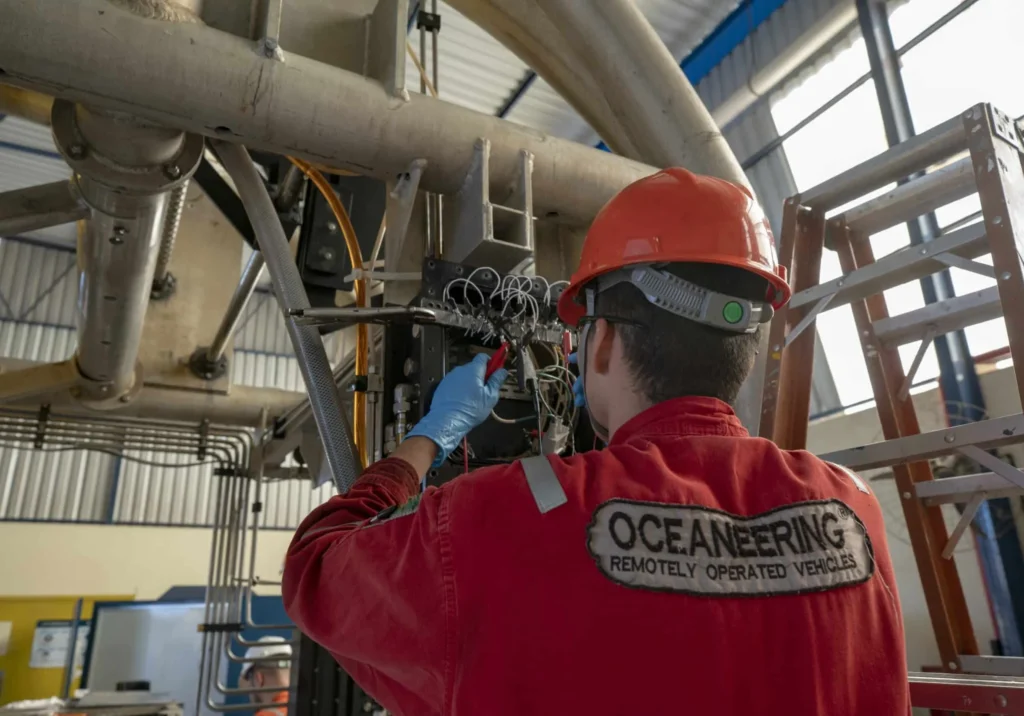
Oceaneering International announced that its subsidiary Marine Production Systems do Brasil obtained a contract from Petrobras to supply remotely operated vehicle (ROV) services for subsea operations in Brazilian waters. The agreement, awarded through a competitive process, will have a duration of four years and contemplates the start of activities in 2027.
As part of the project, the company will provide two work-class ROVs along with specialized tools to execute subsea inspection, monitoring, positioning, and intervention tasks.
The equipment will operate from the subsea engineering support vessel Aker Wayfarer, contracted by Petrobras to support installation, maintenance, and intervention campaigns on offshore infrastructure.
ROVs: Engineering Where Humans Cannot Operate
As the offshore industry develops fields at increasingly greater depths, direct intervention by divers ceases to be technically viable due to high hydrostatic pressures.
In this scenario, remotely operated vehicles become an extension of human capability beneath the sea. Equipped with high-definition cameras, navigation systems, sensors, and manipulator arms, ROVs enable the execution of inspections, equipment connections, valve operations, component installations, and assistance in complex operations without exposing personnel to extreme conditions.
Subsea Robotics Sustains Offshore Infrastructure
The functions of an ROV go far beyond visual inspection. These systems participate in subsea equipment installation activities, preventive and corrective maintenance, integrity monitoring, assistance during well interventions, and support for field abandonment operations at the end of their useful life.
The contract with Oceaneering contemplates precisely this type of specialized services, integrated into the subsea engineering campaigns that Petrobras develops from the vessel Aker Wayfarer, a platform designed to execute technical work on infrastructure located on the seabed.
The incorporation of specialized tools further expands the ROVs’ capability to perform increasingly complex operations, reducing intervention times and improving operational efficiency.
Brazil Consolidates Its Leadership in Offshore Engineering
Brazil hosts some of the world’s most complex offshore developments, particularly in the pre-salt fields, where the combination of great depths, long distances, and high-pressure environments demands highly specialized technological solutions.
In this context, Petrobras has driven for years a strategy based on the incorporation of advanced subsea technologies to ensure the continuity of its operations.
Oceaneering, present in Brazil for nearly three decades, contributes local expertise through specialized centers in ROVs, intervention tools, engineering solutions, remote operations, and umbilical cable manufacturing, thereby strengthening the technological capability available for the Brazilian offshore market.
Automation Redefines Subsea Operations
The development of the offshore industry has been closely linked to the evolution of robotics and automation. Current ROVs incorporate high-precision positioning systems, real-time communications, and operational capabilities that enable the execution of tasks with high levels of reliability in environments where human intervention is impracticable.
This technological evolution continues to expand the possibilities for safe exploitation of energy resources in deepwater, while improving operational efficiency and reducing the risks associated with subsea activities.
Source and photo: https://www.oceaneering.com/