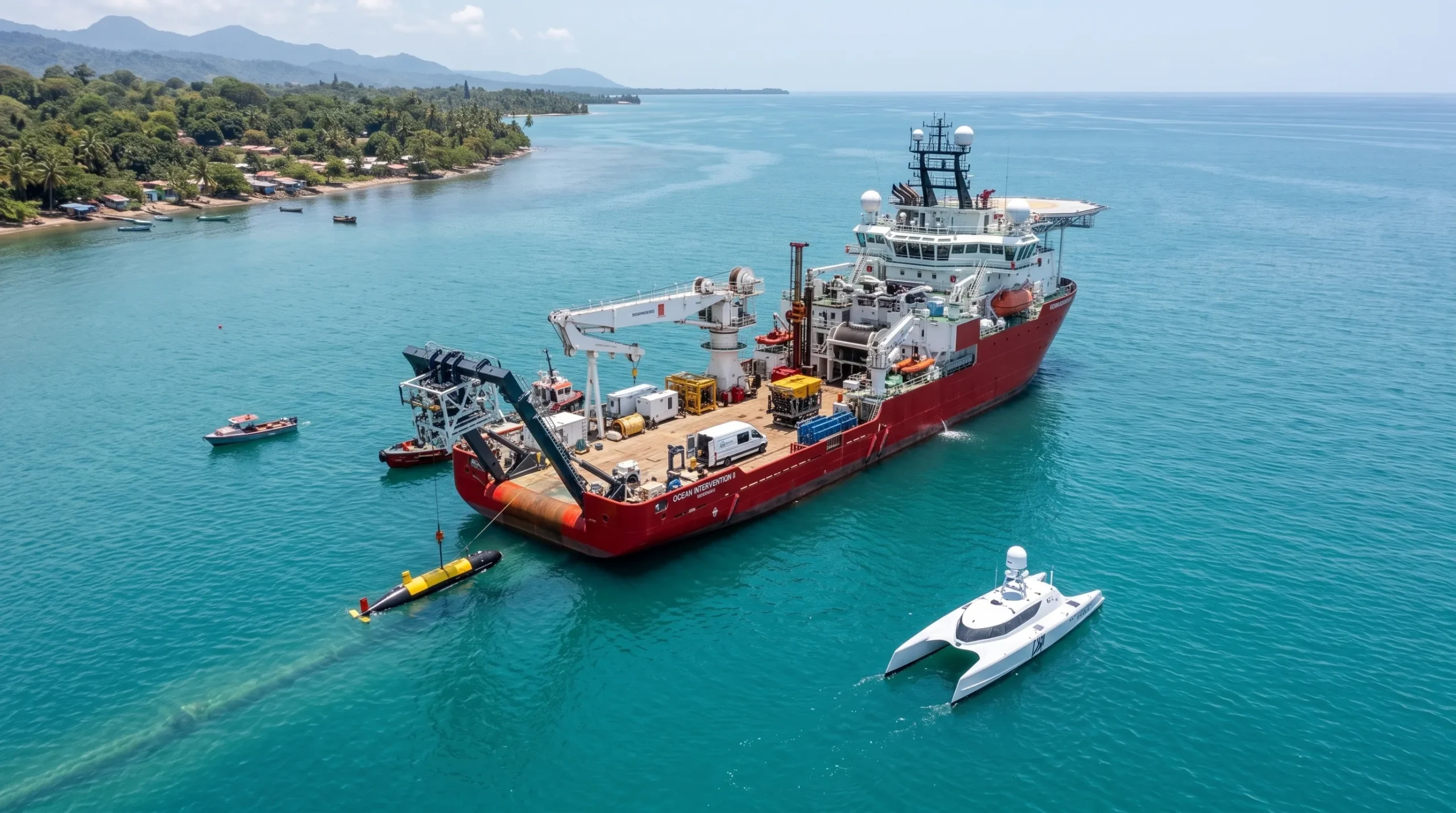
Oceaneering will execute an integrated geophysical survey, geotechnical, and subsea inspection campaign with the vessel Ocean Intervention II in Trinidad and the Gulf of Mexico, consolidating an operating model that integrates multiple offshore services into a single platform.
The contracts, awarded by a major international operator whose identity was not disclosed, include the possibility of extensions and additional work. The campaign consolidates multidisciplinary services on a single vessel, an operating model that Oceaneering has promoted since the modernizations carried out on the OI2 in early 2025. This single-vessel offshore survey model for Trinidad and the Gulf of Mexico is Oceaneering’s strategic bet.
Operations in Trinidad: four months of geophysical and geotechnical survey
The phase in Trinidadian waters, lasting approximately four months, includes 2D and 3D seismic data acquisition, high and ultra-high resolution seismic surveys, seabed mapping, geotechnical investigations, and seabed sampling using box cores and piston cores.
In deeper areas, the vessel will deploy autonomous underwater vehicles (AUVs) for the surveys, while conventional towed geophysical systems will be used in shallow waters. This combination allows for simultaneous operations in a single pass, reducing campaign times.
The autonomous underwater vehicle capability integrated into the OI2 is key for deep-water surveys: the vessel operates with an Exail DriX USV and a Kongsberg Hugin Superior AUV, platforms that work in coordination to extend the survey reach without additional mobilizations.
Pipeline inspection in the Gulf of Mexico with AUV
In the Gulf of Mexico, with an approximate duration of two months, the scope covers geotechnical investigations, AUV block surveys, pipeline inspection activities, and the application of contactless cathodic protection measurement technology, integrated directly into the AUV during subsea pipeline inspections.
This latter technology allows for the assessment of the cathodic protection status in subsea oil and gas pipelines without the need for physical contact with the structure, which reduces operational risks and shortens inspection times compared to conventional methods. The contract also includes options for additional site and block surveys.
A vessel built for simultaneous operations
The Ocean Intervention II was built by Bollinger Shipyards in 2000 for geophysical and geotechnical surveys and underwent significant upgrades in early 2025. The updates included survey systems, dedicated launch and recovery capacity for autonomous systems, and modernized data infrastructure.
Peter Buchanan, Senior Director of Survey, Products and Services at Oceaneering, noted: “By consolidating multiple survey scopes into a single vessel and crew, the OI2 allows for single-pass and simultaneous operations that reduce campaign duration, minimize mobilizations, and shorten offshore exposure, improving efficiency and reducing overall emissions compared to traditional multi-vessel programs.”
The efficiency of the simultaneous operations model is central to Oceaneering’s commercial strategy for the survey segment. Integrating geophysics, geotechnics, and autonomous systems into a single platform responds to operator demand to reduce campaign costs and environmental footprint in offshore development projects.
Market Context
Trinidad and the Gulf of Mexico are among the most active offshore basins in the Western Hemisphere. The award of multidisciplinary contracts to a single provider reflects the trend of operators to reduce logistical complexity and the number of providers in a campaign, especially in development projects that require integrated geophysical and geotechnical data prior to investment decisions.
Oceaneering did not disclose the economic value of the contracts. The company, headquartered in Houston, Texas, provides subsea inspection and engineering services for the global offshore energy industry. This Trinidad offshore survey is part of a broader regional strategy. The offshore survey contracts for Trinidad and the Gulf of Mexico consolidate Oceaneering’s position as a leader in multidisciplinary operations.
Sources: Oceaneering International (official press release) | WorkBoat | Splash247