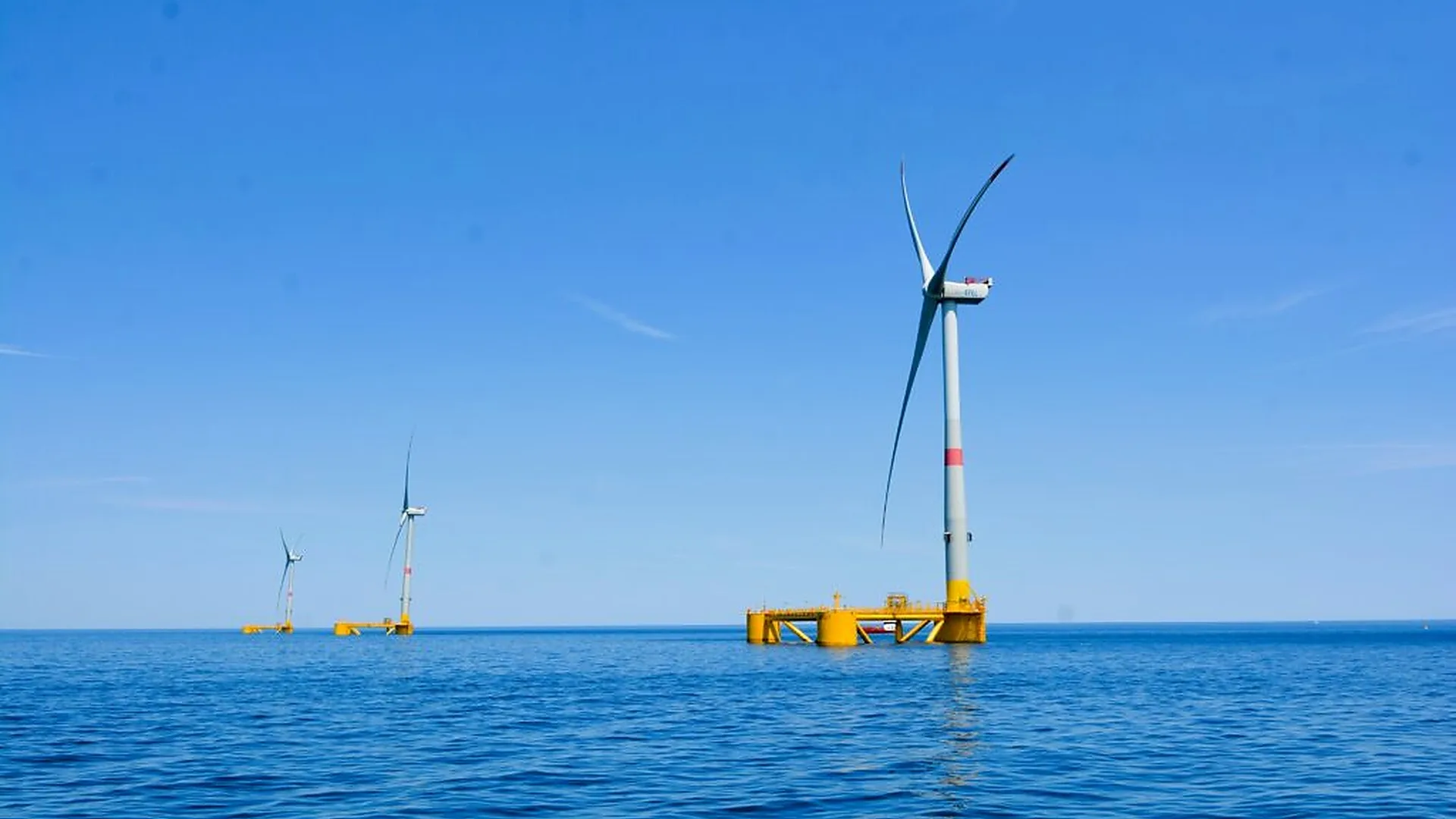
Ocean Winds has fully commissioned the 30 MW EFGL floating wind farm off the coast of Occitania, with the capacity to supply approximately 50,000 people.
EFGL begins operation with three 10 MW turbines
Ocean Winds reached full power at Éoliennes Flottantes du Golfe du Lion, known as EFGL, its first floating offshore wind project in France.
The pilot park features three 10 MW wind turbines installed on semi-submersible platforms. The units are located approximately 16 kilometers off the coast of Occitanie, in the French Mediterranean.
With a total capacity of 30 MW, the installation serves as a technical benchmark for future floating offshore wind projects in deep waters. This technology allows for the development of wind farms in areas where fixed foundations present greater challenges.
The park will generate 110,000 MWh per year
According to project estimates, EFGL will produce around 110,000 MWh of renewable electricity each year. That energy is equivalent to the annual consumption of approximately 50,000 people.
Ocean Winds plans to keep the park operational for the next 20 years; during that period, the company will evaluate the performance of the turbines, platforms, and operating systems under real Mediterranean conditions.
The project was developed in conjunction with Banque des Territoires, with Ocean Winds participating as the majority shareholder and using the experience gained to prepare commercial-scale floating facilities.
The supply chain has a strong French presence
In addition to the energy component, EFGL has fostered an industrial network with strong regional participation. 99% of its direct suppliers are European, and 85% of these are French companies or companies headquartered in France.
Likewise, 60% of the suppliers are small and medium-sized enterprises; these data show the weight that floating offshore wind can have in industrial and port activity.
The operation is managed from a maintenance base built by Ocean Winds in Port-La Nouvelle. From there, energy production is monitored and technical interventions at the wind farm are coordinated.
The facility supports more than 20 local jobs related to operation and maintenance; the base also seeks to strengthen stable economic activity in this port city.
Ocean Winds points to the potential of the Mediterranean
Craig Windram, CEO of Ocean Winds, believes that floating offshore wind will play a significant role in countries with deep coastal waters.
The executive noted that EFGL’s entry into full operation demonstrates the company’s ability to execute complex floating projects safely and in coordination with national and regional actors.
Marc Hirt, CEO of Ocean Winds in France, stated that the wind farm confirms the technology is now operational. He also highlighted the experience gained by the French and European supply chain.
For Ocean Winds, the Mediterranean could become a strategic area for the next stage of offshore wind energy. Its greater depths favor the use of floating platforms over structures fixed to the seabed.
EFGL incorporates measures for marine biodiversity
The park integrates solutions designed to protect and promote biodiversity, including the Biohut artificial marine habitats developed by the local company Ecocean.
These structures provide refuge for juvenile species and help integrate energy infrastructure into the marine environment. Ocean Winds presents EFGL as the first operational floating wind farm to incorporate this nature-inclusive design approach.
The experience gained during the operation will allow for improvements in production, maintenance, and optimization processes. It will also provide information for future commercial floating wind turbine projects in France and other markets.
Source and photo: Oceanwinds