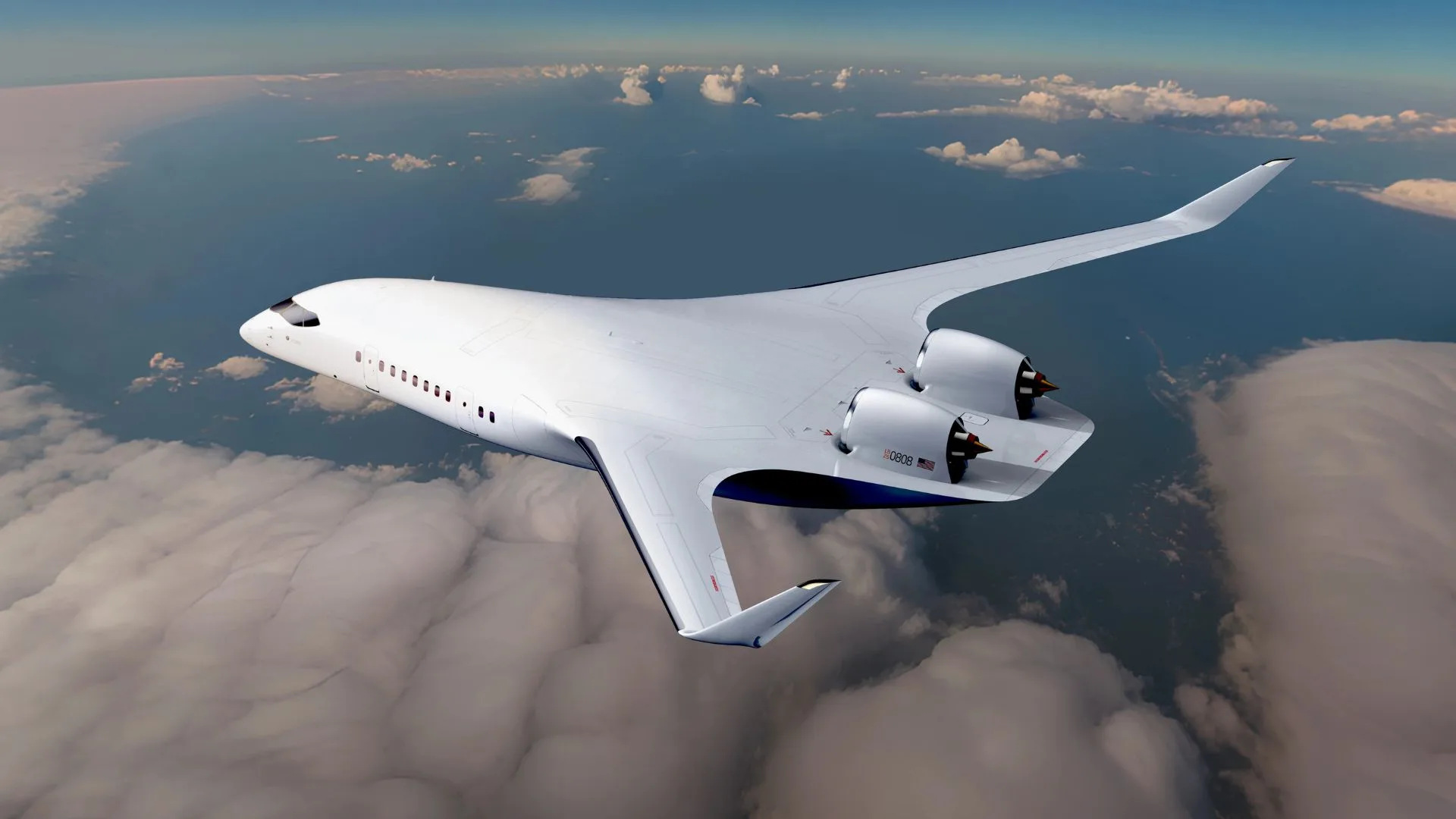
Aerospace startup JetZero, based in the Mojave Desert (California), has begun construction of its first commercial-scale blended-wing aircraft, an aircraft with a radically different design from conventional fuselages that promises to reduce fuel consumption by up to 50% compared to current wide-body models. The project has financial backing from the United States Air Force and letters of intent from airlines such as United Airlines and Alaska Airlines.
The JetZero blended-wing aircraft, technically known as a Blended Wing Body (BWB) design, integrates the wings and fuselage into a single continuous surface, eliminating the distinction between the aircraft body and wings found in traditional designs. This aerodynamic configuration generates lift across the entire aircraft surface—not just the wings—which significantly reduces drag and, consequently, fuel consumption per seat.
JetZero Blended-Wing Aircraft: Disruptive Engineering vs. Boeing and Airbus
The BWB design is not new to the aerospace industry: the U.S. Air Force has operated the B-2 Spirit bomber under this principle since the 1990s, and both Boeing and Airbus have explored civilian versions of the concept in internal research projects that never reached commercial production. What makes JetZero different is its commitment to bringing the design directly to the passenger transport market, with an aircraft sized for long-haul routes that can be operated with existing turbine families.
The company plans to complete the demonstration flight of a reduced-scale prototype in 2027, a milestone that would serve to validate the aerodynamic and structural data needed before moving towards certification of the commercial version. Support from the United States Air Force—which funds part of the program through research and development contracts—reduces the financial risk of the initial stages and lends technical credibility to the program for potential private investors and industry partners.
United Airlines and Alaska Airlines: Demand-Side Support
The participation of United Airlines and Alaska Airlines as strategic partners in the JetZero program does not yet imply a firm aircraft order, but it establishes a formal link that goes beyond a declaration of interest. Both airlines have committed technical support to define the operational requirements of the aircraft—cabin configuration, passenger capacity, flight range, compatibility with existing maintenance networks—and will participate in the prototype’s flight evaluation stages.
For airlines, the appeal of the BWB is direct: a 50% reduction in fuel consumption per seat would represent a structural transformation in their operational cost accounts, which typically allocate between 20% and 30% of their revenue to fuel. On long-haul transpacific or transatlantic routes—where fuel consumption is proportionally higher—the impact would be even more pronounced.
United and Alaska’s commitment to JetZero is also part of their decarbonization pledges for 2050. Both airlines have signed on to the net-zero emissions target by that date and are evaluating multiple avenues for carbon footprint reduction, from sustainable aviation fuels (SAF) to new-generation aircraft with superior efficiency. The BWB falls into this latter category.
Certification and Production Scale Challenges
The construction of the first commercial blended-wing aircraft faces challenges beyond aerodynamics. Certifying an aircraft with a geometry radically different from conventional tubular fuselages will require the FAA (Federal Aviation Administration) to develop or adapt its standards for evaluating structural integrity, emergency evacuation, and flight behavior under adverse conditions. BWB aircraft feature a wider cabin—similar in width to a wide-body aircraft, but with much greater cabin depth—which raises questions about natural lighting, the distribution of emergency exits, and passenger perception in windowless areas.
On the structural integrity and materials front, the BWB design requires intensive use of high-strength composite materials to keep weight controlled while meeting the pressurization requirements of a larger cross-section cabin. JetZero has indicated that it will work with suppliers in the U.S. aerospace supply chain for the development of the main structural components.
At the level of onboard power generation and auxiliary systems, the BWB configuration also differs from conventional aircraft: the integration of engines in the rear of the blended wing fuselage—one of the most explored configurations—implies changes in nacelle systems, thrust reversers, and maintenance access that airline ground crews will need to learn to manage.
Potential Impact on the Boeing-Airbus Duopoly
JetZero’s progress comes at a time of pressure on the Boeing-Airbus duopoly. Boeing is experiencing a reputation and production crisis linked to 737 MAX issues and 777X delays. Airbus, for its part, faces supply chain bottlenecks that limit its delivery capacity. In this context, a new-generation aircraft with a radically superior efficiency profile could generate real interest from airlines looking to differentiate themselves or reduce their dependence on established suppliers.
However, timelines are a decisive factor. JetZero speaks of a demonstration flight in 2027, but the path from a demonstration prototype to a certified and serially produced aircraft typically takes between 8 and 15 years, depending on the results of test programs and the availability of funding for industrial development stages. Boeing took more than a decade from the start of the 787 program to its first deliveries, and that aircraft used a conventional fuselage with composite materials, without the complexity of certifying a totally new aerodynamic geometry.
Sources: Reuters / JetZero — News | United Airlines Newsroom
Photo: JetZero