Table of Contents
- AI-powered digital twin will study the interaction between waves and floats
- Artificial intelligence will compare simulations with real data
- The model could anticipate loads and energy performance
- Eco Wave Power seeks to adapt the model to new locations
- Physical simulation and machine learning for wave energy
AI-powered digital twin this is the technology that Eco Wave Power and the German company AI Engineering will develop to model the behavior of their wave energy systems under different marine conditions. Eco Wave Power’s US subsidiary has already begun the first phase of the project with AI Engineering, this work will combine advanced physics-based simulations with real-world engineering, wave, and operational data to build a digital representation of the system.
AI-powered digital twin will study the interaction between waves and floats
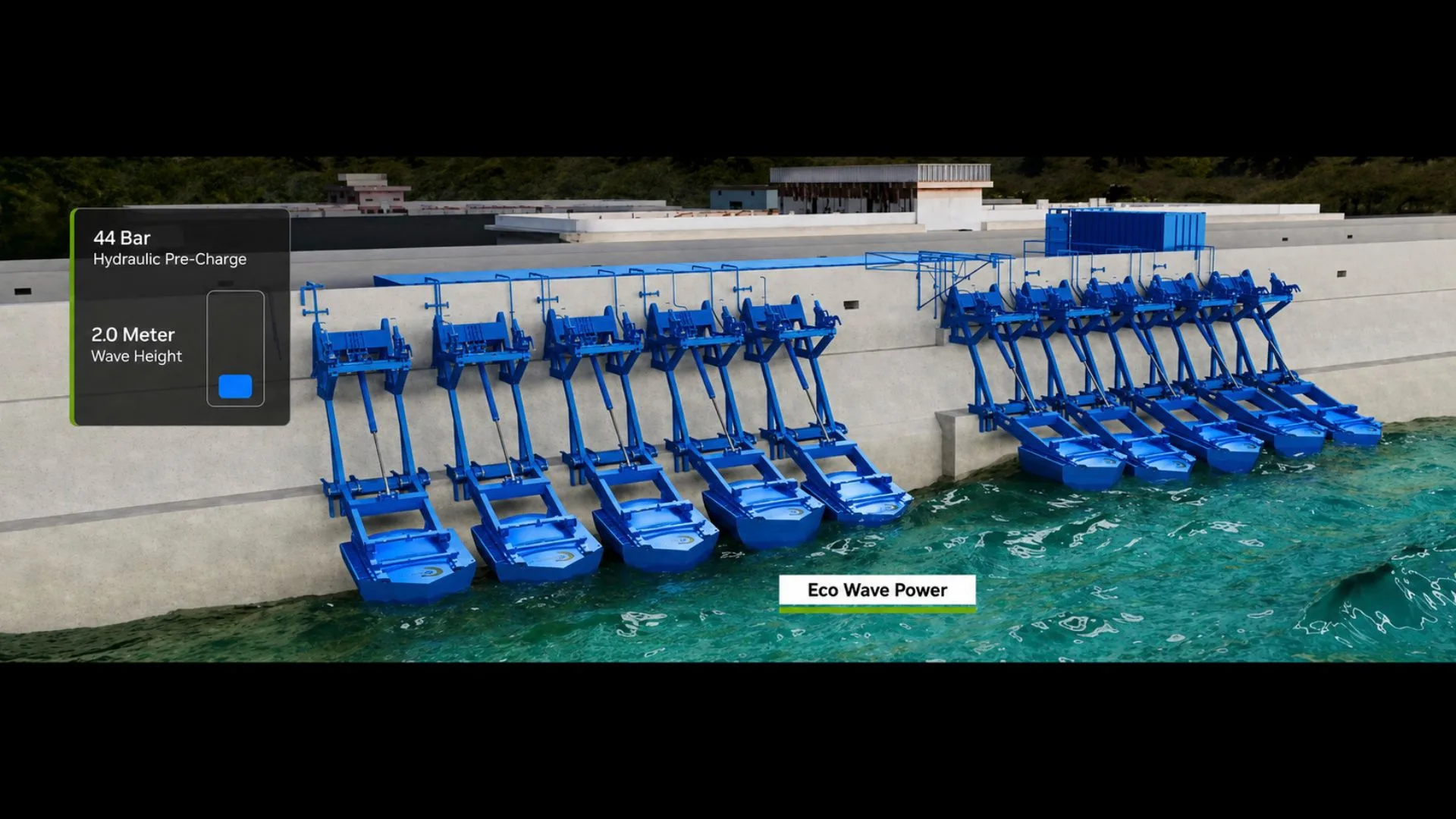
In this first stage, the companies will model the interaction of ocean waves with Eco Wave Power’s patented floats, using PAMICS, AI Engineering’s simulation technology. This tool will allow them to analyze the floats’ movement, structural loads, wave-generated forces, and the theoretical energy contribution under different sea conditions.
The process is especially relevant for wave energy due to the variability of the ocean environment, structures must respond to constant changes in wave conditions while capturing the energy needed to produce electricity. AI Engineering specializing in applied fluid mechanics, numerical flow simulation, and high-performance computing, PAMICS functions as a particle-based multiphysics simulation framework and can be used to study fluid dynamics and the interaction between fluids and structures.
Artificial intelligence will compare simulations with real data
Furthermore, Eco Wave Power and AI Engineering will compare the results generated by the digital twin with measurements from sensors installed in real-world systems. This information will serve as the basis for developing machine learning models capable of predicting the system’s loads and energy performance.
For us, AI is not simply a software layer that we add to our technology, but an opportunity to radically improve our understanding, design, prediction, and ultimately, operation of wave energy systems.
Inna Braverman
The project will also incorporate tools for NVIDIA these include NVIDIA Omniverse for digital twin visualization and simulation workflows, and NVIDIA Warp for simulation and modeling tasks. Eco Wave Power U.S. and AI Engineering are part of the NVIDIA Inception program.
The model could anticipate loads and energy performance
One of the technical objectives will be to move from physical simulation towards predictive capabilities, the models will be able to relate wave conditions to variables such as structural forces, the movement of the floats, and the energy that the system can capture.
Phase 1 of this collaboration is therefore very practical. We will model wave loading, float behavior, structural forces, and theoretical energy input, while also beginning to develop machine learning capabilities to predict loads and energy performance.
Braverman
Combining real-world data with high-fidelity simulations can also provide valuable information for optimizing future designs. In this way, the digital twin would serve as a tool for studying system behavior before making physical changes to an installation.
Eco Wave Power seeks to adapt the model to new locations
Another key aspect of the project will be determining whether the digital twin can be transferred between facilities subject to different wave conditions. This capability would allow the operational data and engineering knowledge gained from one project to be used to study other sites later.
For Eco Wave Power, this approach may prove relevant during its international expansion, the company maintains operations and projects in the United States, Europe, and Asia. It currently operates a grid-connected wave energy facility in the port of Jaffa, Israel, and has a pilot project in the port of Los Angeles, it is also developing initiatives in Portugal, Taiwan, and India.
Physical simulation and machine learning for wave energy
Stefan Adami, co-founder and CEO of AI Engineering, noted that wave energy presents a complex challenge due to the combination of free-surface fluid dynamics, structural motion, and variable environmental conditions. The company’s goal is to create a physics-based digital representation that connects high-fidelity simulations with data collected during the operation of Eco Wave Power systems.
As the project progresses, the integration of physical models and machine learning could improve the prediction of energy performance and structural loads. It could also provide data to optimize the design and evaluate the deployment of wave energy technology under different marine conditions.
Source: Offshore Energy
Photo: Eco Wave Power