The Fraunhofer IWES Institute, a German research center specializing in wind energy, conducted a year-long study in Liivi Bay, Estonia, for the energy company Enefit, with the aim of analyzing the environmental conditions of the site where an offshore wind farm called Project Liivi is planned to be built.
This type of study is essential before the construction of offshore wind infrastructure. It allows for obtaining precise data on wind, waves, and currents, which facilitates a safer and more efficient design, as well as a better evaluation of the project’s profitability.
What is the purpose of this study?
Before building an offshore wind farm, it is mandatory to study the site conditions for at least a year. This allows for:
- Measure wind speed and behavior.
- Analyze ocean waves and currents.
- Detect the intensity of turbulence (how the wind varies).
- Design efficient and safe wind turbines for that specific site.
- Calculate whether the project will be profitable.
Advanced technology for precise measurements
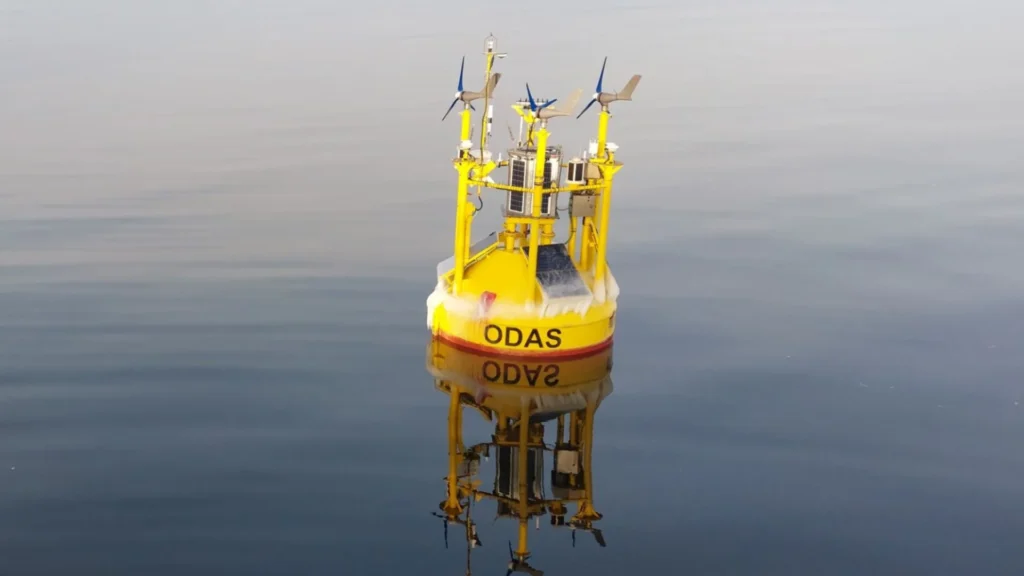
The institute used a Lidar buoy model Stage 3+, a model developed by the Fraunhofer IWES institute, basically functions as a ” laser eye ” that measures the wind at different heights, accompanied by oceanographic sensors deployed simultaneously to monitor waves and currents.
Furthermore, for the first time in a commercial project, they measured turbulence intensity using an advanced method developed by Fraunhofer IWES called high-frequency motion compensation. This is technically very complex because the buoy moves with the waves, and this movement must be corrected for the measurements to be accurate.
The sea ice challenge
During the winter, the Baltic Sea freezes over, so the buoy had to be temporarily removed to prevent damage. During the months it was out of service, they used:
- A land-based Lidar on Kihnu Island.
- Mathematical models that calculated what the wind was like at sea based on the wind measured on land.
Why is this important?
Estonia wants to develop its offshore wind energy to improve its energy security and avoid dependence on imported energy, while accelerating the transition towards clean energy, harnessing the potential of the Baltic Sea.
The institute will present its progress at the WindEurope 2026 event in Madrid, where it will showcase its technological offering for the offshore wind sector.
Source and photo: Fraunhofer Institute IWES