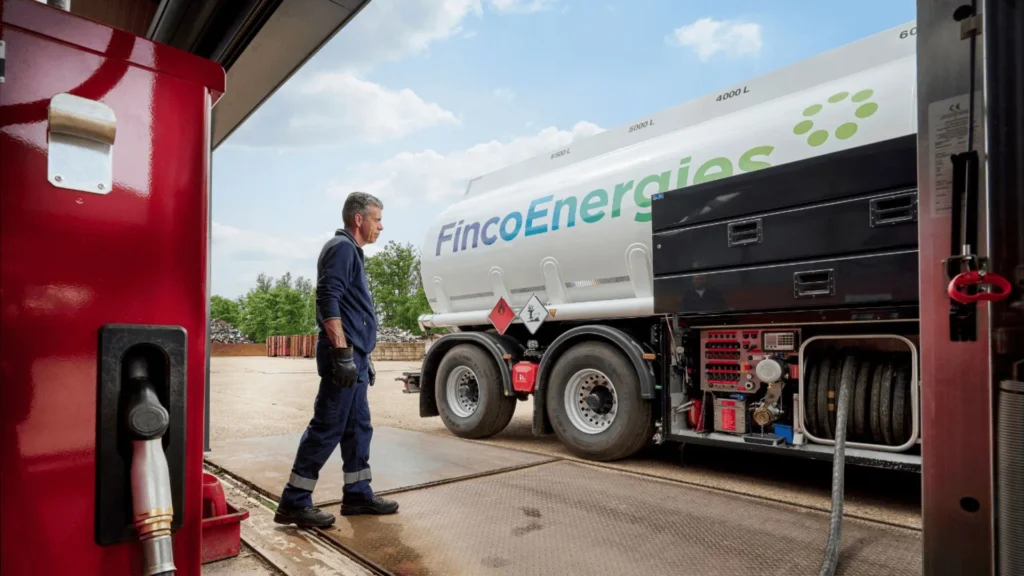
FincoEnergies and Scan Global Logistics strengthened their collaboration with the launch of Biofuel Swap, a program designed to immediately and verifiably reduce CO₂e emissions in road transport.
The proposal is based on the use of certified HVO100, a renewable biofuel that makes it possible to reduce the carbon footprint without requiring changes to vehicles, infrastructure, or day-to-day logistics operations.
In addition, the initiative builds on a pilot developed in 2023, in which both companies tested intermodal transport solutions and emission-reduction mechanisms applicable to land logistics. That prior work paved the way to scale the program in 2025 and turn it into a global option for customers with more demanding sustainability targets.
Biofuels for the decarbonization of road transport
Currently, road transport remains closely tied to fossil diesel, which complicates meeting climate targets across the logistics chain. Adding to this pressure is another factor: the limited availability of sustainable fuels on key routes and the operational difficulty of integrating them into owned or subcontracted fleets.
In this context, Biofuel Swap seeks to bridge the gap between the need to reduce emissions and the real-world implementation of low-carbon solutions. The model allows HVO100 to be physically used in trucks operating in the Netherlands, while a book-and-claim system transfers the environmental benefit to customers in different regions of the world.
Likewise, this approach facilitates the accounting of verified Scope 3 emission reductions, an increasingly relevant point for companies that must report their climate performance with greater accuracy. CO₂e data traceability and the absence of double counting reinforce the scheme’s usefulness for corporate reporting and ESG strategies.
Certified HVO100 and traceability for a verifiable CO₂e reduction
The program is based on HVO100, a fuel produced from waste and by-products under voluntary schemes approved by the European Union’s Renewable Energy Directive, including ISCC, RSB, or REDCert. According to information released by the companies, this fuel can achieve CO₂e reductions of up to 90% compared with fossil diesel in full life-cycle analysis.
In addition, the proposal incorporates external audits and sustainability criteria aligned with European regulations. For logistics customers, this means access to a tool with transparent, traceable data compatible with their carbon reporting systems.
In this way, the alliance between FincoEnergies and Scan Global Logistics is positioned as an immediately deployable alternative at a time when many long-term decarbonization technologies are still progressing slowly. Against this backdrop, the use of certified biofuels emerges as an available pathway to begin reducing emissions without redesigning the entire transport operation.
For its part, Scan Global Logistics frames this initiative within its portfolio of low-carbon logistics solutions, which also includes marine biofuels, sustainable aviation fuel, and electric vehicles. The addition of Biofuel Swap expands that catalog with a solution focused on land transport, one of the segments most difficult to decarbonize in the short term.
In addition, for FincoEnergies the collaboration extends the reach of its decarbonization services in the transport sector by connecting them with SGL’s international customer network. This combination of biofuel supply, certification, and logistics capability scales up a proposal designed to move from climate targets to measurable actions.
Source: Scan Global Logistics
Photo: FincoEnergies