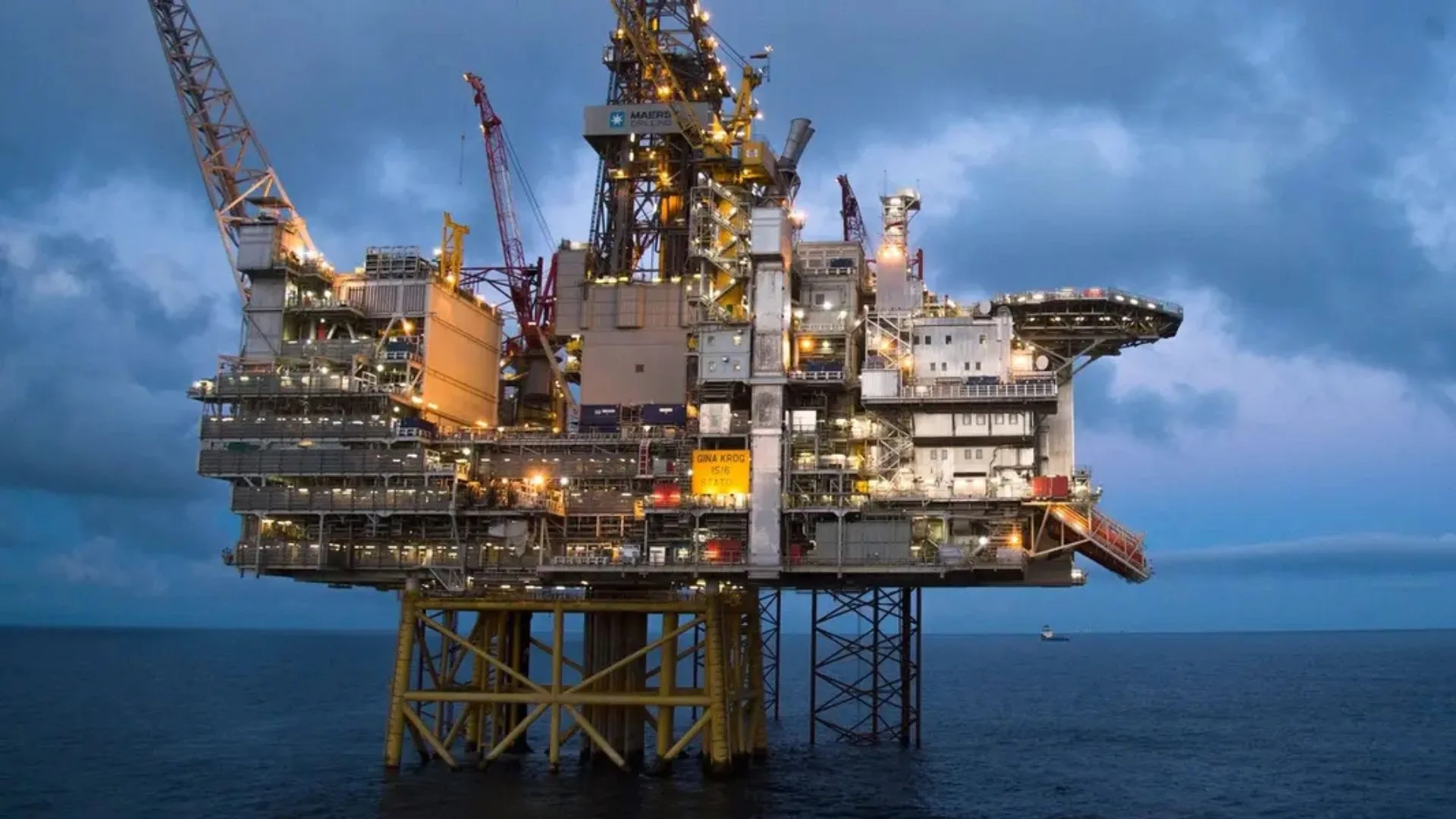
Equinor has brought the Eirin field in the North Sea into production, an offshore development that already exports gas to Europe via the Gina Krog and Sleipner A infrastructure. The field, originally tested in 1978, was restarted after a new technical and commercial evaluation carried out in 2023.
According to the company, Eirin has an estimated 27.6 million barrels of oil equivalent in recoverable resources, primarily gas. The operation strengthens the flow of Norwegian gas to the European market at a time when energy security remains a priority for the region.
The Eirin field takes advantage of infrastructure in the North Sea
Specifically, the field was developed as an underwater facility connected to the Gina Krog platform. From there, the gas is processed and exported via Sleipner A, an area considered key for Norway’s gas exports to Europe.
Furthermore, the solution utilizes existing riser pipelines and allows for the connection of new discoveries in the area. This model reduces implementation times, contains costs, and extends the value of mature assets on the Norwegian continental shelf.
The total investment for the project is estimated at 4.5 billion Norwegian kroner. Equinor also anticipates that Eirin will extend the productive life of Gina Krog from 2029 to 2036, adding seven years of operation to an already electrified facility.
Accelerated development since 2023
Furthermore, the project timeline confirms the speed of Eirin’s development. After remaining dormant for decades, the project was reactivated in January 2023.
In May of that same year, Equinor made the investment decision, followed in September by the approval of the development and operation plan. Subsequently, in January 2024, the authorities gave the project final approval.
Finally, in May 2026, the field began production. This journey, from conceptualization to operation, was completed in just three years, a short timeframe by offshore standards.
According to Equinor, early collaboration, more agile decision-making processes, and the use of standardized solutions were key factors in accelerating execution. The project also provides lessons for developing marginal fields more profitably in the future.
Gas for Europe with lower emissions intensity
Thus, the Eirin field is now operational with an estimated CO₂ emissions of around 3 kg per barrel of oil equivalent produced. This performance is linked to the electrification of Gina Krog, completed in 2023.
The development is located approximately 250 kilometers west of Stavanger, in waters roughly 120 meters deep. The reservoir lies about 4,000 meters below the seabed, and the subsea facility features a template with two slots.
Operationally, the gas is exported via Gassled, while the liquids are sent to Kårstø for processing and subsequent export. This integration allows for leveraging an already established transport chain and improving the project’s efficiency.
Equinor currently operates the license with a 58.7% stake, while Orlen Upstream Norway AS holds the remaining 41.3%. For both partners, the development increases regional production and strengthens the role of North Sea gas in European supply.
Furthermore, Eirin’s connection to Gina Krog can boost the area’s recovery factor and sustain employment associated with the platform’s operation.
Source and photo: Equinor