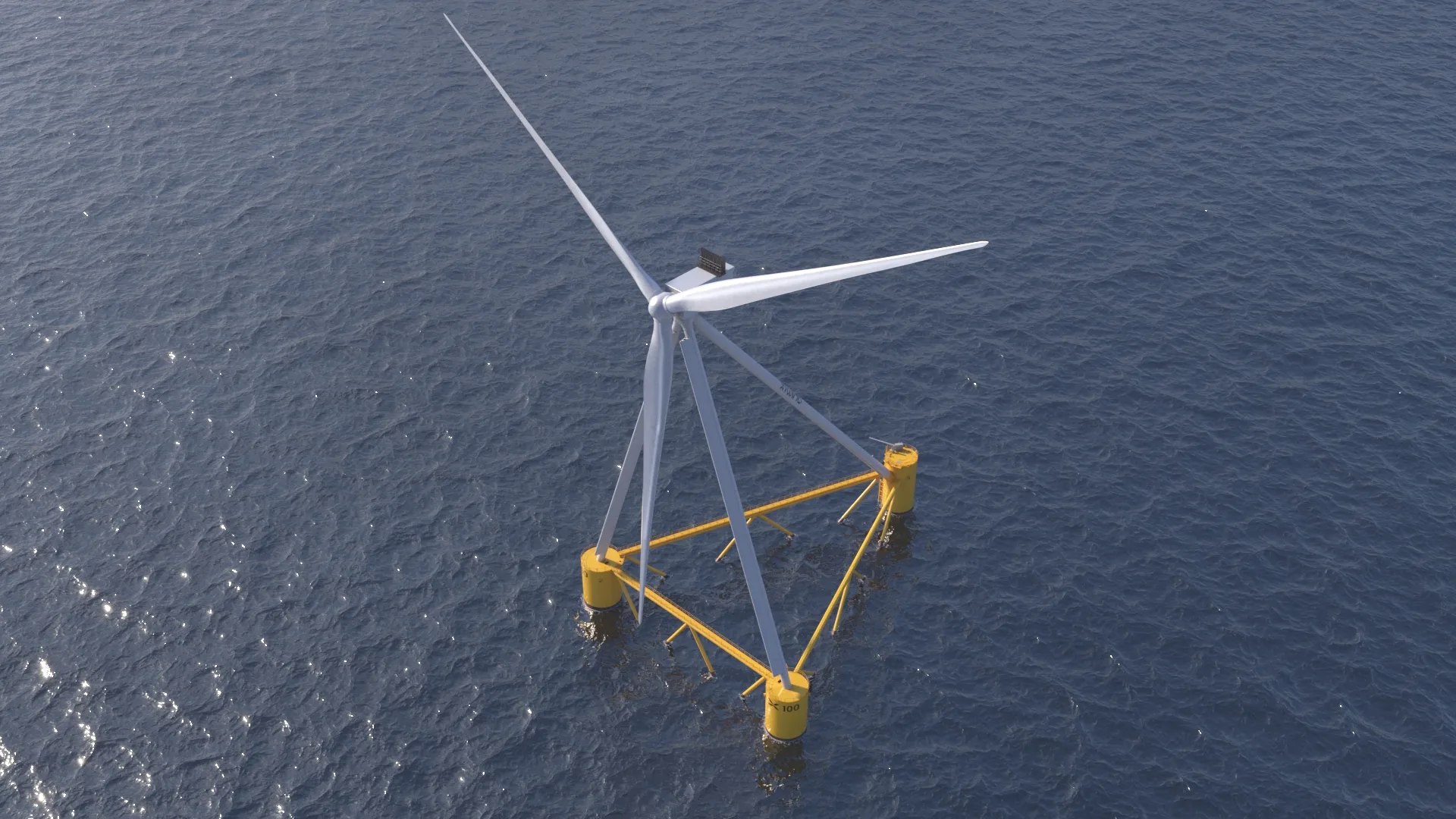
The PlemCat test center, located in the Spanish Mediterranean, obtained approval of its Environmental Impact Assessment, a fundamental step for the advancement of the NextFloat project and the deployment of X1 Wind’s X100 floating platform.
The resolution, published in the Official State Gazette on July 8, validates the compatibility of the proposed site with environmental protection, the conservation of the marine environment, and local biodiversity. Furthermore, it allows progress to be made toward the necessary procedures for occupying the Maritime-Terrestrial Public Domain.
PlemCat’s EIA paves the way for the NextFloat project
The NextFloat project, led by Technip Energies and X1 Wind, involves installing X1 Wind’s first commercial-scale floating platform. The X100 will have an 8.5 MW downwind turbine and a rotor 160 meters in diameter.
Likewise, the pilot will operate for several years in real marine conditions; with this data, the partners will seek to complete the certification of the prototype and prepare for the leap to larger-scale commercial applications.
Smaller marine footprint with TLP mooring system
The X100 platform combines a tripod design with a tensioned leg system, known as TLP. This configuration uses vertical mooring lines, reducing the seabed footprint compared to traditional catenary lines.
Furthermore, by avoiding chains and using tensioned synthetic lines, the system limits drag on the seabed and reduces underwater noise. This approach facilitates coexistence with activities such as fishing, scientific research, and other maritime operations.
Lightweight design for large turbines
From a structural point of view, the X100 reaches a primary steel weight of 1,500 tons, according to X1 Wind, this represents an estimated reduction of between 30% and 50% compared to other floating steel platforms used in European pre-commercial projects of a similar scale.
On the other hand, the technology will serve as the basis for the future X150 platform, designed for turbines exceeding 20 MW. With this, NextFloat aims to accelerate an industrial pathway for low-cost floating offshore wind.
Environmental approval and technical validation
The environmental approval comes in addition to the recent Declaration of Conformity for Basic Design granted by DNV to the X100 platform. This independent review confirms that the design meets international requirements for safety, engineering, and technical performance.
With both endorsements, NextFloat is better positioned to move towards financial closure and pilot deployment in the Mediterranean. The project is supported by private capital, European funding through NextFloat and NextFloat+, the French PAREF program, ADEME, and the Spanish RenMarinas program.
Alex Raventós, CEO and co-founder of X1 Wind, noted that PlemCat’s EIA and DNV certification demonstrate that the technology is ready for deployment. Jacques Vendé, director of the NextFloat project at Technip Energies, highlighted the platform’s low environmental impact and the project’s strength in moving to the pilot phase.
Source and photo: X1wind