Ensign Energy’s Eagle Ford asset deal confirms the Canadian company’s appetite for proprietary assets in Texas: the firm closed the Eagle Ford asset deal by acquiring positions directly linked to ConocoPhillips, reinforcing its presence in a basin that produces between 1.1 and 1.3 million barrels per day in 2026 and continues to attract capital amid a shale consolidation cycle.
Eagle Ford asset deal strengthens Ensign in Texas
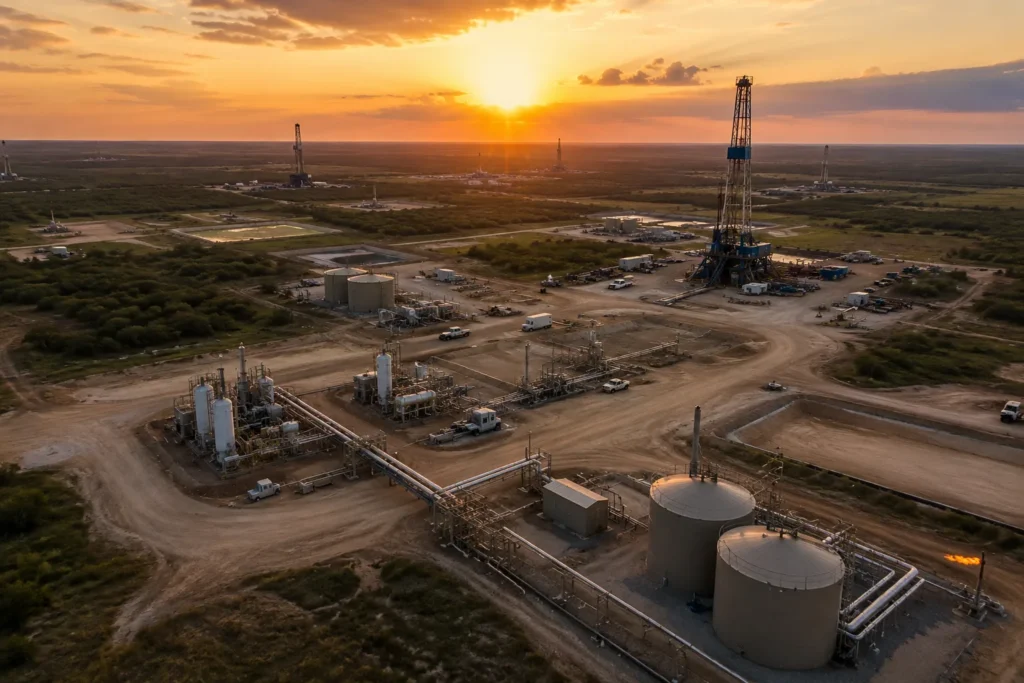
The transaction, confirmed on June 8, 2026, involves assets in South Texas within the Eagle Ford Shale formation, one of the most productive shale provinces in the United States. Ensign Energy, a Canadian company historically focused on drilling services, is advancing its transition towards direct ownership of productive assets in mature basins. Eagle Ford concentrates diversified production of light oil, condensates, and dry natural gas, making it a strategic destination for operators seeking stable cash flow. For more context on the evolution of the US energy sector in 2026, consult the analysis on US LNG flows at 2026 lows.
ConocoPhillips Eagle Ford adjusts portfolio after Marathon Oil
ConocoPhillips closed the acquisition of Marathon Oil in 2024 and has since rationalized its portfolio to concentrate capital on higher-return assets. The divestment of specific positions in Eagle Ford does not represent an abandonment of the basin, but rather a typical portfolio optimization for large independents post-merger. Upstream Online reported that this Eagle Ford asset deal directly links the transferred assets to the selective divestment process ConocoPhillips is executing in South Texas. A sector spokesperson noted that “asset consolidation in mature basins like Eagle Ford allows operators to concentrate capital where they achieve the highest return per well”.
Texas shale assets accelerate 2026 M&A cycle
The market for shale assets in Texas has been undergoing a sustained cycle of mergers, acquisitions, and divestments since 2023, reorganizing the operator base in established basins. Mid-sized and large independents seek scale in areas with already installed transportation infrastructure to reduce the cost of development per barrel equivalent. Industry analysts point out that “buying assets in Eagle Ford today is equivalent to acquiring accumulated learning curves and a pipeline network that would take years to replicate in a new area”. This movement also reflects a broader reconfiguration of global energy flows, evident in trends such as ADNOC’s alternative naphtha route to Asia.
US shale operations: Ensign changes upstream in Eagle Ford
For upstream operators active in the basin, Ensign Energy’s arrival as an asset owner changes the contractual and technical dynamics in Eagle Ford. The company brings decades of experience in directional drilling and completions, which can translate into shorter development cycles and lower cost per lateral foot drilled. The Eagle Ford asset deal also sends a clear signal to the market: Canadian capital maintains its confidence in US shale even with volatile crude prices during the first half of 2026.
Eagle Ford acquisition boosts Ensign’s strategy
With this Eagle Ford asset deal, Ensign Energy consolidates a proprietary asset base that allows it to reduce its exclusive reliance on drilling contracts and diversify revenue towards direct production. Eagle Ford offers key logistical advantages due to its proximity to Gulf ports and Texas coast refineries. The coming months will define whether the company accelerates the development of acquired wells or awaits more favorable price conditions before committing new capital.