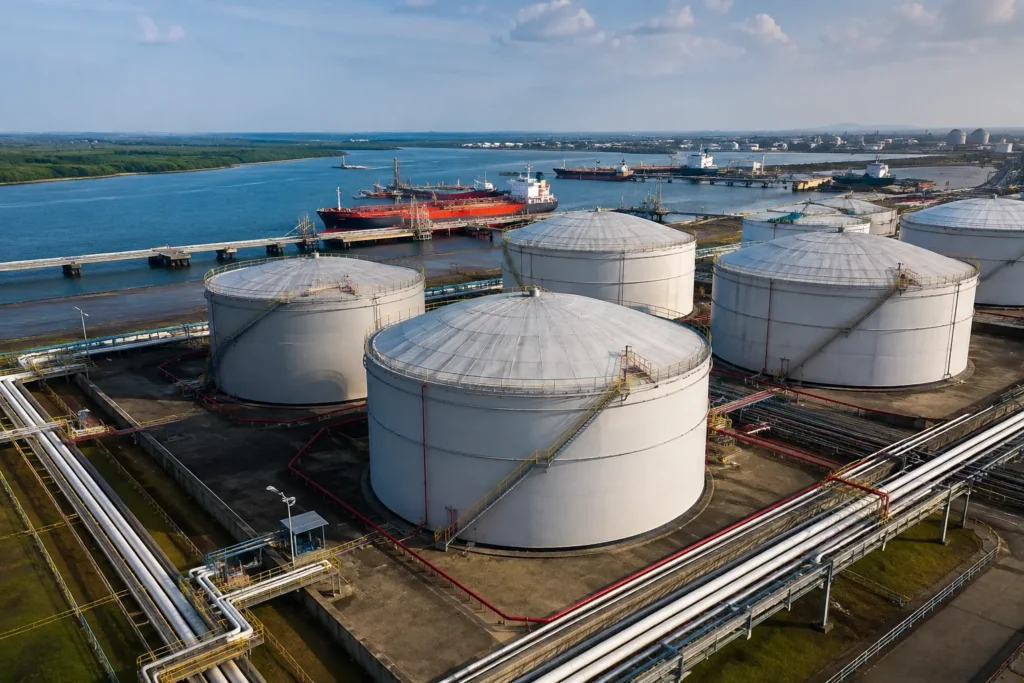
The Dangote terminal in Cameroon is beginning to emerge as a potential component of the Nigerian group’s downstream expansion into Central Africa. Dangote Group presented the Cameroonian government with a proposal to evaluate the development of a petroleum products storage facility that could strengthen the country’s strategic reserves and open a new route for distributing fuels produced in Nigeria.
The initiative also includes the possibility of incorporating a pipeline network to transport refined products. If it moves forward, this infrastructure could reduce some of the costs associated with road transportation and strengthen the logistical connection between fuel supplies and regional markets.
The project, however, remains at a preliminary stage. The proposal was presented to Prime Minister Joseph Dion Ngute by Devakumar Edwin, Vice President of Oil, Gas and Fertilizer at Dangote Group, but so far no construction agreement has been announced, nor have capacity, investment, final location, or a project timeline been disclosed.
The Dangote terminal in Cameroon could open a new route for Lekki fuels
The project’s strategic significance extends beyond storage within Cameroon. A potential terminal would provide a new outlet for products manufactured at the Dangote refinery in Lekki, Nigeria, and could strengthen the group’s commercial presence both in Cameroon and across other Central African markets.
This component makes the proposal a potential logistics element within a broader downstream strategy. Large-scale refining capacity requires not only fuel production, but also storage, transportation, and distribution points capable of connecting those volumes with consumer markets.
Dangote already participates in Cameroon’s fuel supply. According to Africa Oil+Gas Report, it currently exports gasoline to the country through Neptune Oil. National fuel storage and distribution, however, are managed by the Société Camerounaise des Dépôts Pétroliers (SCDP), which also manages the government’s strategic fuel reserves.
Therefore, it remains to be determined how a potential Dangote infrastructure project would fit into the existing system and what development model would ultimately be adopted.
Cameroon prepares to expand its storage capacity
The proposal comes as Cameroon is already considering significant investments to expand its fuel storage infrastructure. Among them is a project in the port city of Kribi, where a terminal with a capacity of 230,000 cubic meters for gasoline, kerosene, and diesel is planned, along with storage capacity for 40,000 metric tons of liquefied petroleum gas (LPG).
According to the source, this infrastructure would increase SCDP’s total liquid fuel storage capacity to approximately 490,000 cubic meters, while also significantly strengthening its available LPG storage capacity.
This development is joined by another 250,000-cubic-meter storage project associated with CSTAR Tank Farm Project Management, a company backed by Ariana Energy, Tradex, and Cameroon’s state-owned National Hydrocarbons Corporation.
The coexistence of these initiatives shows that storage is becoming increasingly important within Cameroon’s energy infrastructure. For the country, increasing inventories and logistics capacity could provide greater flexibility to manage fuel supplies and strategic reserve.
Central Africa enters the horizon of Dangote’s refining strategy
The proposal also reflects how the expansion of refining capacity can shift the challenge from production to logistics.
If the terminal moves forward, Dangote could gain additional infrastructure to bring its fuels closer to new consumers outside Nigeria. In this scenario, Cameroon offers a relevant position as both a market and a potential distribution platform for Central Africa.
However, key questions remain. Dangote has not disclosed whether it intends to build and operate the facility directly, develop the project alongside a state-owned company, or pursue a concession or public-private partnership.
It also remains unclear how the proposal would relate to the terminals that Cameroon is already planning to develop. For now, the concrete development is the presentation of the initiative to the Cameroonian government. The next steps will determine whether discussions progress toward studies, institutional agreements, and eventually an investment decision.
If that happens, the project’s significance would extend beyond simply adding new storage tanks. The terminal could become a new link between Nigeria’s refining capacity, Cameroon’s security of supply, and the Central African fuel market, expanding Dangote’s downstream or refining footprint across the region.
Source: Africa Oil+Gas Report