Table of Contents
- SPM system commissioning and operational delay
- CALM buoy installation and preliminary tests
- PLEM and hoses before first cargo
- SPM system commissioning and final acceptance
- The bottleneck between contractors and operator
- First cargo and handover to operations
- How to interpret a delay without rushing the cargo
- Conclusion
- References
- Frequently Asked Questions (FAQs)
A CALM buoy may be installed and yet the terminal is not ready to receive a vessel. The delay usually appears at the interfaces, a subsea connection without proof of integrity, an untested alarm, or an acceptance criterion that no one closed out. SPM system commissioning requires demonstrating that mooring, transfer, control, and operation work together. This analysis identifies where time is lost between the end of installation and the first cargo, and what decisions allow recovering the sequence without transferring risks to the operator.
SPM system commissioning and operational delay
The contractual milestone “buoy installed” describes a physical condition; “ready to load” requires accepted tests, documentation, and a prepared crew. Between both dates lie weather windows, support vessels, permits, diver or ROV intervention, and the availability of the first tanker. In offshore terminals, every dependency can halt the critical path, even if the main equipment is already in position.
The most costly scheduling error consists of booking the vessel based on assembly progress only to discover later that hose certificates, valve adjustments, or functional tests are missing. For SPM system commissioning, it is advisable to distinguish three verifiable milestones: mechanical completion per subsystem, integrated test acceptance, and operational authorization for a controlled load. In offshore terminals, a percentage does not replace them.
Before booking the vessel, the operator needs a punch list with a responsible party, impact, closure condition, and realistic date. Marine terminal commissioning also depends on agreement among engineering, contractor, port authority, and operations team regarding which deviations block loading.
CALM buoy installation and preliminary tests
CALM buoy installation does not end when the lifting slings are released. The result must be compared against the approved design: position, orientation, freeboard, tension and geometry of mooring lines, connections, and seabed condition. A minor variation can alter the buoy and require another offshore intervention.
ABS rules for single point moorings include component verification and a pull test of each installed mooring line according to an approved procedure, with the inspector present when classification applies. That reference helps separate manufacturing tests from SPM system tests performed after installation. The record must join component number, certificate, field result, deviation, and acceptance; a scattered folder delays release.
Works that are still accessible before mounting hoses or closing connections also matter: visual inspection, connection verification, anticorrosive protection, and positioning records. If a defect is detected later, it may require a new vessel, good weather, and additional testing. Therefore, CALM buoy installation and SPM system testing must be delivered with evidence usable by operations, not just with a construction sign-off act.
PLEM and hoses before first cargo
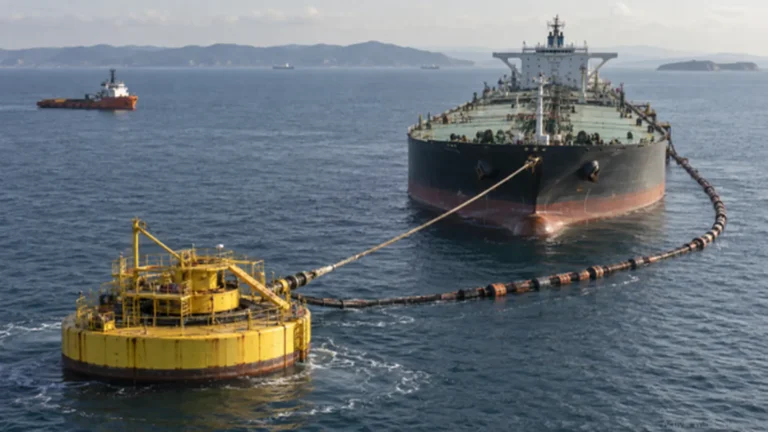
The PLEM connects the subsea pipeline with the underbuoy hoses; further on, the product passes through the swivel and floating lines to the vessel. If a connection in this chain lacks traceability, the entire system loses availability. In SPM system commissioning, ABS points out that the PLEM must withstand the expected hose loads and that its classification scope can vary by agreement: it is advisable to verify this explicitly.
A satisfactory test of an isolated section does not in itself prove the integrity of the final path. SPM system testing must document test limits, medium used, approved pressure and duration, valve configuration, instruments, and leak management, in accordance with the design, manufacturer, and applicable body. The OCIMF guide for offshore hoses serves as a reference for manufacturing and performance; it does not replace the specific field acceptance procedure.
The typical delay arises when a flange, length, or hose curvature incompatibility is detected after anchoring the buoy. CALM buoy installation and PLEM integration require a joint review of final drawings, bend radii, motion constraints, and transfer route. A joint interface list reveals failures that each discipline declared closed.
SPM system commissioning and final acceptance
SPM system commissioning begins with equipment-by-equipment checks, but its value appears when checking the whole system: valve sequence, pressure indication, communications, alarms, and response to an emergency shutdown. A signal reaching the console does not prove that the final element acts as expected. Results must be tied to an acceptance criterion and to the personnel who will receive the terminal.
The OCIMF SMOG guide addresses single point mooring operation and maintenance; the project plan must convert that reference and manufacturer requirements into concrete scenarios for the terminal. In marine terminal commissioning, normal conditions and responses to design-relevant failures are tested with representatives from operations, maintenance, and safety. It is not appropriate to extrapolate requirements from a different facility nor to declare an ESD tested with a simple on-screen simulation.
An open punch list does not always prevent starting, but defects affecting containment, mooring, isolation, critical communications, or safe shutdown require resolution and competent approval. The authorization record must identify temporary operating limits, responsible parties, and closure dates for minor issues. Thus, SPM system testing and SPM system commissioning cease to be a collection of certificates and become evidence to decide whether actual loading capacity exists.
The bottleneck between contractors and operator
Delays are concentrated at the points where responsibility changes: subsea work versus transfer system, manufacturer versus installer, contractor versus operator, and terminal versus vessel. It is common for everyone to report their package as complete while no one has validated the complete sequence. SPM system commissioning needs an interface manager with the authority to close dependencies and call joint tests.
The practical alternative is to plan backwards from the first cargo: tanker availability, maritime authorization, integrated test, subsystem testing, and mechanical handover. In marine terminal commissioning, every transition requires evidence, not a progress meeting. When a document is missing, it is known which test, signature, or specialist shifts the date.
This is where a company covering design, procurement, fabrication, installation, and commissioning of SPM systems fits in. SeaWing claims an end-to-end delivery of CALM buoy, PLEM, mooring, and hoses up to the first cargo; that scope can reduce contract gaps if the responsibility matrix and acceptance criteria are defined from the outset. Their involvement is relevant when the reader’s problem is coordinating interfaces, and it should be evaluated by verifiable scope and results, not by a generic promise.
First cargo and handover to operations
The first cargo is an operational test with product, vessel, and real conditions, not a substitute for previous checks. The agreed plan must consider flow rate and pressure limits, connection monitoring, vessel-terminal communications, shutdown criteria, and spill response. Offshore terminals also need to confirm tanker compatibility, mooring arrangement, and the environmental window before receiving it.
During controlled startup, shore, buoy, and vessel readings are compared, joints and hoses are monitored, and anomalies are recorded with time and operating condition. If a leak or unexpected response appears, the decision to stop and isolate must follow pre-agreed criteria. Marine terminal commissioning and SPM system commissioning end with a formal transfer: manuals, as-built drawings, spare parts, training, residual punch list items, and initial baseline data for maintenance.
In that transition, the presence of the team that installed and tested the system shortens fault investigation without shifting the operator’s authority. SeaWing indicates that it remains to support the first cargo; the convenience of this service depends on whether it includes authorized personnel, test traceability, and handover protocol. Afterwards, the single point mooring inspection and overhaul strategy belongs to the operating cycle, an editorial territory distinct from this startup.
How to interpret a delay without rushing the cargo
Not every delay justifies rushing tasks. If waiting for a spare part, documentation, training, or independent testing can be advanced; if a containment barrier or shutdown logic fails, affected SPM system tests must be corrected and repeated. Priority depends on the consequence of the defect and which interfaces it alters. Rescheduling the tanker usually costs less than discovering a critical failure with the vessel moored.
A useful dashboard displays few data points: milestone, missing evidence, impact on first cargo, responsible party, and new date. It should differentiate weather delays from those originating from incomplete engineering or late acceptance. Thus, SPM system commissioning allows learning where project preparation failed and avoids automatically attributing every variance to the marine environment.
In offshore terminals with multiple companies, the contract can split work without splitting the final decision to operate. Acceptance authority must be identified along with the limits of the system received. Transparent closure of punch items in SPM system commissioning supports the first cargo and provides a credible starting point for inspection, maintenance, and future modifications.
Conclusion
Delays between installation and first cargo are frequently explained by unowned interfaces, incomplete evidence, and tests that do not represent joint operation. SPM system commissioning gains predictability when each milestone requires verifiable acceptance of the mooring, PLEM, hoses, and safety response. An integrated delivery can facilitate that closure, but final authorization rests with the operator and applicable authorities. The objective is to initiate transfer with demonstrated barriers and a terminal that operations can receive.
References
- American Bureau of Shipping. (2025). Rules for building and classing single point moorings. https://ww2.eagle.org/content/dam/eagle/rules-and-guides/current/offshore/8-rules-for-building-and-classing-single-point-moorings-2025/8-spm-rules-jul25.pdf
- Oil Companies International Marine Forum. (2015). Single Point Mooring Maintenance and Operations Guide (SMOG; 3rd ed.). https://www.ocimf.org/publications/books/single-point-mooring-maintenance-and-operations-guide-smog
- Oil Companies International Marine Forum. (2009). Guide to Manufacturing and Purchasing Hoses for Offshore Moorings (GMPHOM; 5th ed.). https://www.ocimf.org/publications/books/guide-to-manufacturing-and-purchasing-hoses-for-offshore-moorings-gmphom
- SeaWing. (n.d.). Single point mooring and offshore terminal systems. https://seawing-company.uk
Frequently Asked Questions (FAQs)
What is the difference between installation and SPM system commissioning?
Installation places and connects equipment according to drawings; SPM system commissioning verifies its operation, interaction, and documented acceptance before loading product.
What tests usually delay the first cargo?
SPM system tests that detect leaks, mooring defects, indication failures, or insufficient valve and shutdown response may require repair, remobilization, and repetition.
Can an installed CALM buoy already receive a tanker?
No. In addition to CALM buoy installation, transfer interfaces, maritime conditions, vessel compatibility, and operational authorization must be approved.
When is marine terminal commissioning considered complete?
When project acceptance criteria have been met and the operator receives the system with formally agreed limits, records, and residual punch list items; the first cargo provides additional operational evidence