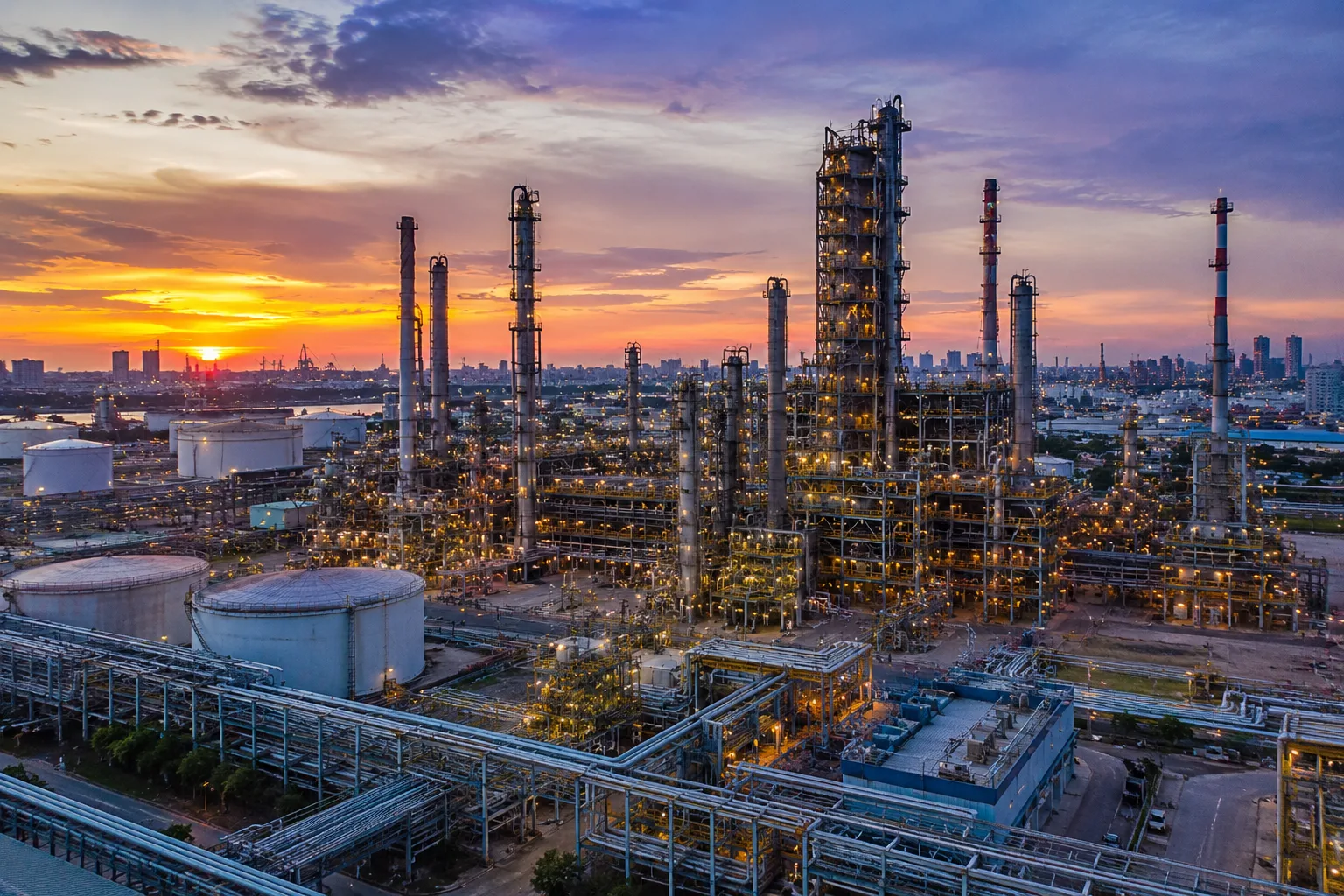
China refining projects face their first major delay since the onset of the energy crisis in the Middle East. Two projects totaling 500,000 barrels per day of new capacity were postponed due to uncertainty over crude oil supply from the Persian Gulf, reflecting the impact that tensions in the Strait of Hormuz already have on industrial investments.
China refining projects halt 500,000 bpd due to Hormuz
Energy Aspects consultancy revised its forecasts for Huajin Aramco Petrochemical Co. (HAPCO): the startup of the Panjin refinery was shifted from the second quarter to September or October 2026, according to sources cited by Reuters.
The project includes a 1.65 million tons per year ethylene cracker and a 2 million tons per year paraxylene unit, making the delay a first-order petrochemical event. To understand the broader impact of the Strait of Hormuz closure on global LNG flows, the analysis on U.S. LNG flows at 2026 lows can be consulted.
PetroChina Dalian: restart postponed with no defined date
The second of the halted China refining projects corresponds to PetroChina, which indefinitely suspended plans to restart the 200,000 bpd unit at its Dalian complex. Reuters noted that PetroChina did not officially confirm the delay, although market sources took it as fact.
Refinery utilization in China fell to 69% in April—the lowest level since August 2022—with a throughput of 13.3 million bpd. Crude imports plummeted 44% between February and May, from 11.39 to 6.36 million bpd, while refineries operated on inventories accumulated before the conflict.
Saudi Aramco refinery China: strategic link under pressure
The delay of the China refining projects does not operate in a vacuum. HAPCO depends on Saudi Aramco for up to 210,000 bpd of feedstock crude under a long-term agreement, a supply that the disruption in the Strait of Hormuz calls into question. Energy Aspects specified that the determining factor is not only price, but “the uncertainty over crude feedstocks” that prevents operators from committing to commissioning schedules.
Brent traded at $97.15 on June 8—a 4.47% gain for the session—accumulating an increase of nearly 60% since late February. The broader geopolitical context can be followed in the analysis on Ksi Lisims LNG and supply to Germany.
China petrochemical investment: startup schedule defines global supply pace
For refining operators, process equipment suppliers, and companies linked to the petrochemical chain, the delay of these projects also implies adjustments in supply contracts, logistics planning, and investment strategies. The evolution of China refining projects will be one of the indicators the market will follow to measure the speed of recovery of Asian industrial capacity.
According to Crux Investor, sector analysts warn that “the key signal for changing market conditions is the startup of delayed refining capacity”, given that even a geopolitical de-escalation requires months of commissioning, crude contracting, and logistics before product reaches the market.
China also faces compressed margins due to elevated feedstock prices and weakened gasoline demand from massive electric vehicle adoption. The delay of these China refining projects—500,000 bpd combined—removes from the global supply equation a volume equivalent to the daily consumption of refineries in a medium-sized country.
Sources
- Reuters, June 8, 2026 — China delays refinery and petrochemical projects amid Middle East supply risks
- OilPrice.com, June 8, 2026 — China Delays 500,000 Bpd Of Refining Capacity As Hormuz Disruptions Deepen
- Crux Investor, June 8, 2026 — Middle East Supply Risks Raise Oil Prices as Chinese Refinery Delays Tighten Fuel Supply