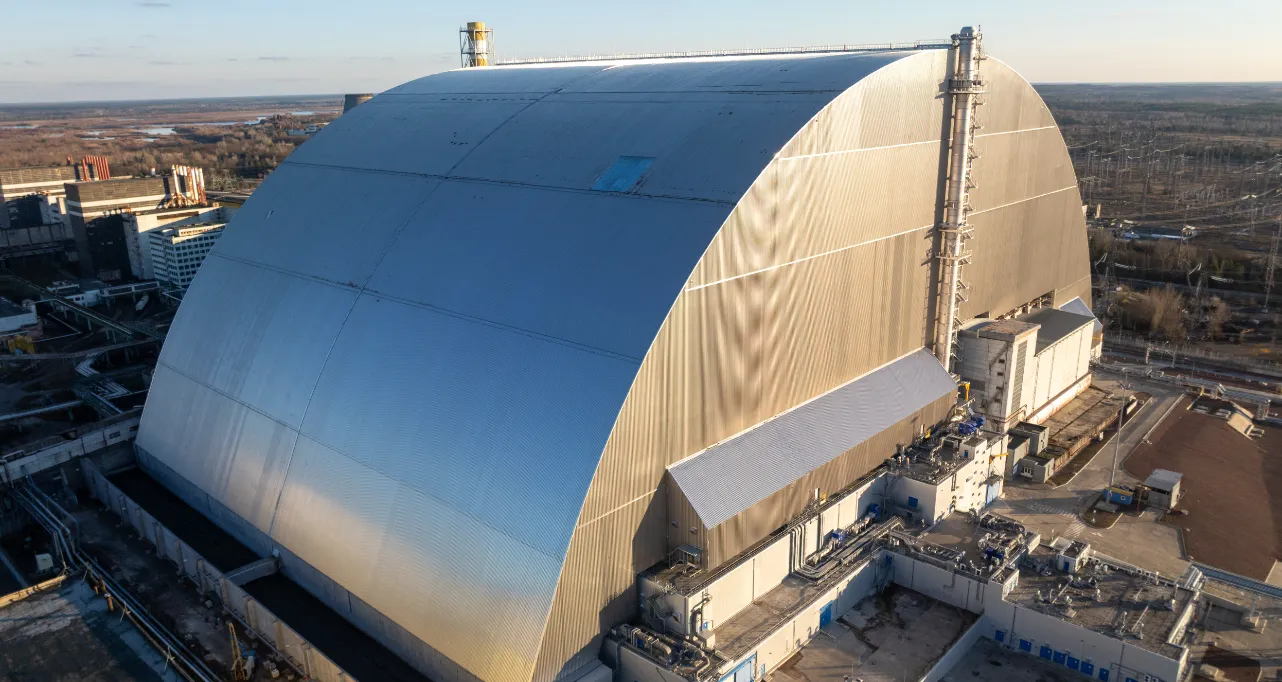
The New Safe Confinement (NSC) at Chernobyl is not just a protective dome. It is a work of nuclear engineering designed for a 100-year lifetime, conceived to contain the radiological hazards of the reactor destroyed in 1986 and sustain its progressive decommissioning for decades.
When a Russian drone attacked it in February 2025, it not only caused a fire: it disabled the active systems that ensure structural longevity.
According to the European Bank for Reconstruction and Development (EBRD), key systems designed to ensure the operational life of the NSC have been rendered inoperative. Without repairs, the main steel structure faces a significant risk of accelerated deterioration and corrosion.
This is not cosmetic damage: it is the degradation of the mechanisms that maintain active radiological containment and allow workers to operate inside for decommissioning.
NSC’s dual mandate: containment and decommissioning
The NSC fulfills two simultaneous functions that are inseparable. The first is radiological containment: isolating from the outside environment the contaminated materials that remain inside the old sarcophagus built as an emergency in 1986.
The second is operational: to provide the technical infrastructure; cranes, ventilation systems, environmental monitoring and humidity control; that allows progress in the long-term dismantling of the destroyed reactor.
The Russian attack severely affected both functions. The loss of the active ventilation and humidity control systems not only compromises the integrity of the structural steel: it also prevents the minimum safety conditions for technical personnel to access the interior.
EBRD: three decades of nuclear leadership at stake
The EBRD has been managing Chernobyl nuclear safety since 1995. In that period it has mobilized more than €2.5 billion in international contributions, mainly from the G7, and has contributed more than €700 million of its own resources to safety and decommissioning projects.
The EBRD currently administers the International Chernobyl Cooperation Account (ICCA), established in 2021 as a follow-on fund to finance risk reduction at the site. The ICCA covers progressive decommissioning, structural stabilization, safety improvements, continuous monitoring and emergency responses.
However, its current endowment is a mere 70 million euros; including recent contributions from France, the United Kingdom and the European Union, a figure far below the 500 million required for NSC repairs.
Odile Renaud-Basso, President of the EBRD
EBRD President Odile Renaud-Basso quantified the damage at least 500 million euros in needed repairs. Her appeal came on the eve of the 40th anniversary of the Soviet nuclear accident, a moment of high international visibility that the EBRD used to urge a coordinated response from the global community before structural deterioration proceeds unchecked.
Source: https://www.ebrd.com/
Photo: Shutterstock