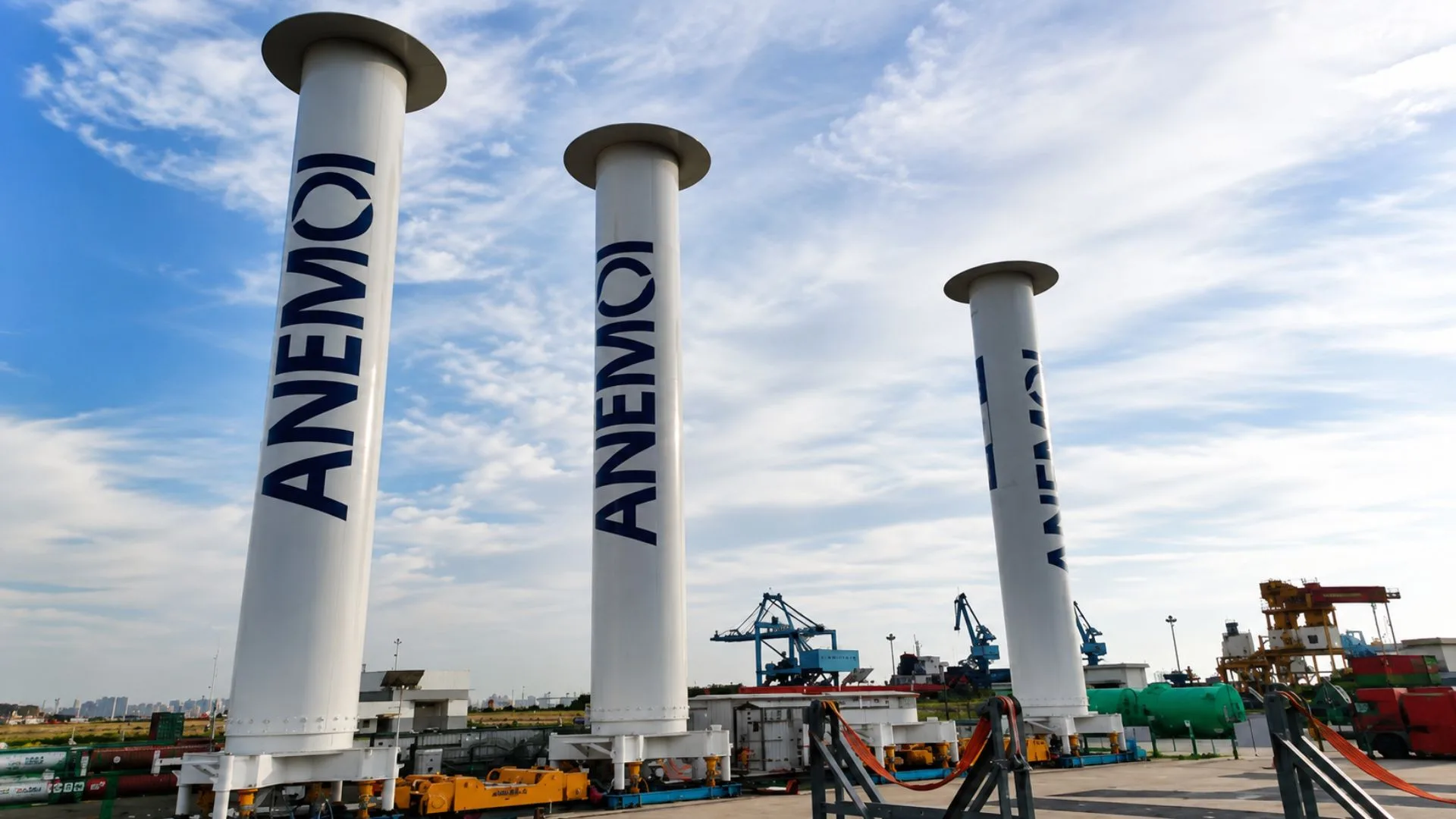
Bureau Veritas certified several versions of Anemoi’s Rotor Sails to facilitate their safe installation on different types of vessels.
The classification society Bureau Veritas has approved several configurations of the wind propulsion technology developed by Anemoi Marine Technologies. The design assessment certificates cover both fixed and rail-mounted models of their Rotor Sail rotating sails.
With this approval, the British company expands the technical support for a solution designed to harness wind power to supplement conventional marine propulsion systems. The technology can help shipowners reduce the strain on engines during navigation and improve the energy efficiency of their vessels.
Bureau Veritas certifies various Rotor Sail models
The assessments include the 3.5-meter diameter and 24.5-meter high Rotor Sails; the certification covers fixed configurations, rail-mounted systems, EX-rated versions, and lower-height units for ships with air draft restrictions.
In addition, Anemoi is processing approvals for its 5-meter diameter and 35-meter high models; these versions can be installed using fixed or foldable configurations depending on the operational needs of the vessel.
The variety of designs allows wind-assisted propulsion to be adapted to different decks, shipping routes, and operating profiles. It also facilitates its use on vessels that need to pass under bridges or access ports with height restrictions.
The classification reduces testing for shipowners
According to Anemoi Marine Technologies, approval by a classification society confirms that a system can be manufactured, installed, and operated under standards recognized by the maritime industry.
This process is important because it reduces some of the verifications and tests that must be repeated for each project. In this way, shipowners can have a clearer technical roadmap for incorporating rotating sails on new vessels or on ships already in service.
Likewise, the design evaluation provides confidence to shipyards, insurers and operators; each of these actors needs to verify that the structure, deployment mechanisms and control systems meet the conditions foreseen for navigation.
Anemoi expands the support for its rotating candles
Clare Urmston, CEO of Anemoi Marine Technologies, said the approvals reflect the company’s technical advancement and larger scale of implementation.
The executive noted that verification by Bureau Veritas and other classification societies helps build trust in the company’s solutions. This endorsement can encourage wider adoption of offshore wind propulsion among ship owners and operators.
Currently, Anemoi’s Rotor Sails range has approvals issued by Bureau Veritas, Lloyd’s Register, DNV, and ClassNK. This coverage strengthens the technology’s market position in a sector seeking to reduce fuel consumption and emissions in maritime transport.
An option to improve naval efficiency
Rotor sails use vertical cylinders that rotate and harness the power of the wind to generate additional thrust. This principle allows for supplemental propulsion without replacing the ship’s engines.
Therefore, the technology can be integrated into energy efficiency strategies along with hull improvements, route optimization, and fuel consumption control systems. Its application depends on the type of vessel, wind conditions, and available deck space.
Bureau Veritas approval eliminates some of the technical uncertainty surrounding each installation, with this endorsement, Anemoi will be able to offer various Rotor Sail configurations based on design criteria recognized by the international maritime industry.
Source and photo: Offshore-energy.biz