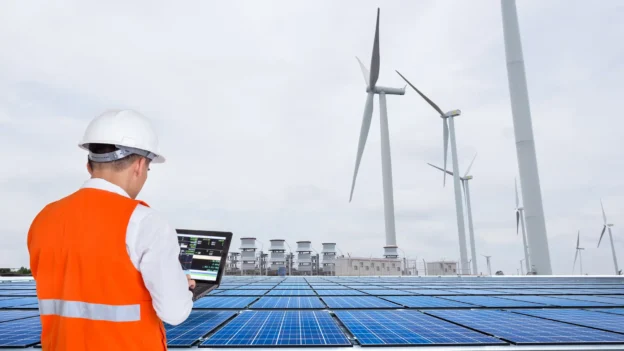
The United Kingdom’s automotive industry increased its on-site renewable electricity generation by 36% during 2025, reaching a record production of 80.4 GWh, according to the latest analysis from the Society of Motor Manufacturers and Traders (SMMT).
The electricity generated is sufficient to supply more than 32,000 homes annually and prevented approximately 14,000 tons of carbon dioxide emissions associated with vehicle manufacturing. The report compiles information from manufacturers responsible for 99.7% of national automobile and commercial vehicle production, as well as from supply chain companies.
In addition to growth in self-generation, more than one-third of the sector’s electricity consumption came from renewable energy supplied by the grid, while plants reused or recycled more than 93% of their industrial waste, consolidating a decarbonization strategy that encompasses both energy production and materials management.
Energy Costs Hinder New Investments in Automotive Industry
Despite these advances, the automotive industry warns that competitiveness remains conditioned by external factors.
Industrial electricity prices in the United Kingdom remain 115% above the European average, a difference that has practically doubled since 2019. Although the British Industrial Competitiveness Scheme could reduce part of these costs for certain companies, the SMMT estimates that British industry will continue paying approximately 60% more than its European competitors.
Added to this situation are delays in electrical grid connections, considered one of the main obstacles to accelerating new investments in electrification and industrial expansion.
Electrification Drives New Industrial Capabilities
The transformation is also reflected in the product offering and in the training of specialized talent.
During 2025, more than 160 zero-emission vehicle models were available in the British market and approximately 470,000 new battery electric vehicle registrations were recorded.
Simultaneously, the number of apprentices and interns grew by nearly 30%, exceeding 6,000 positions, in response to the growing demand for competencies related to electrification, sustainable manufacturing, and circular economy.
Electrical Infrastructure Emerges as the Next Challenge
SMMT Chief Executive Mike Hawes noted that the industry continues investing to reduce emissions throughout the entire vehicle production cycle, but warned that sustainability will depend on having more agile electrical connections, greater availability of low-carbon energy, and competitive rates compared to other European markets.
In this context, the organization proposes accelerating the modernization of the electrical grid, simplifying connection processes, reviewing regulated charges, and advancing toward a pricing system less dependent on the volatility of international gas markets.
Source: https://www.energylivenews.com/