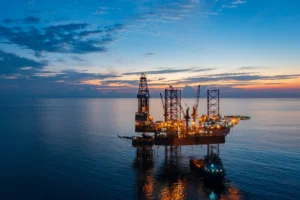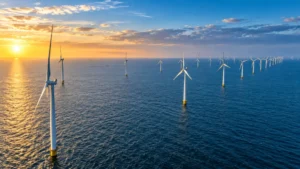
The MOREnergy Lab at the Politecnico di Torino, in collaboration with WindEurope, published a study that identifies the factors needed to accelerate the development of offshore wind energy in the Mediterranean.
The research, published in the journal Renewable and Sustainable Energy Reviews, analyzes the technical, regulatory, and industrial challenges that must be addressed to turn the region’s high wind potential into commercially viable projects aligned with Europe’s energy transition goals.
The study concludes that the sector’s growth will depend not only on technological advances in floating platforms, but also on the existence of stable regulatory frameworks, ready power grids, port infrastructure, established supply chains, and mechanisms that reduce uncertainty for investors.
Floating offshore wind shifts the challenge from the turbine to the industrial system
The Mediterranean has a geographic feature that shapes the development of offshore wind energy: much of its coastline reaches great depths just a few kilometers from shore.
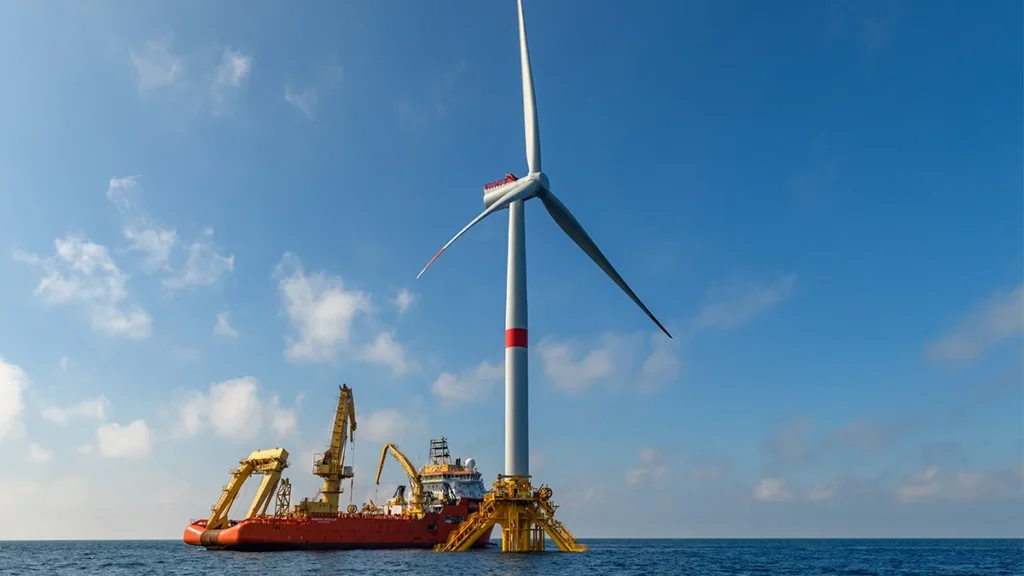
This configuration limits the installation of conventional fixed foundations and makes floating offshore wind the technological alternative with the greatest potential to harness the wind resource.
However, the study notes that the maturity reached by floating platforms has shifted the main challenge from turbine design to the industrial system’s capacity to manufacture, assemble, install, and maintain large-scale projects.
As a result, future competitiveness will increasingly depend on factors such as port capacity, the availability of specialized vessels, the manufacture of large components, and coordination among industrial suppliers.
Electrical infrastructure will determine the pace of expansion
One of the most relevant aspects identified by the research is the role of transmission grids.
Each offshore wind farm requires electrical infrastructure capable of transporting large volumes of energy from sea to consumption centers through offshore substations, high-voltage submarine cables, and reinforcements to the onshore grid.
The availability of these connections directly influences the project’s total cost, development time, and financial risk.
From an electrical engineering perspective, insufficient grid planning can become a bottleneck even when the wind resource, financing, and technology are available.
Therefore, the study proposes that the expansion of offshore generation must be coordinated with the simultaneous development of transmission infrastructure.
Spatial planning reduces technical and social risks
The work also highlights the importance of incorporating environmental and social criteria from the earliest planning stages.
Environmental assessments, continuous monitoring of marine ecosystems, and early engagement with coastal communities, fishing sectors, and maritime operators help reduce conflicts during project execution and improve social acceptance.
For developers, integrated planning reduces delays in permitting processes and facilitates more efficient management of regulatory risk.
Source: https://windeurope.org/