Large photovoltaic parks could lift moist air and encourage cloud formation in desert regions near the Persian Gulf. The possibility of using a solar plant to generate rain is beginning to move from meteorological simulations to field tests.
Researchers at the University of Hohenheim in Germany are studying whether the heat produced by large photovoltaic surfaces can modify air circulation and increase the probability of precipitation in arid zones.
The project has financial support from the United Arab Emirates and will be tested near Dubai. There, scientists will measure how temperature, humidity, and wind change around one of the country’s largest solar complexes.
Heat from solar panels could lift moist air
On the coasts of the Arabian Peninsula, there is moisture coming from the Persian Gulf. However, this air mass usually remains near the surface due to the thermal conditions of the desert. Without sufficient ascent, water vapor hardly reaches colder layers where it can condense.
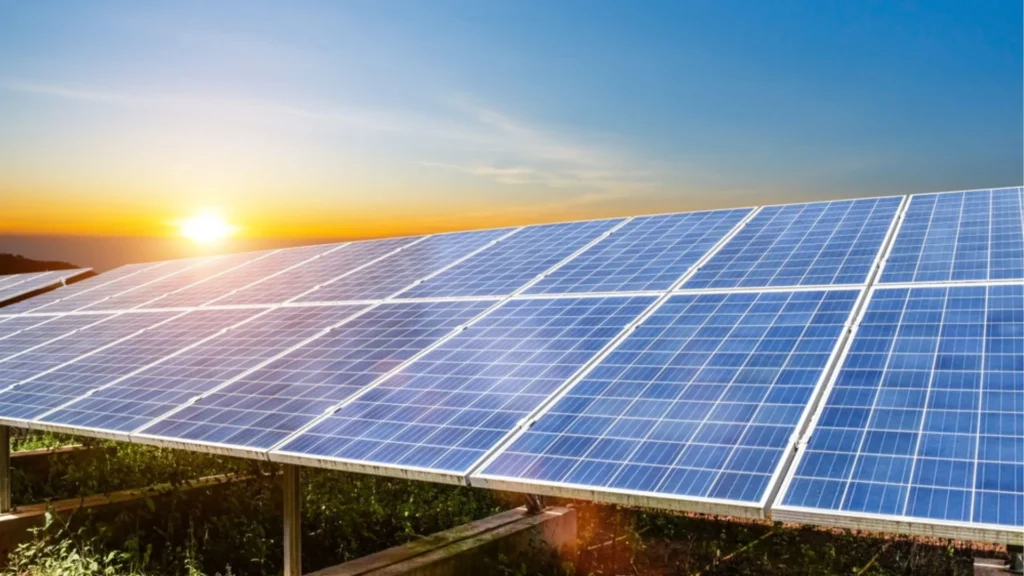
Faced with this scenario, researchers suggest that thousands of solar panels could act as a large hot surface. Photovoltaic modules absorb solar radiation and reach temperatures higher than those of the surrounding sand.
As a consequence, the air near the panels heats up, loses density, and begins to rise. When the photovoltaic surface is extensive, these updrafts can gain strength and transport moisture to higher areas of the atmosphere.
In those layers, the reduction in temperature favors condensation. Under suitable conditions of humidity and atmospheric stability, the process could facilitate cloud formation and increase the possibility of rain.
Simulations point to effects in large-scale parks
Models developed by the German team indicate that the size of the installation will be decisive. A solar park about 20 kilometers wide could begin to alter local weather conditions.
Likewise, a photovoltaic surface 50 kilometers wide would have a much greater effect on air currents. According to simulations, the associated precipitation could provide enough water to cover the needs of more than 100,000 people for a year.
These figures still depend on computer models. Therefore, the next stage seeks to verify if the heating observed over the panels can produce vertical currents with sufficient intensity in a real environment.
Emirates to test hypothesis near Dubai
The UAE Research Program for Rain Enhancement Science selected the proposal from 120 international applications. The initiative will fund three years of experimental research on rain generation and atmospheric behavior.
Measurements will be carried out at the Mohammed bin Rashid Al Maktoum Solar Park, located near Dubai. The facility has several gigawatts of power and continues to expand as one of the main photovoltaic infrastructures in the United Arab Emirates.
To study the air over the park, scientists will install LiDAR equipment. These systems use laser pulses to record three-dimensional profiles of wind, humidity, and temperature from the ground to the layers where clouds can form.
The data will allow for a comparison of atmospheric conditions over the panels with those recorded in nearby desert areas. In this way, the team will be able to determine if the solar park generates a stable convective current or if the effect disappears before reaching the necessary heights.
Artificial dunes could reinforce air ascent
The project also includes a complementary proposal: building artificial dunes several hundred meters high at strategic points in the desert.
These structures would function as orographic barriers. Upon encountering them, moist wind would have to ascend in a similar way to what happens when an air mass hits a mountain.
The combination of dunes and solar panels seeks to combine two mechanisms. While the photovoltaic plant would heat the air from the surface, the elevations would direct moisture toward higher altitudes.
The team will evaluate whether both effects increase condensation and cloud formation. It will also analyze which orientation, height, and location would offer the best results.
Solar energy, water, and agriculture in a single system
In addition to studying rain, the initiative contemplates agricultural uses for the electricity and water available in the environment.
The energy produced by the plant could be used to pump groundwater and sustain crops adapted to the desert climate. Among the species considered is jojoba, a plant resistant to high temperatures and water scarcity.
Vegetation could also reduce the ground temperature around the modules. This cooling would favor the efficiency of the solar panels, whose performance usually decreases when operating at high temperatures.
If the hypothesis is confirmed, a solar plant could fulfill several functions within the same territory: generate electricity, partially modify atmospheric currents, support agricultural production, and contribute to water management.
The test must confirm a still uncertain effect
Although the models show favorable results, researchers must demonstrate that the phenomenon can be reproduced outside of a simulation. Rain formation depends on numerous factors, including available moisture, wind direction, atmospheric stability, and the presence of particles that facilitate condensation.
For this reason, the experiment does not guarantee automatic precipitation every time the temperature rises over the solar plant. Its objective will be to measure the real effect of the installation and establish under what conditions it could influence clouds.
The results will help define the size, location, and design of future photovoltaic parks. They will also allow for determining if this technology can complement other strategies used by the Emirates to face water scarcity.
Source: Energy News
Photo: Shutterstock