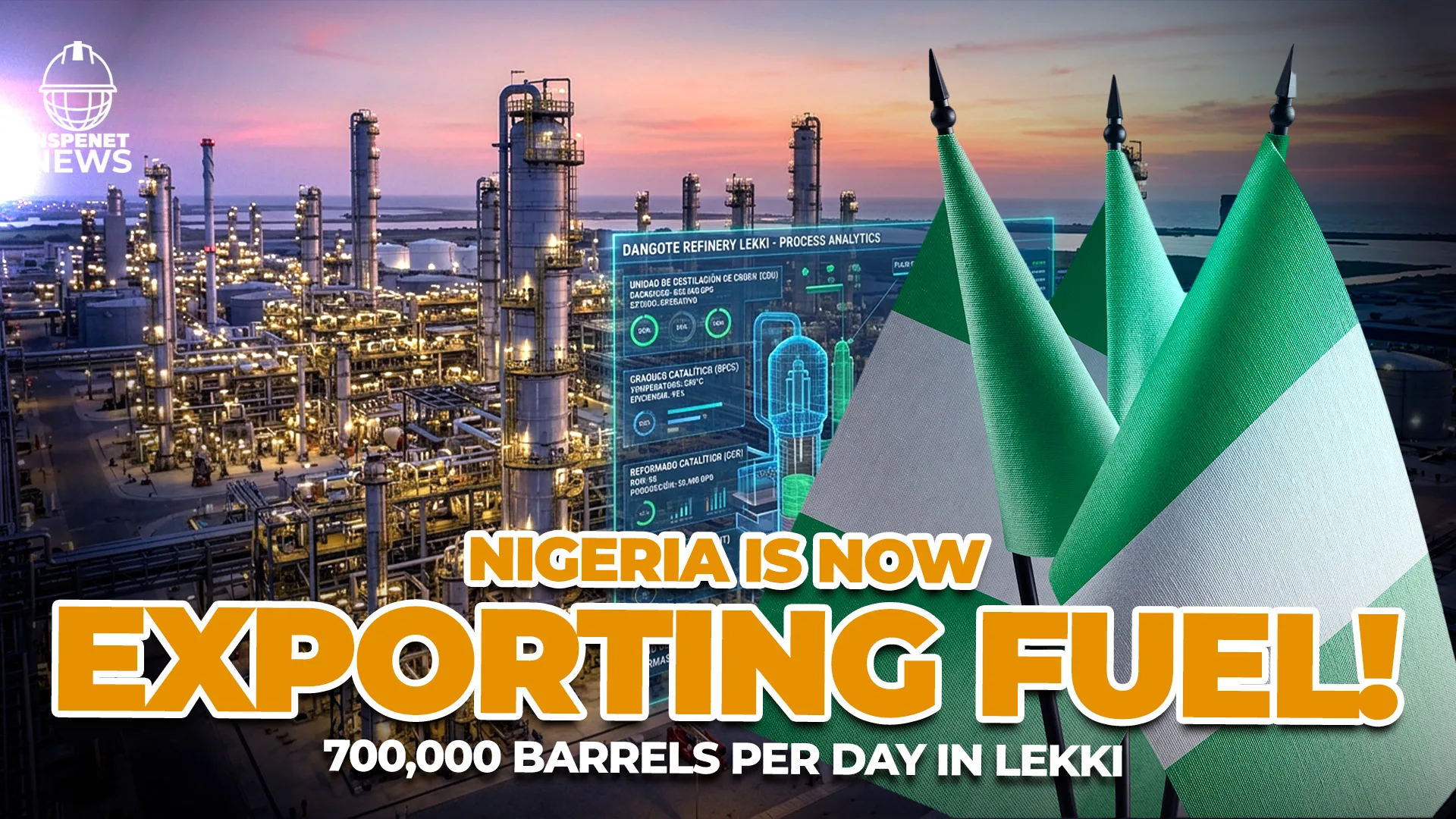
The Dangote Refinery boosts Nigeria’s fuel exports
The Dangote Refinery is transforming Nigeria's petroleum product trade. Since the plant began operating in 2014, the country has significantly increased its fuel exports and reduced its reliance on foreign supplies.
According to Vortexa data cited by the U.S. Energy Information Administration (EIA), Nigerian maritime exports of petroleum products averaged 350,000 barrels per day during the second quarter of 2026. In 2023, the annual average was just 46,000 barrels per day.
This represents an increase of more than seven times in less than three years and shows the effect that the increased refining capacity is having on the country's energy trade.
Furthermore, if product movements between Nigerian ports are included, maritime shipments reached 561,000 barrels per day during the second quarter of 2026. In 2023 they had averaged 79,000 barrels per day.
The Dangote Refinery changes Nigeria's supply
Behind this growth is the Dangote Refinery, located in the Lekki Free Zone near Lagos. The Dangote Group facility began operations in 2024 and has become the largest refinery in the country.
Since then, a larger portion of the crude oil can be transformed within Nigeria into gasoline, diesel, and other refined petroleum products.
This change is relevant for a country that for years maintained high crude oil production while depending on international purchases of processed fuels.
According to the EIA, the increased supply from Dangote allowed for a reduction in imports and an increase in exports. At the same time, Nigeria made progress toward greater capacity to meet its demand for refined products with domestic production.
Imports of petroleum products fall sharply
Furthermore, the transformation can also be observed in imports. Nigeria was buying approximately 400,000 barrels of petroleum products per day from abroad in 2023 .
By the second quarter of 2026, maritime imports had fallen to less than 130,000 barrels per day .
The difference shows how domestic production has gained market share. However, imports still maintain a presence and compete with locally processed fuels.
This scenario allows Nigeria to reduce its exposure to foreign supply while developing a new position as a supplier of refined products to other markets.
Europe receives more refined petroleum products from Nigeria
At the same time, Europe has become one of the main destinations for the increase in Nigerian fuel exports .
Maritime shipments to the European continent reached approximately 130,000 barrels per day in the second quarter of 2026. This figure contrasts sharply with the 40,000 barrels per day recorded in 2025 and the 15,000 barrels per day in 2023.
Therefore, the growth of the Dangote Refinery is having effects that extend far beyond the Nigerian market. Its production is entering international routes that previously had a much smaller share for Nigeria.
This development also expands the country's role in the refined petroleum products trade. Nigeria maintains its importance as a crude oil producer and exporter while developing greater capacity to sell processed fuels.
Fuel exports to Africa are also increasing
Likewise, other African markets are absorbing a growing share of the supply coming from Nigeria.
Maritime exports to Africa approached 120,000 barrels per day during the second quarter of 2026 , compared to 89,000 barrels per day the previous year.
The increase could alter regional fuel flows. Higher Nigerian production offers African buyers another source of refined products and reduces the distance between some of the continent's refining capacity and consumer markets.
In parallel, maritime movements within Nigeria also increased. These shipments reached 211,000 barrels per day during the second quarter of 2026, compared to 81,000 barrels per day in 2025 and 33,000 barrels per day in 2023.
Dangote increases its capacity to 700,000 barrels per day
In addition, shipment growth received another boost during 2026. Following maintenance and expansion work completed in February, the crude distillation capacity of the Dangote Refinery increased from 650,000 to 700,000 barrels per day .
The recovery of operations coincided with supply restrictions related to the Strait of Hormuz, according to the EIA. This context created more opportunities for Nigerian products to reach international markets.
The combination of increased capacity and external demand explains part of the acceleration observed during the second quarter.
With a plant capable of processing hundreds of thousands of barrels each day, Nigeria now has a much larger platform to transform crude oil within its borders and market more processed products.
Nigeria maintains imports despite Dangote's growth
However, the increase in domestic production does not mean that imports have disappeared. Nigeria still receives foreign fuel, and competition between imported products and local production continues.
This situation creates a particular dynamic: the country can import certain fuels while increasing its own exports to other destinations.
Therefore, the growth in exports of oil and refined products must be analyzed in conjunction with changes in the domestic market. Prices, demand, product availability, and trade routes can determine whether a fuel produced in Nigeria is sold domestically or finds better opportunities in foreign markets.
The Dangote Refinery changes Nigeria's oil role
Finally, the growth recorded since 2023 shows a significant change in Nigeria's relationship with the international fuel market.
The country remains a major crude oil producer but now has greater capacity to process it before selling its refined products. This allows Nigeria to retain a larger share of refining activity within its borders and expand its presence in the international trade of finished goods.
The drop in imports from nearly 400,000 barrels per day to less than 130,000 bpd reflects one part of that transformation. The surge in exports to 350,000 barrels per day shows the other.
Europe and Africa are already receiving a growing share of these products. Therefore, the future performance of the Dangote Refinery will have a significant impact on both Nigeria's domestic supply and fuel flows between African and European markets.
News of additional interest
Aggreko seeks to return to the stock market, driven by data centers
Aggreko has filed to list on the New York Stock Exchange under the symbol AGKO, capitalizing on the growing interest in companies capable of meeting the strong demand for electricity. The company has not yet announced how many shares it will offer or its price range. Its business is currently expanding: revenue increased 28% to approximately US$1.92 billion during the six months ending July 4.
Data centers are playing an increasingly important role in this growth, driven by the advancement of artificial intelligence and its high energy consumption. Aggreko's revenue from these facilities nearly doubled to US$391 million in its last fiscal year. Furthermore, the company turned a loss of US$196 million into a profit of US$80 million in continuing operations during the first half of the year and reported US$6 billion in contracted net revenue through July 2026.
TotalEnergies strengthens oil routes outside Hormuz
TotalEnergies plans to invest in two major oil pipelines to reduce its reliance on the Strait of Hormuz. The company will support the expansion of the Habshan-Fujairah system in the United Arab Emirates and participate in a project that would connect Iraq to the Mediterranean via Syria. The company has not yet disclosed how much capital it will allocate or what stake it will hold in each initiative.
The pipeline to Fujairah can transport up to 1.8 million barrels per day from Abu Dhabi to the Gulf of Oman, and authorities are looking to double its capacity. Meanwhile, the route between Iraq and Syria would give Baghdad another outlet for its oil outside the Persian Gulf. This project could require around US$15 billion and at least four years of construction.
Indonesia activates 14 solar projects worth 5.3 GW
Indonesia unveiled 14 solar energy projects with a combined capacity of 5.3 GW and an estimated investment of US$7.62 billion. Two plants are already operational, six are under construction, and six more will be offered to investors. The initiative is part of the government's goal to add 100 GW of solar capacity between 2026 and 2029, a plan that would require approximately US$64 billion.
President Prabowo Subianto's government expects the new power plants to reduce electricity generation costs by approximately 73.9 trillion rupiah annually. Indonesia also aims to decommission 13 GW of diesel-powered plants and replace them with renewable energy sources, with solar power being a key component.
Argentina LNG seeks US$15 billion to move forward
JPMorgan and Santander will lead the search for US$15 billion to finance Argentina LNG , according to Bloomberg. The project, a joint venture between YPF, Italy's Eni, and the UAE's XRG, envisions a total investment of US$24 billion. The partners expect to make a final investment decision in November to move forward with an initial capacity of 12 million tons of LNG per year.
The initiative will utilize gas from Vaca Muerta and will include two floating liquefaction units, two pipelines, and a natural gas liquids (NGL) plant. Capacity could be expanded to 18 million tons per year. Vaca Muerta has estimated reserves of 308 trillion cubic feet of gas and offers Argentina a substantial resource base for developing long-term LNG exports.