Tecnoconsult and engineering for complex EPC projects
Engineering for EPC projects requires much more than bringing together different technical disciplines; when design, procurement, planning and construction advance without common coordination, decisions made at one stage can generate delays, changes and additional costs in the following ones.
Tecnoconsult proposes a model based on multidisciplinary teams integrated from the initial phases through execution. With nearly six decades of experience, the organization combines project leadership from the United States with engineering centers distributed throughout the Americas, seeking to maintain technical continuity, responsiveness, and coordination within time zones compatible with its clients.
Integration versus complex projects
industrial projects generate thousands of interdependent technical decisions. A change in processes can affect piping, equipment, electricity, instrumentation, structures, costs, procurement, and subsequently the construction sequence.
For this reason, one of the greatest risks doesn't necessarily arise from an individual discipline, but from a lack of alignment between them. Integrated engineering seeks to reduce these misalignments by having teams work under common criteria for scope, planning, and document control.
Tecnoconsult summarizes this philosophy with a simple premise: complex projects require a single team from the initial engineering documents to the final execution stages. The goal is to prevent each phase from operating in isolation and to ensure that decisions remain consistent throughout the entire project lifecycle.
From initial studies to detailed design
Early engineering involvement can significantly determine a project's subsequent performance. Before developing detailed drawings, it's essential to validate technical alternatives, site constraints, client requirements, estimates, and design criteria.
Tecnoconsult structures its initial involvement around activities such as visualization, conceptual engineering, feasibility studies, and master plans. These phases allow them to establish a technical foundation before committing larger resources.
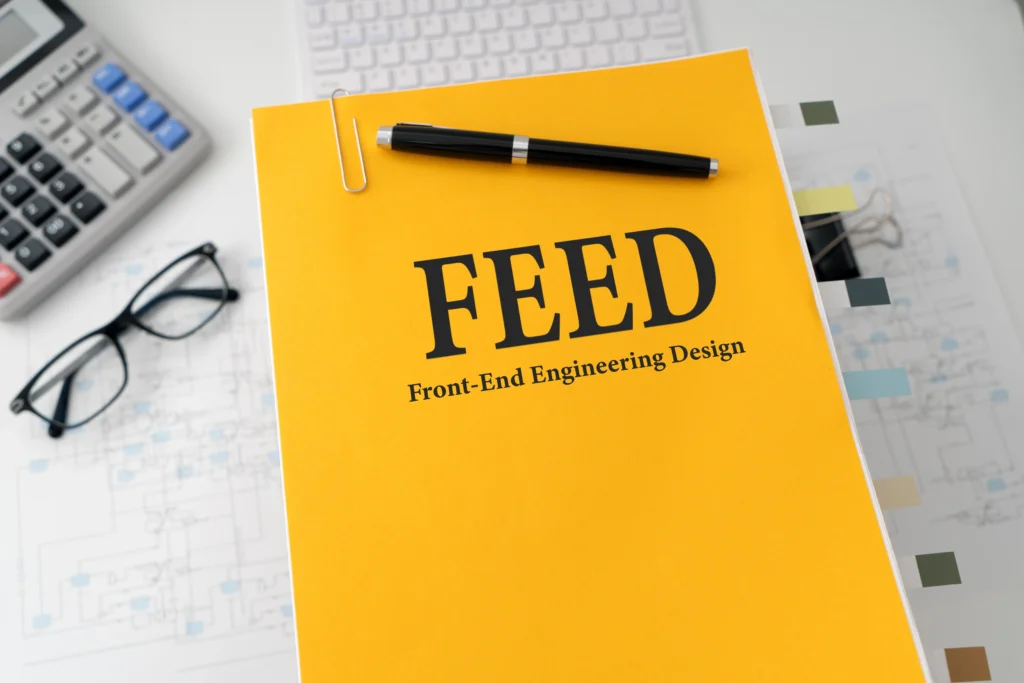
Subsequently, development can progress to Front End Loading (FEL) , Front End Engineering Design (FEED) , detailed engineering, cost estimates, and planning.
This continuity between definition and design is especially relevant in EPC projects, where an incomplete decision during the early stages can later be carried over to purchasing, manufacturing, construction or commissioning.
FEED as a bridge to project execution
The FEED phase fulfills a critical function by transforming general concepts into a sufficiently developed definition to support investment decisions and subsequent engineering stages.
In this phase, technical criteria, specifications, equipment configurations, estimates, schedules, and documentation necessary to reduce uncertainties are consolidated before starting the detailed design.
Within an engineering model for EPC projects, the value of FEED increases when the teams involved in this stage maintain direct communication with those who will continue developing the project.
Thus, the criteria initially established can retain traceability as the number of documents, suppliers, disciplines, and decisions involved increases.
Procurement also begins with engineering.
The acquisition of equipment and materials is not a separate activity from design; incomplete specifications, late supplier evaluations, or inconsistent technical documentation can have significant impacts on the schedule.
Therefore, Tecnoconsult incorporates technical support into procurement during different phases of the process, including the evaluation of bids and the review and approval of supplier documentation.
This participation allows the selection of equipment to consider the requirements defined by engineering and for the documentation supplied by manufacturers to be subsequently integrated into the design.
In capital projects, this coordination is important because long-term manufacturing teams can influence both the engineering and the construction sequence.
Coordinated engineering and construction management
A technically sound engineering design must be adaptable into a buildable structure. This transition requires consideration of accessibility, materials, work sequences, safety, costs, and the actual conditions of the project.
construction management services , including supervision, cost control, materials management and activities related to safety, health and environment.
The involvement of engineering and construction under a coordinated structure makes it easier for field queries, changes, or incompatibilities to be analyzed with knowledge of previously made decisions.
This also reduces the distance between those who design and those who must convert those documents into physical installations.
Nearshore engineering within the same time zone
The international distribution of engineering has allowed numerous organizations to access specialized talent outside their main locations. However, this model can also create challenges when there are large time zone differences between teams.
Tecnoconsult combines project management from the United States with operational centers in Monterrey, Mexico City, Bogotá and Caracas .
A key feature of this structure is that the teams operate within the time zones of Eastern and Central America. This allows for work schedules to largely coincide with those of client teams in the United States and other markets in the Americas.
From an execution perspective, the nearshore model seeks to combine distributed engineering capacity with technical interaction during the same workday, preventing each query from requiring additional 24-hour cycles.
More than 4,500 projects of accumulated experience
The experience of an engineering organization is not measured solely by its years of existence, but also by the volume and diversity of technical decisions accumulated during that period.
Tecnoconsult began operations in Venezuela in 1967 and later evolved into an international organization headquartered in the United States.
According to its corporate data, the company has participated in more than 4,500 projects . The transcript provided by the company also places its accumulated experience at over 42 million man-hours of engineering .
This career path incorporates work developed in some of the most demanding industrial environments and project experience in America and other international regions.
The accumulated knowledge can be especially relevant when teams face configurations, constraints, or problems that already have technical precedents within the organization.
Quality as part of the execution system
In industrial projects, quality cannot be limited to the final inspection of documents; it must be part of the way in which deliverables are generated, verified, approved, and controlled throughout the execution.
According to corporate information, Tecnoconsult has maintained a formal quality management system for approximately three decades and has developed its structure on the principles of ISO 9001 since the 1990s.
This involves establishing procedures that allow for consistent criteria across disciplines, offices, and different stages of the project.
In organizations with multiple engineering centers, a common system is particularly important because it allows teams located in different countries to work under homogeneous rules for review, control and delivery of information.
Compliance for regulated industrial environments
Large industrial projects are also exposed to risks that go beyond purely technical variables.
Contracting, supplier relations, procurement, international operations, and third-party management require appropriate compliance mechanisms for organizations that operate in different jurisdictions.
Tecnoconsult states that its operations are subject to a corporate code of conduct and compliance. The company also notes its alignment with the U.S. Foreign Corrupt Practices Act (FCPA) .
This dimension is relevant for clients who need to integrate the technical requirements of the project with corporate policies, internal controls, and regulatory obligations.
Safety, health and environment during execution
Industrial project management also incorporates risks related to people, facilities, and the environment.
Tecnoconsult establishes as a principle a goal of zero accidents and directs its policies towards the prevention of occupational risks, environmental impacts and damage to equipment and facilities.
The company also links this management to the operational continuity of the project. A security incident can simultaneously affect people, planning, costs, and execution.
Therefore, safety, health and environment are part of the general management system and not only of the activities carried out directly on site.
What does an integrated model bring to an EPC project?
Engineering integration does not eliminate the complexity of large projects; however, it can help to better manage dependencies between disciplines and stages.
When conceptualization, FEED, detailed engineering, procurement support, and construction management maintain continuity, information can advance with less fragmentation among the various participants.
Tecnoconsult's approach is based precisely on that continuity: combining project leadership from the United States, multidisciplinary capacity distributed throughout America, and experience accumulated over almost six decades.
For EPC projects, this approach makes the coordination between people, documentation, and decisions as important a part of the execution as the technical development itself.
Integration to reduce project friction
Complex industrial projects rarely fail because of a single decision; more often, problems arise when small deviations between disciplines, suppliers, and phases begin to accumulate.
An engineering model for EPC projects that is integrated from early definition to construction can reduce these interfaces and make it easier for decisions to maintain continuity throughout the project lifecycle.
With experience since 1967, more than 4,500 projects developed and a structure distributed between the United States and engineering centers in America, Tecnoconsult positions technical integration, quality and coordination as central elements of its execution model.