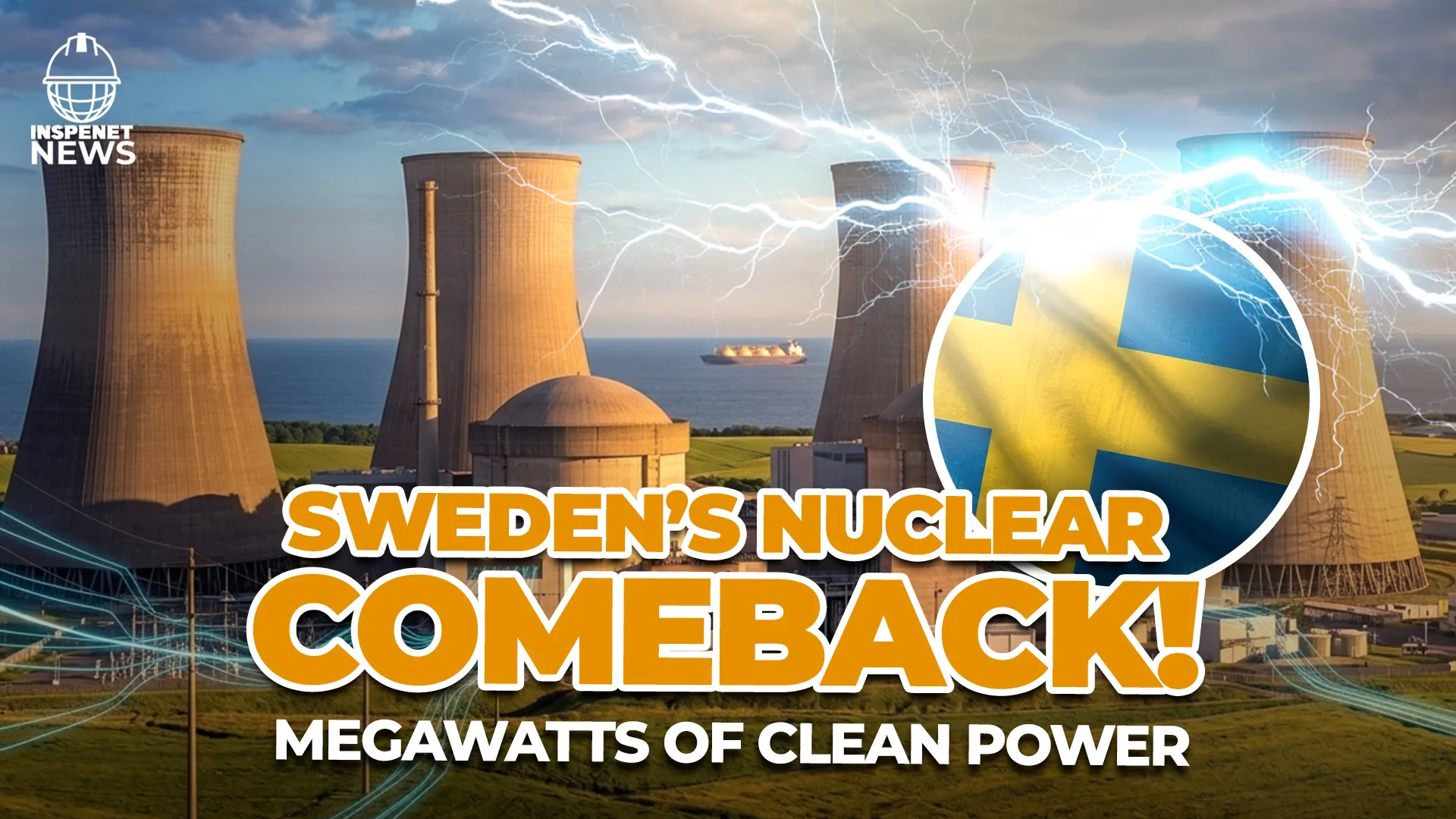
Studsvik requests up to 1,400 MW of nuclear power in Nyköping
The Swedish company Studsvik has taken another step in the country's energy expansion plans by applying for authorization to develop between 600 and 1,400 MW of new nuclear capacity in Nyköping. The initiative is part of the national strategy to strengthen the electricity supply in the face of growing industrial demand and the ongoing electrification of the grid.
Studsvik requests expansion of nuclear capacity in Sweden
Studsvik AB recently submitted a formal application to the Swedish government to assess the construction of new nuclear infrastructure around its historic Nyköping site. The proposal envisions a generating capacity of between 600 and 1,400 MW and could become one of the country's most significant energy projects over the next decade.
Furthermore, the company anticipates that the first reactors will become operational during the 2030s, provided the project successfully completes the regulatory and environmental procedures required by the Swedish authorities.
The nuclear project is part of the ReFirm SMR program.
Furthermore, the initiative is part of the ReFirm SMR program, a portfolio of developments focused on small modular reactors that Studsvik incorporated after acquiring Kärnfull earlier this year.
Currently, the program also includes projects in locations such as Valdemarsvik, Motala, and Karlshamn. The application submitted in Nyköping represents the group's second major move in new nuclear energy during 2026 and strengthens the company's position within the growing European SMR market.
According to Karl Thedéen, president and CEO of Studsvik, the combination of decades of accumulated technical expertise and the availability of a well-established nuclear site offers favorable conditions for contributing to the future Swedish electricity system.
Sweden seeks to respond to increased electricity demand
Meanwhile, Sweden is facing a profound transformation of its energy matrix, which is why the electrification of industries such as steel, chemicals and transport is constantly increasing the need for electricity supply.
This is compounded by the expansion of data centers , a sector that demands large volumes of stable energy to ensure its operation. At the same time, part of Sweden's current nuclear fleet is gradually approaching the end of its operational life, necessitating the planning of new baseload power generation sources.
With that objective, the Swedish Government has launched financing mechanisms valued at approximately 220 billion Swedish kronor to support the deployment of nearly 5,000 MW of new nuclear capacity over the next few years.
Nyköping gains weight in Sweden's energy plans
Furthermore, the chosen location offers several advantages for the development of new energy infrastructure. Nyköping is located within the SE3 price zone, where a significant portion of the country's electricity demand is concentrated and where supply needs continue to grow.
The Studsvik site has access to transport connections, proximity to major industrial consumers and a long history linked to research on reactors, fuels and nuclear materials.
For decades, the complex has provided specialized services to operators and regulatory bodies in various international markets, becoming one of Sweden's most renowned nuclear environments.
The project will have to pass through an extensive regulatory process
However, the application submitted is only the first stage of a procedure that could extend over several years.
From now on, the project will be evaluated by the Swedish government, the municipality of Nyköping, the Swedish Land and Environmental Court, and the Swedish Radiation Safety Authority. Each of these bodies will analyze aspects related to safety, environmental impact, and land-use planning.
According to Studsvik, the next step will be to develop technical and environmental studies along with community dialogue processes to generate consensus around the initiative.
Studsvik strengthens its role in Sweden's nuclear expansion
Finally, the proposal has special significance for the company itself. Studsvik was founded in 1947 as AB Atomenergi with the purpose of contributing to the development of Sweden's nuclear capabilities .
After decades dedicated to research, fuel analysis, and technological services for industry, the company now aims to participate directly in the construction of new commercial nuclear capacity. If the project progresses as planned, Nyköping could become the first site where Studsvik produces nuclear power on a commercial scale within its own infrastructure.
News of additional interest
France tests its bet on wave energy at sea
Seaturns has launched its first full-scale wave energy demonstrator off the French Atlantic coast . The installation marks the start of an offshore testing campaign that will last at least a year and aims to verify the technology's performance and reliability under real-world conditions. The project is the culmination of more than a decade of research and progressive testing conducted in collaboration with European research centers and universities.
The system is located 27.5 kilometers from the port of Le Verdon and will operate autonomously while collecting data on energy production and the floating platform's performance. The information gathered will support the certification process planned for 2027 and prepare for future commercial developments, including a 2 MW pilot project in Mauritius with the goal of scaling up to larger-capacity installations.
Greenland Energy accelerates its oil plan in Greenland
oil exploration strategy in the Jameson Land Basin of eastern Greenland, following its recent listing on the Nasdaq. The company secured approximately $70 million in financing and signed agreements with industry partners such as Halliburton and Stampede Drilling to support activities planned for its 2026 exploration campaign.
Over the past few months, the company has been working on the logistical and operational preparations for the project, including permits to move heavy machinery, the acquisition of materials, and infrastructure planning. Its goal is to begin drilling two exploratory wells in October 2026 to assess the potential of an area considered one of the world's least developed energy frontiers.
The biggest cement decarbonization plan is gaining momentum
The MNZ Peak Cluster project has reached a new regulatory milestone, advancing in the process that will allow the storage of carbon dioxide in former Morecambe gas fields, located in the Irish Sea. Spirit Energy confirmed that the initiative has entered the carbon storage license assessment phase, a fundamental requirement for converting these depleted fields into a facility capable of permanently storing industrial emissions.
The infrastructure is designed to transport up to three million tons of CO₂ per year from cement and lime plants in Derbyshire and Staffordshire. Over the past few years, technical teams have conducted geological and seismic surveys to assess the capacity of the reservoirs, which could store nearly one billion tons of carbon dioxide. The project also includes plans to repurpose existing energy infrastructure once gas production in the area ceases.
EnQuest makes a big bet on Malaysia with a multi-million dollar purchase
EnQuest announced an agreement to acquire stakes in four production-sharing contracts in Malaysian waters for up to $833 million. The transaction, which is still subject to regulatory approvals and conditions, would significantly strengthen the company's presence in Southeast Asia, a region where it already operates and maintains a strong relationship with local energy authorities.
If the transaction is completed, the group's production would exceed 100,000 barrels of oil equivalent per day, more than double the levels recorded by the company in 2025. Furthermore, reserves would increase by approximately 85%, and a significant portion of the acquired assets would be directly operated by EnQuest. The company also highlights that the new fields offer competitive operating costs and additional potential for increased resource recovery through future technical improvements.