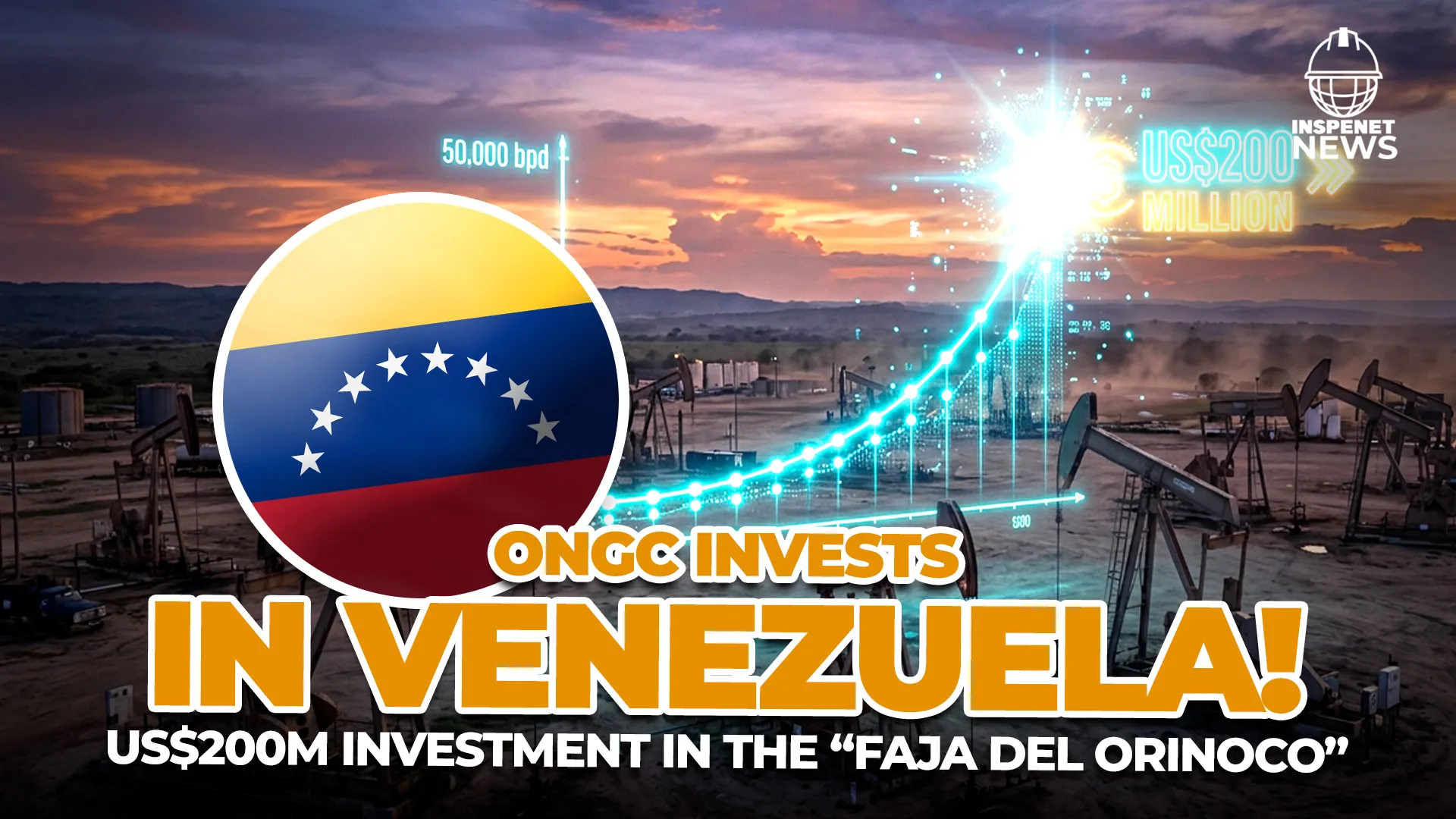
ONGC in Venezuela aims to increase its oil production tenfold
ONGC in Venezuela is preparing an investment of around US$200 million to reactivate the San Cristóbal oil field. The project is operated jointly with PDVSA and currently produces between 4,000 and 5,000 barrels per day (bpd).
According to available information, the investment would be carried out over the next 12 months, with the goal of progressively recovering the capacity of the field and bringing its production closer to levels recorded years ago.
In addition, ONGC Videsh Limited (OVL) , the international subsidiary of the Indian state oil company, owns a 40% stake in San Cristóbal. The remaining 60% belongs to PDVSA.
The plan still depends on an agreement between both companies; ONGC and the Venezuelan state-owned company must finalize the investment program that will establish how the work in the field will be carried out.
San Cristóbal aims to recover a production of 50,000 bpd
Currently, San Cristóbal extracts between 4,000 and 5,000 bpd , ONGC intends to raise that figure to around 50,000 bpd during the next few years.
Therefore, achieving that goal would mean multiplying the current volume by approximately ten if the upper limit of 5,000 bpd is taken as a reference.
The 50,000 barrels per day figure is not an unfamiliar level for San Cristóbal; the field previously produced around that volume before its activity declined due to factors such as US sanctions, management problems, and years of low investment.
If the plan materializes, the project would go through a period of gradual recovery; the US$200 million planned over the next 12 months would serve to develop that process, although reaching the final goal would require several years.
ONGC would also assume PDVSA's share of the investment
Furthermore, the planned financial structure has a particular component: ONGC would cover both its contribution and PDVSA's share with the US$200 million.
Subsequently, the Indian company would recover the resources allocated to cover the Venezuelan state-owned company's participation through future production from San Cristóbal .
This mechanism would allow progress on oil investment in Venezuela without PDVSA having to immediately contribute the entire amount corresponding to its 60% share.
However, the plan still needs to be formalized in the investment agreement between the two companies. The parties are close to finalizing that plan, according to sources cited by the Economic Times.
The US license allows the project to move forward.
Furthermore, the reactivation is related to the authorization received by ONGC from the United States Office of Foreign Assets Control (OFAC) .
The Indian oil company obtained a license in early August allowing it to return to Venezuela. US restrictions had limited its activities related to the country's oil projects for years.
With this authorization, ONGC has room to resume the development of its Venezuelan assets within the conditions established by the United States.
This scenario explains why the company is again considering a larger-scale investment in San Cristóbal after a period marked by much more limited activity.
ONGC maintains oil interests beyond San Cristóbal
Furthermore, ONGC's presence in Venezuela is not limited to the San Cristóbal field; the company also holds an approximately 11% stake in the Carabobo project .
However, San Cristóbal is now the focus of attention due to the plan to revive its production. The combination of the US license, the pending agreement with PDVSA, and the planned US$200 million investment opens the possibility of significantly increasing the field's output.
For ONGC, the project means recovering activity in a market where it already has assets; for PDVSA, the disbursement from its partner would allow it to mobilize resources destined for a field whose current production remains well below its previous peak.
What would the increase in production mean for San Cristóbal?
Ultimately, the outcome will depend on the execution of the program and on maintaining the necessary conditions for operation over the next few years.
If San Cristóbal goes from a current maximum of around 5,000 bpd to 50,000 bpd , the field could add around 45,000 barrels per day compared to that reference level.
The target also shows the extent of the existing recovery margin; San Cristóbal had previously reached 50,000 bpd, so ONGC is looking to recover a capacity that the asset demonstrated before its decline.
Now, the next step will be to finalize the investment plan with PDVSA. Based on that agreement, the planned US$200 million can be used to increase oil production and gradually return the San Cristóbal field to its previous levels.
News of additional interest
Thailand steps on the gas with clean energy
Thailand wants to reduce its heavy reliance on imported natural gas amid tensions in the Middle East. The country gets more than 60% of its electricity from gas and is Southeast Asia's largest LNG buyer. The situation in the Strait of Hormuz and reduced exports from Qatar have heightened concerns about security of supply and energy costs.
The government will present an energy plan for the next 25 years in October. The proposal aims to increase the use of solar, wind, and hydroelectric power sources, with the goal of covering 60% of electricity generation by 2050. It also includes the incorporation of small modular nuclear reactors for the first time. This strategy comes as data centers and advanced manufacturing drive increased electricity demand.
The Netherlands brings its new reactors closer to reality
The Netherlands is moving forward with preparations for two new large nuclear power plants. The state-owned company NEO NL has contracted EDF and Westinghouse to study how their reactors can be adapted to meet the country's standards. The analyses will begin in late 2026 and could last between 12 and 18 months. They will also review technical requirements, permits, construction timelines, and potential risks before work begins.
The process will be divided into two phases to avoid delays while the government decides where to locate the plants. First, aspects that are not dependent on a specific location will be analyzed. Then, the conditions of the chosen site will be studied. EDF is participating with its EPR reactor and Westinghouse with the AP1000. Both companies had been previously evaluated along with the South Korean company KHNP, which ultimately withdrew from the process. The final supplier will be selected later through a bidding process.
India puts a stop to foreign reactors
nuclear capacity almost tenfold to 100 GW over the next two decades, a goal that would require approximately US$210 billion in investment. After opening the sector to private companies, the country hoped to attract foreign capital and technology. However, a new draft regulation could complicate these plans by requiring more approvals for the installation of foreign reactors.
The proposal requires that imported equipment have operating licenses and certifications in its country of origin. Furthermore, the Indian regulator must approve each design before construction can proceed. These conditions could particularly affect small modular reactors, as many designs are still in the early stages of commercial development. Companies such as Rosatom, EDF, and GE Hitachi have held talks with the government, while Indian groups like Tata Power, Adani Power, and Reliance Industries are evaluating opportunities in the sector.
Singapore is stockpiling more fuel in its reserves
petroleum product inventories rose 4% in one week to 39.18 million barrels as of August 26, their highest level in three weeks. The increase was seen across the major fuel categories. Fuel oil stocks reached 19.24 million barrels after growing 4.4%, as the market anticipates increased international shipments, which are already putting downward pressure on spot prices.
Diesel and jet fuel stocks approached 8.5 million barrels. At the same time, light distillates stocks exceeded 11.5 million barrels. Singapore received gasoline primarily from China, South Korea, and Taiwan, while Indonesia and Malaysia were among the top export destinations. For diesel and gas oil, net exports increased sharply despite limited imports.