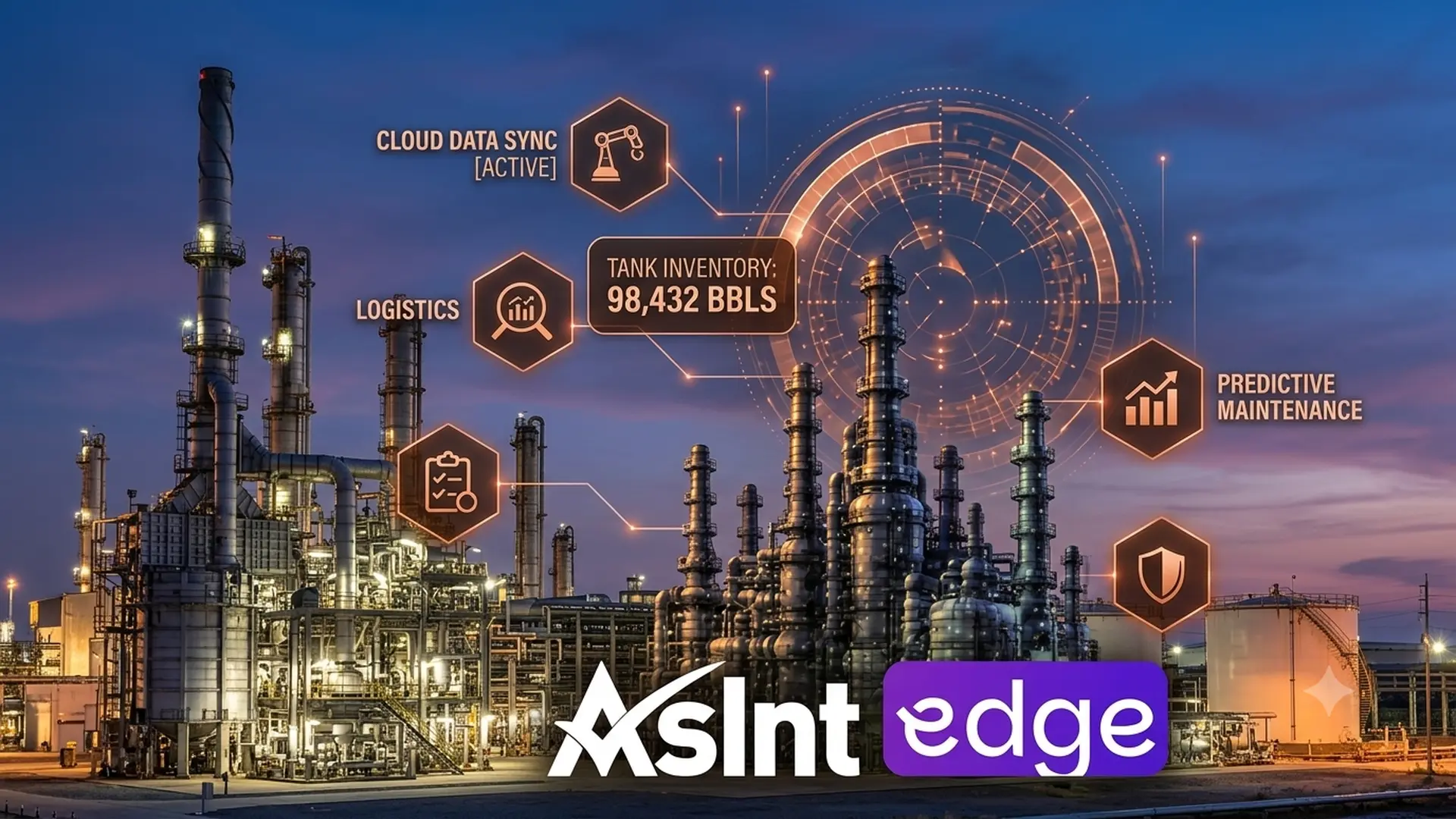
Asset integrity is one of the most critical disciplines in industrial operations. Yet much of the engineering behind it still relies on paper records, spreadsheets, and institutional knowledge.
Inspection findings often remain buried in PDFs and email inboxes. Thickness readings are collected without the operational context needed to make them meaningful. At the same time, Fitness-for-Service (FFS) evaluations, among the most critical decisions in integrity engineering, are frequently performed using spreadsheets that are difficult to audit and maintain.
AsInt Edge was developed to transform this reality. It is a cloud-based Asset Integrity Management (AIM) platform that brings API-grade engineering into a single, asset-centric foundation. The platform makes the same engineering rigor used by major industrial operators accessible to organizations of every size.
A unified platform for asset integrity management
Developed by AsInt, Inc., a Houston-based engineering software company serving the oil and gas, petrochemical, chemical, and refining industries, AsInt Edge extends more than a decade of enterprise asset integrity experience beyond the SAP ecosystem.
While AsInt’s established software suite runs natively on SAP Business Technology Platform (SAP BTP), AsInt Edge expands how and where that engineering intelligence can be deployed without compromising its technical depth.
Learn how AsInt Edge works and how it centralizes asset integrity management on a cloud-based platform.
Platform vision and objectives
The vision behind AsInt Edge is simple to state and demanding to deliver: one equipment record supporting every integrity application.
Rather than relying on disconnected point solutions, AsInt Edge brings inspection, corrosion monitoring, risk assessment, and Fitness-for-Service (FFS) together within a shared, asset-centric hierarchy.
This approach allows engineers to spend their time on technical judgment rather than reconciling data across multiple systems.
Its guiding objective is accessibility without compromise.
AsInt Edge is designed so that an independent consulting engineer and a global operator can work on the same platform, using the same encoded standards and the same defensible audit trail. The engineering depth remains constant. Only the scale changes.
Platform flexibility and scalability
Tier 1: provides a shared multi-tenant environment with headcount-based pricing, making it ideal for small consultancies and independent engineers.
Tier 2: introduces dedicated schemas within shared infrastructure.
Tier 3: provides a dedicated deployment environment.
Tier 4: allows customers to select the geographic region that satisfies their data residency requirements.
Tier 5: adds Bring Your Own Key (BYOK) encryption and, for organizations with the highest security requirements, a fully air-gapped deployment.
- Same platform.
- Same workflows.
- Same engineering standards.
Five deployment models that allow organizations to scale without ever having to replatform their teams.
By making enterprise-grade engineering accessible to organizations of every size, AsInt Edge democratizes capabilities that have traditionally been limited to costly, multi-year enterprise implementations.
Organizations can adopt integrity engineering one application at a time and expand their programs as operational needs evolve.
Key features and capabilities of AsInt Edge
At the core of AsInt Edge is the Asset-Centric Workbench, a unified workspace where projects are organized around an asset, a process unit, a plant turnaround, or an inspection campaign.
From this environment, engineers can activate the applications required for each project and access a contextual view that integrates inspection findings, thickness measurements, risk assessments, and Fitness-for-Service (FFS) results for the same equipment. This approach eliminates the need to export information or switch between different applications, enabling users to work with all relevant data within a single environment.
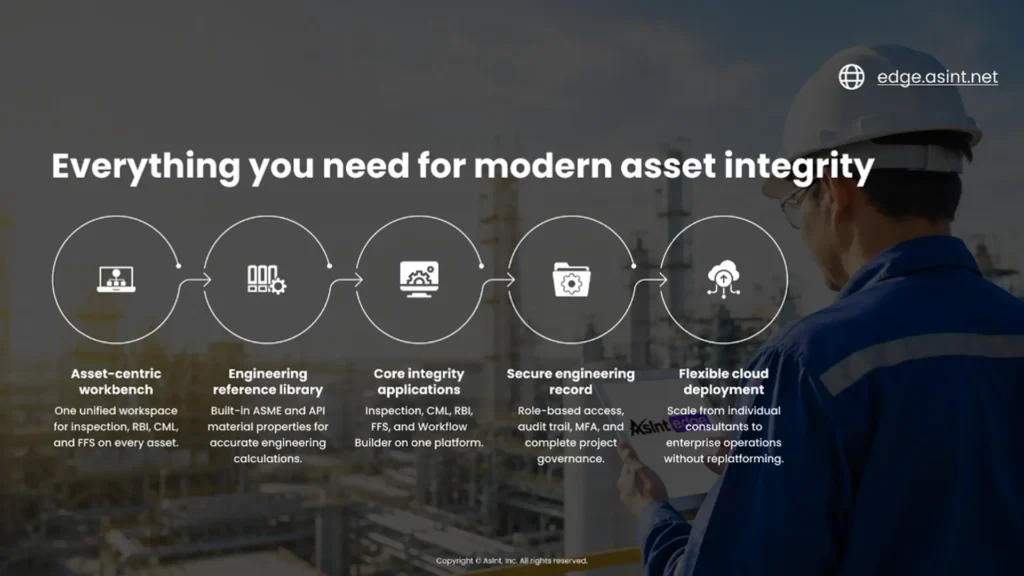
A governed Material Properties reference library, aligned with ASME Section II-D, ASME Section VIII, and API 579, feeds allowable stress, yield strength, tensile strength, and temperature-dependent properties directly into engineering calculations.
Instead of manually transcribing values, engineers retrieve data from a curated, standards-based reference source, improving both consistency and traceability.
Five engineering applications operate on this common foundation:
- Asset Inspection, which provides configurable workflows aligned with API 510, API 570, and API 653 standards, enabling inspections to be managed from planning through the closure of findings, with support for documents, annotations, and a complete audit history.
- CML (Corrosion Monitoring Location Management), designed to manage corrosion monitoring locations, record thickness measurements, calculate short- and long-term corrosion rates, and estimate the remaining service life of equipment based on minimum allowable thickness values.
- RBI (Risk-Based Inspection), which incorporates a configurable engine capable of executing qualitative, semi-quantitative, and quantitative methodologies, complemented by a damage mechanism library aligned with API 571.
- Fitness-for-Service (FFS), focused on developing assessments in accordance with API 579-1 / ASME FFS-1, including both Level 1 and Level 2 evaluations, for mechanisms such as brittle fracture, general metal loss, localized thinning, and crack-like flaws. Its functionalities include the automatic generation of color-coded thickness maps from a single data upload.
- Workflow Builder, a tool that enables organizations to design and configure customized processes to address specific requirements that exceed the scope of technical standards.
In addition to these applications, all AsInt Edge implementations include cross-functional capabilities such as collaborative workspaces, role-based access control, project-based organization, and multi-factor authentication.
The platform also incorporates a cryptographic audit trail capable of recording every action performed by users, as well as interactions between the different applications.
The result is an engineering record system designed to provide traceability and documentary support throughout the entire asset lifecycle.
Operational benefits of AsInt Edge
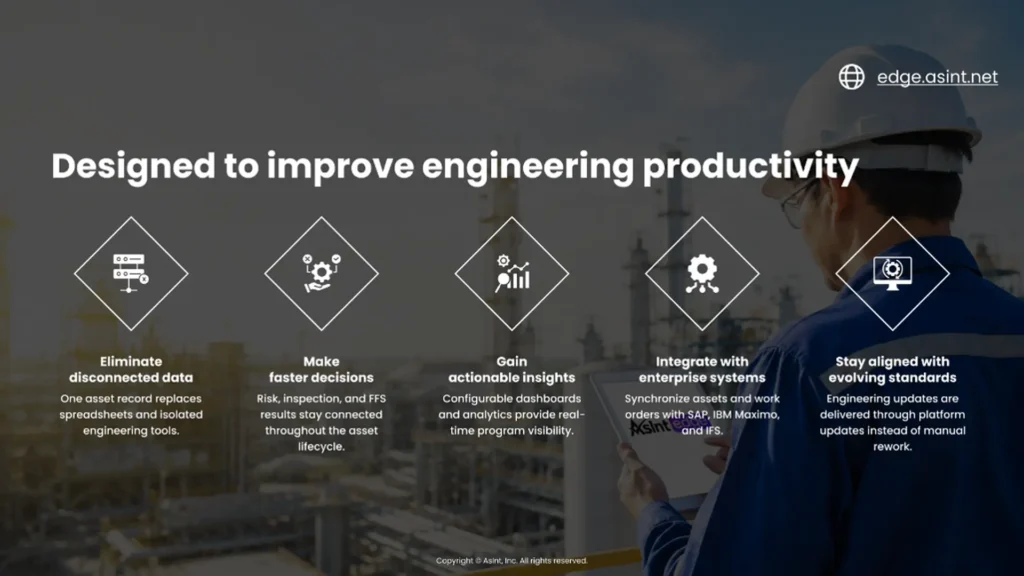
Because every application writes to the same asset record, engineers no longer spend hours reconciling data across disconnected point solutions.
Configurable analytics, including findings by damage mechanism, severity distributions, and custom dashboards, are generated automatically, giving integrity leaders actionable insights without manual data consolidation.
At the same time, a configurable Risk-Based Inspection (RBI) engine feeds inspection frequency, techniques, and inspection scope directly into inspection workflows, creating a seamless connection between risk assessment and execution.
Integrated engineering intelligence
By sharing a common asset record, every engineering application works with the same validated information.
Inspection findings, corrosion data, risk assessments, and Fitness-for-Service (FFS) evaluations remain connected throughout the integrity program, improving consistency while reducing duplicate work.
This integrated approach allows engineers to focus on technical decisions instead of managing disconnected datasets.
Enterprise system integration
AsInt Edge is designed to coexist with existing enterprise systems rather than replace them.
Native connectors synchronize equipment hierarchies and work orders with SAP, IBM Maximo, IFS, and other ERP and maintenance platforms.
This allows engineering intelligence to reside within AsInt Edge, while enterprise transactions continue to be managed in the systems organizations already rely on.
As industry standards evolve, updates issued by American Petroleum Institute (API) committees can be implemented through platform version updates instead of costly reimplementation projects.
Scalable commercial model
The platform’s commercial model reflects the same flexibility as its engineering architecture.
AsInt Edge is offered as a subscription service with headcount-based pricing, allowing organizations to move between deployment tiers as their operational requirements evolve.
A consultancy can scale from Tier 1 to Tier 3 after securing enterprise customers, while a specific client deployment can move from Tier 3 to Tier 5 when Bring Your Own Key (BYOK) encryption or higher security requirements become necessary.
These are configuration changes—not replatforming projects.
- The engineering remains the same.
- The workflows remain the same.
- Only the deployment model changes.
Industrial applications of AsInt Edge
AsInt Edge is built for asset-intensive industries, including oil and gas, petrochemical, chemical, pharmaceutical, and fast-moving consumer goods (FMCG).
In these sectors, mechanical integrity and structural integrity are essential to ensuring both operational safety and asset availability.
The platform supports the full range of fixed equipment managed within an integrity program.
This includes pressure vessels, piping systems and circuits, above-ground storage tanks, heat exchangers, and the structural assets that support them.
Whether an organization manages a single refinery unit or multiple facilities across different locations, AsInt Edge applies the same encoded engineering standards consistently throughout the operation.
Standards including API 510, API 570, API 653, API 579, and API 580/581 are implemented uniformly, providing consistency across inspection, assessment, and integrity management activities.
Use cases
AsInt Edge supports a wide range of real-world asset integrity workflows, enabling engineering teams to manage inspections, corrosion monitoring, risk assessments, and Fitness-for-Service (FFS) evaluations within a single platform.
API-Based Inspection Management
Inspection teams configure API-aligned checklists once and execute them across hundreds of inspections.
Findings, recommendations, and supporting documentation are recorded directly against the equipment record, creating a complete and auditable inspection history.
Corrosion monitoring
An analyst creates Corrosion Monitoring Locations (CMLs) for a piping circuit, tracks thickness trends against retirement limits, and feeds those results directly into a risk assessment.
Working from a shared asset record ensures that inspection and corrosion data remain connected throughout the integrity program.
Risk-Based Inspection (RBI)
An integrity engineer performs a Risk-Based Inspection (RBI) study using either an out-of-the-box methodology or a proprietary model configured alongside published industry standards.
The resulting risk assessment directly influences inspection scope, frequency, and planning, strengthening the connection between engineering analysis and field execution.
Fitness-for-Service (FFS)
A materials engineer performs an API 579 Level 2 Fitness-for-Service (FFS) assessment on a corroded tank shell or heat exchanger tube in a matter of hours.
This replaces spreadsheet-based workflows that were difficult to audit and often required weeks to complete.
Regardless of the application, every activity is performed against the same shared equipment record.
Inspection teams, reviewers, coordinators, and program leaders all work from the same information, improving collaboration, traceability, and confidence in engineering decisions.
Key differentiators
Several capabilities distinguish AsInt Edge from conventional Asset Integrity Management (AIM) platforms.
Methodology flexibility
Most Risk-Based Inspection (RBI) applications are built around a single risk model, requiring engineering teams to adapt their processes to the software.
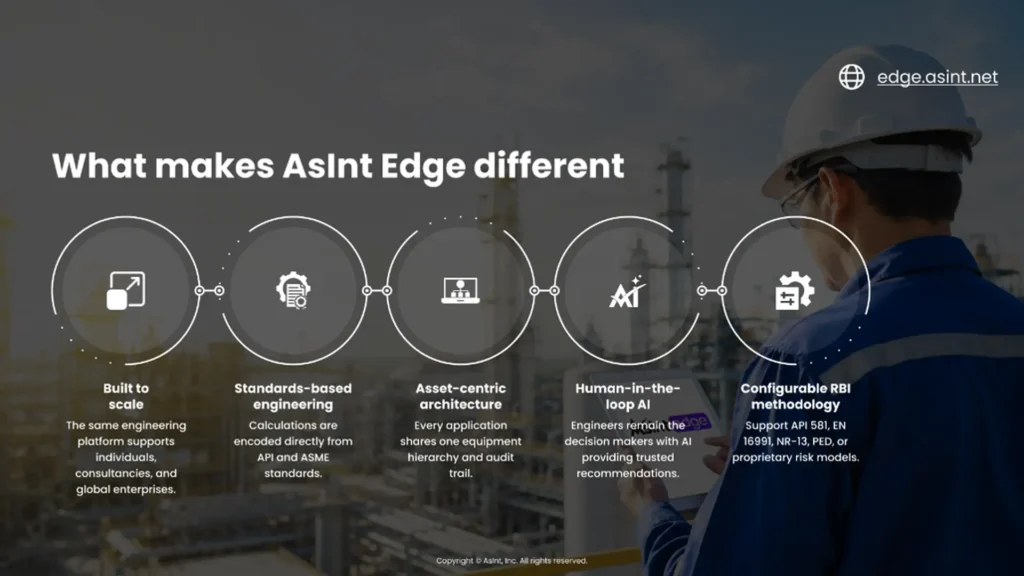
AsInt Edge, however, runs on a configurable engine that supports API 581, EN 16991, NR-13, PED, and proprietary methodologies developed by individual operators.
The risk model adapts to the asset not the other way around.
Standards-based engineering calculations
Engineering calculations are encoded not approximated. API 579-1, API 580/581, and inspection code requirements are implemented directly within the platform, using standards-based reference data throughout every calculation. This approach improves consistency, traceability, and confidence in engineering results.
Asset centric architecture
Every application within AsInt Edge shares the same equipment hierarchy and the same audit trail.
Inspection, corrosion monitoring, Risk-Based Inspection (RBI), and Fitness-for-Service (FFS) all operate from a single engineering record.
By eliminating disconnected data silos, the platform strengthens traceability and the defensibility of engineering decisions.
Human accountability
Every engineering action remains accountable to a named individual.
When the reasoning engine operates above its confidence threshold, the engineer makes the decision, and the platform records that decision through a cryptographically secured audit trail.
If confidence falls below the required threshold, the runtime escalates the case to a designated subject-matter expert before any action is taken.
Artificial intelligence serves as a recommendation engine. The engineer remains the decision maker.
Enterprise scalability
AsInt Edge scales seamlessly from a single consulting engineer to a global industrial operator without changing platforms.
Organizations gain access to the same engineering capabilities regardless of deployment size, ensuring advanced functionality is never limited to enterprise-only implementations.
The value of AsInt Edge for integrity programs
Mechanical Integrity and Asset Integrity programs often struggle with the same recurring challenges: disconnected inspections, thickness data without context, rigid methodologies, and Fitness-for-Service (FFS) evaluations trapped in spreadsheets.
AsInt Edge addresses these limitations by bringing inspection, corrosion monitoring, Risk-Based Inspection (RBI), and Fitness-for-Service (FFS) together within a single, auditable engineering record.
The result is program data that is traceable, defensible, and ready for both regulatory oversight and internal review.
Integrity leaders gain greater visibility into program performance through centralized reporting that supports compliance, improves decision-making, and scales as operations grow.
At the same time, engineers spend less time managing procedures and more time applying engineering judgment where it matters most.
By bringing enterprise-grade engineering to organizations of every size, AsInt Edge redefines what a modern integrity program can be.
The same trusted engineering logic. The same standards-based approach. Made accessible to every organization responsible for keeping critical assets safe, reliable, and in service.