
Table of Contents
- What is solar EOR in oil fields?
- How does renewable steam work in thermal recovery?
- How solar EOR reduces the thermal footprint in oil fields
- Advantages of solar heat in thermal recovery processes
- Technical challenges of solar EOR in upstream operations
- What role does renewable steam play in upstream decarbonization?
- How to minimize emissions in fields using thermal steam
- Cases and future perspectives of solar EOR
- Solar heat and enhanced oil recovery
- Solar EOR: Why does it matter now?
- Case study: Miraah (Oman), the largest solar field in the world
- Technical challenges defining the adoption horizon
- The core thesis: Freed Gas = Multiplied Value
- What the radar reveals?
- Conclusions
- References
- Frequently Asked Questions (FAQs)
The energy industry is undergoing a historic transition. While global hydrocarbon demand remains high, operating companies face increasing pressure to reduce emissions, improve energy efficiency, and lower the carbon footprint of their upstream operations.
In this context, Solar EOR is emerging as one of the most innovative solutions for thermal recovery in oil fields.
Enhanced oil recovery through steam injection has been an essential tool for producing heavy and extra-heavy crude oils for decades. However, conventional systems rely primarily on the combustion of natural gas or fossil fuels to generate heat. This results in high operating costs, elevated carbon intensity, and exposure to energy market volatility.
The incorporation of solar thermal energy into EOR processes is redefining the production paradigm in mature reservoirs. The concept of renewable steam combines concentrated solar technologies with thermal generation systems capable of supplying industrial heat for thermal recovery operations.
Countries with high solar irradiance and abundant heavy crude reserves are beginning to accelerate investments in this technology. Regions such as California, Oman, the Middle East, and Latin America are recognizing the potential of solar heat applied to enhanced oil recovery, especially in areas where natural gas consumption represents an economic or environmental challenge.
The advancement of Solar EOR does not mean completely replacing traditional thermal systems, but rather complementing them through hybrid schemes that reduce fuel consumption, minimize emissions, and increase operational sustainability. The convergence between oil and renewable energy is no longer a futuristic theory; it is an evolving technical and economic reality.
What is solar EOR in oil fields?
The term Solar EOR refers to the use of solar thermal energy to produce the steam used in enhanced oil recovery processes. Instead of relying exclusively on boilers powered by fossil fuels, the system uses concentrated solar radiation to generate industrial heat.
Thermal EOR processes are especially used in heavy oil reservoirs, where crude viscosity hinders natural flow toward the production well. Through steam injection, the crude oil is heated, viscosity is reduced, and mobility within the reservoir is improved.
Traditionally, this steam is produced using large volumes of natural gas. Although effective, the method also generates significant CO₂ emissions and fuel-related costs. This is where renewable steam gains strategic relevance for the upstream industry.
The solar thermal systems used in EOR employ parabolic mirrors, heliostats, or linear Fresnel collectors capable of concentrating solar energy onto a thermal fluid. The generated heat makes it possible to produce high-pressure steam for continuous or cyclic injection into the reservoir.
Solar EOR represents a direct integration between renewable technologies and hydrocarbon production. This combination makes it possible to reduce the carbon intensity of the produced barrel without compromising the thermal recovery efficiency required by the reservoir.
How does renewable steam work in thermal recovery?
The operational principle of renewable steam is based on converting solar radiation into useful thermal energy for industrial oilfield applications. The system begins with a solar field composed of collectors capable of tracking the sun’s trajectory throughout the day.
These collectors concentrate radiation onto receiver tubes containing water or specialized thermal fluids. The accumulated energy increases temperature until saturated or superheated steam is generated, depending on the operational requirements of the oil field.
The generated steam is then integrated into the reservoir injection system. In many cases, the scheme operates in hybrid mode alongside conventional generators powered by natural gas. This guarantees operational continuity even under variable weather conditions.
In processes such as CSS (Cyclic Steam Stimulation) or SAGD (Steam Assisted Gravity Drainage), renewable steam can partially or significantly supplement the thermal demand required to mobilize heavy crude within the reservoir.
Automation plays a fundamental role in these installations. Thermal sensors, SCADA systems, and control algorithms optimize steam production according to solar irradiance, energy demand, and oilfield operating conditions.
How solar EOR reduces the thermal footprint in oil fields
One of the main benefits of Solar EOR is the reduction of emissions associated with conventional thermal generation. Steam production through natural gas combustion represents a significant source of CO₂ in upstream operations.
By partially or completely replacing fossil fuels with solar thermal energy, companies can significantly reduce the carbon intensity of the produced barrel. This aspect is especially important in the face of increasingly strict environmental regulations.
Reducing natural gas consumption also improves the energy security of certain producing regions. In markets where gas supply is limited or expensive, solar heat offers a strategic alternative to stabilize operating costs.
Another important benefit is the reduction of indirect emissions associated with the transportation and processing of fuels used in conventional thermal generation. The use of solar energy eliminates part of the logistics chain associated with fuel supply.
In addition to environmental benefits, solar integration strengthens corporate ESG indicators. Oil companies adopting upstream decarbonization technologies improve their positioning with investors, regulators, and international markets.
Advantages of solar heat in thermal recovery processes
Solar heat applied to enhanced recovery offers multiple operational and economic advantages. One of the most important is the progressive reduction of long-term energy costs, especially in regions with high solar irradiance.
Once the solar infrastructure is installed, the primary energy resource (solar radiation) is free. This reduces dependence on fossil fuels and decreases exposure to fluctuations in the international energy market.
Another key advantage is the modularity of solar thermal systems. Projects can be expanded progressively according to thermal demand growth or capital investment availability.
Solar EOR also contributes to extending the operational life of mature fields. By reducing thermal costs and improving operational sustainability, certain reservoirs previously considered marginal can recover economic viability.
From a technical standpoint, renewable steam can be integrated relatively flexibly into existing thermal generation systems. This facilitates hybrid strategies where solar energy complements conventional infrastructure without requiring immediate replacement.
Technical challenges of solar EOR in upstream operations
Despite its advantages, implementing Solar EOR involves significant technical challenges. The first is the inherent intermittency of solar energy. Thermal production depends directly on weather conditions and solar irradiance availability.
To address this issue, many facilities incorporate thermal energy storage or hybrid schemes with conventional generation. However, these solutions increase operational complexity and capital investment costs.
Another relevant challenge is the large area required to install high-capacity solar fields. EOR operations demand enormous steam volumes, which implies extensive surfaces covered with solar collectors.
Dust and sand accumulation represent a significant issue in desert regions, where many heavy oil fields are located. Dirt accumulation on mirrors reduces optical efficiency and requires intensive cleaning and maintenance programs.
There are also challenges related to thermal integration and operational stability. Maintaining constant steam pressure and quality is essential to ensure efficient thermal recovery performance.
What role does renewable steam play in upstream decarbonization?
Upstream decarbonization has become a strategic priority for global oil operators. In this scenario, renewable steam represents a practical tool for reducing emissions without stopping hydrocarbon production.
Conventional thermal generation constitutes one of the largest emission sources in heavy oil fields. Partially replacing this energy with solar heat can generate significant CO₂ reductions per produced barrel.
Beyond the direct environmental impact, Solar EOR contributes to achieving corporate carbon neutrality goals. Many energy companies already include solar thermal projects within their energy transition strategies.
International regulatory pressure is also driving the adoption of low-carbon technologies. Producing countries face increasing requirements related to emissions, energy intensity, and industrial sustainability.
Renewable steam demonstrates that technological innovation can coexist with oil production. The integration between renewables and upstream operations is redefining the traditional perception of incompatibility between these two energy sectors.
How to minimize emissions in fields using thermal steam
Thermal efficiency is one of the most important factors in EOR operations. Large amounts of energy are required daily to generate steam, so any operational improvement can translate into major economic and environmental benefits.
Digitalization also plays a key role in energy optimization. Advanced monitoring systems allow real-time adjustment of injection parameters, temperature, and pressure to maximize recovery and minimize thermal losses.
Another important strategy involves improving the thermal insulation of pipelines and surface equipment. Heat losses are a common issue in steam operations, especially in extensive fields.
Cases and future perspectives of solar EOR
Several international projects have demonstrated the technical feasibility of Solar EOR. In Oman, for example, large solar thermal installations have been implemented to produce steam for heavy oil recovery.
California has also been a pioneer in the use of solar technologies applied to oil fields. The combination of high solar irradiance and strict environmental regulations favors the adoption of upstream decarbonization solutions.
In Latin America, the potential is considerable. Countries with abundant heavy oil reserves and high solar radiation, such as Venezuela, could benefit significantly from these technologies in the coming decades.
Technological evolution will continue reducing costs and improving the efficiency of solar collectors, thermal storage systems, and industrial automation. This will increase the competitiveness of renewable steam compared to conventional systems.
The future of Solar EOR will depend on economic, regulatory, and technological factors. However, all indicators suggest that the convergence between solar energy and thermal recovery will continue expanding as part of the global energy transformation.
Solar heat and enhanced oil recovery
Solar EOR represents one of the most promising innovations for the sustainable evolution of oil fields. The possibility of generating renewable steam through solar thermal energy opens new opportunities to reduce emissions, optimize costs, and improve environmental performance in upstream operations.
Although technical challenges related to intermittency, integration, and thermal storage still exist, technological advances continue strengthening the viability of these systems. The trend points toward hybrid models in which fossil fuels and renewable energy coexist strategically.
Enhanced oil recovery will remain essential to meeting global energy demand over the coming decades. However, the challenge is no longer simply producing more oil, but producing it with lower environmental impact.
In this context, renewable steam emerges as an essential solution for decarbonizing energy-intensive thermal processes and modernizing traditional EOR operations. The energy transition is also reaching oil fields, and solar heat will be one of its most relevant protagonists.
Solar EOR: Why does it matter now?
Enhanced oil recovery through steam injection, known as thermal EOR or steamflooding, is a tertiary recovery technique that reduces heavy crude viscosity by heating it, facilitating flow toward production wells. The historical problem is that generating this steam requires large volumes of natural gas, making thermal EOR one of the most carbon-intensive processes in the entire upstream chain.
Solar EOR (also called Solar Thermal Enhanced Oil Recovery) uses concentrated solar energy arrays to heat water and generate steam that is directly injected into the reservoir, reducing heavy crude viscosity and facilitating flow toward the surface. The major technical advantage is that solar systems can generate steam of the same quality as natural gas systems, reaching temperatures up to 750°F (399°C) and pressures of 2,500 PSI.
The key figure defining the market opportunity is that Solar EOR could supply up to 80% of a field’s annual steam requirements, injecting solar-generated steam during daylight hours while complementing with gas-generated steam during cloudy or nighttime periods, displacing large volumes of gas consumption without affecting crude production.
Case study: Miraah (Oman), the largest solar field in the world
The global reference project is Miraah, operated at the Amal field by Petroleum Development Oman (PDO), a joint venture between the Government of Oman, Shell, TotalEnergies, and Partex.
The 330 MWth solar thermal installation generates an average of 2,000 tons of solar steam per day, covering a substantial portion of the steam demand at the Amal field operated by PDO. The full project scope is ambitious: at full operation, Miraah will deliver 1,021 megawatts of peak thermal energy to generate 6,000 tons of steam per day for heavy crude production.
The results from the previous pilot project unlocked large-scale investment: the pilot demonstrated performance above its nominal capacity, met all design criteria, and showed minimal maintenance requirements with operational availability above 98% for more than two and a half years, regardless of weather conditions.
The impact on Oman’s energy policy is equally strategic: natural gas used for oil production in Oman represents more than 20% of the country’s total gas consumption, exceeding even the power sector; Solar EOR could reduce that consumption by up to 80%, redirecting the gas toward exports or higher-value applications.
Technical challenges defining the adoption horizon
Adoption is not free from genuine obstacles. The radar chart above maps them honestly.
Solar intermittency
Steam must flow continuously into the reservoir. The current solution is hybrid integration: solar during peak daylight hours, gas during the remaining periods. However, high-temperature thermal energy storage (molten salts, solar energy biogels) is emerging as the next frontier.
A technical note: the TES scenario is based on frontier research (the NaCl–KCl graphene biogels discussed in the 2023 J. Clean. Prod. paper are experimental), so the text explicitly identifies it as a “projected scenario” to avoid confusing operational technologies with emerging developments.
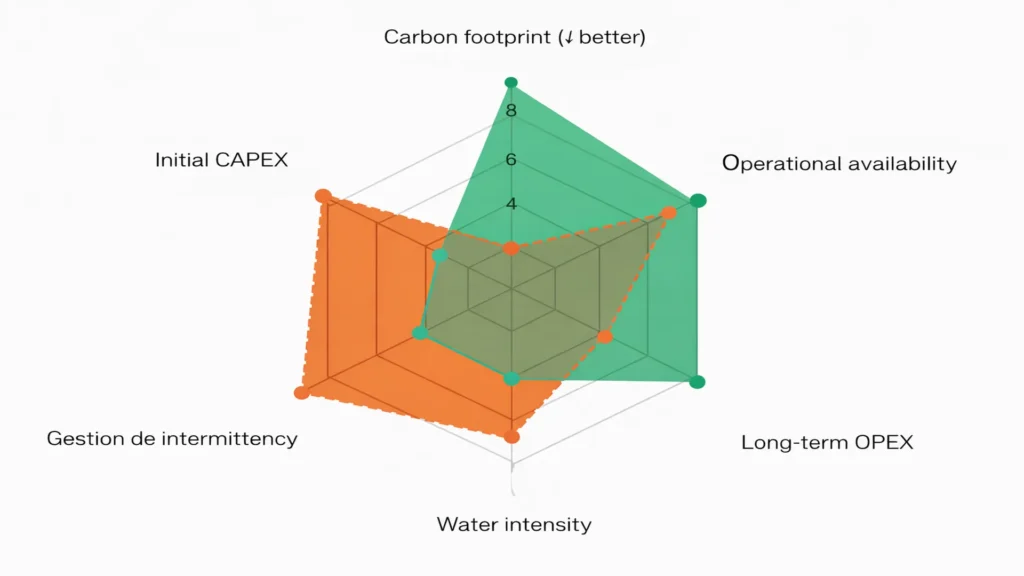
Scale 0–10: higher value = better performance in that dimension. Author’s elaboration based on technical literature.
The intermittency of solar radiation and the lower steam saturation energy efficiency (steam flooding) still limit large-scale industrial Solar TEOR applications.
Water Intensity: Steam generation requires treated water, a scarce resource precisely in the desert regions where heavy crude operations are located. Reservoir water management (produced water) and its reuse for steam generation constitute a critical technical vector.
Initial CAPEX: Although the initial investment in solar infrastructure can be high, long-term operating costs are significantly lower than those of conventional EOR, and as solar technology costs continue to decline, the economic case becomes increasingly stronger.
Geographic Limitations: Solar EOR works where three conditions coincide: high direct normal irradiance (DNI), heavy crude reservoirs (API < 20°), and scarce or expensive natural gas for steam generation.
This intersection exists in the Persian Gulf, California, and parts of Mexico and Venezuela’s Orinoco Oil Belt, but it is not universal.
The core thesis: Freed Gas = Multiplied Value
There is a financial logic that goes beyond the ESG argument. In Gulf economies where natural gas is subsidized but scarce, the gas no longer burned in EOR operations can be redirected toward LNG exports or electricity generation, multiplying its economic value.
PDO estimated that solar substitution at Miraah saves 5.6 trillion BTU of natural gas annually, gas that Oman can sell in international markets at LNG prices.
For major national oil companies (NOCs) with large heavy crude inventories — Saudi Aramco, Pemex, PDVSA, Petroecuador — Solar EOR is not merely a green technology; it is an energy portfolio optimization instrument.
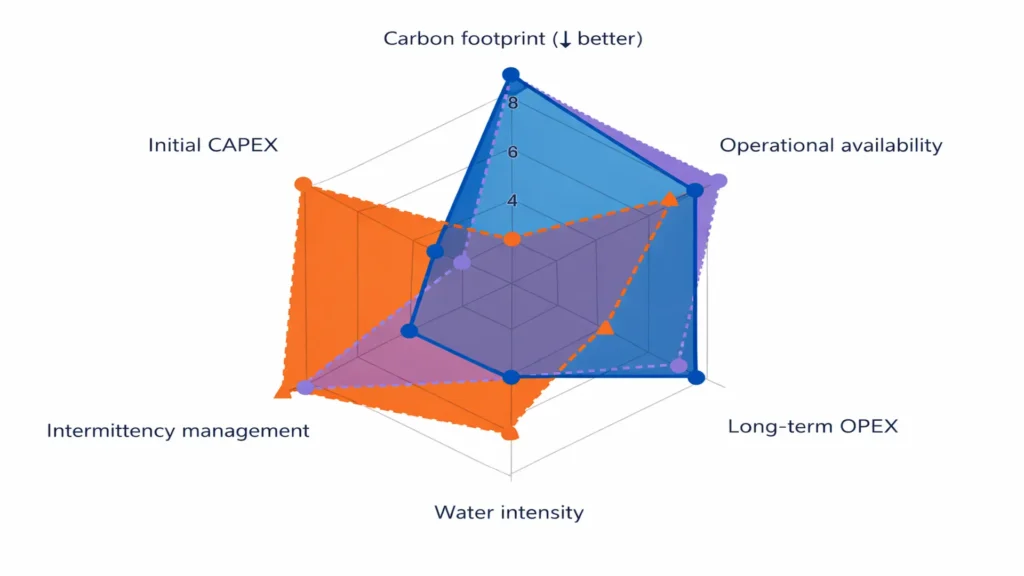
Scale 0–10: higher value = better performance. TES: Thermal Energy Storage. Author’s elaboration based on technical literature. The TES scenario reflects projections of NaCl–KCl systems currently in advanced research stages.
What the radar reveals?
The molten salt thermal storage variant (NaCl–KCl or similar) solves the historical Achilles’ heel of Solar EOR: intermittency, increasing from 4/10 to 8/10 on that axis. This positions it as the only technology capable of aspiring to continuous 24/7 steam supply without depending on backup gas systems.
The cost of this improvement is predictable: initial CAPEX drops one additional point (from 3 to 2/10) because adding the TES system on top of the solar plant significantly increases initial investment. However, long-term OPEX also decreases one point (from 8 to 7/10) because molten salt systems require specialized maintenance and continuous thermal management.
What does not change is water intensity, which remains the same across all three scenarios. This challenge is intrinsic to the steam generation process regardless of the heat source.
Conclusions
Solar EOR is emerging as one of the most promising technologies for decarbonizing heavy oil thermal recovery by enabling renewable steam generation with lower dependence on natural gas and reduced carbon intensity in upstream operations.
The integration of solar thermal systems with hybrid configurations and energy storage solutions represents a strategic pathway to improve energy efficiency, reduce long-term operating costs, and strengthen the sustainability of mature oil fields.
Although technical challenges related to solar intermittency, thermal storage, water management, and initial CAPEX still remain, technological advancements and global pressure to reduce emissions continue to drive Solar EOR adoption as part of the industrial energy transition.
References
- International Energy Agency. (2023). World Energy Outlook 2023. IEA. https://www.iea.org/reports/world-energy-outlook-2023
- Malaeb, L., Hachem, F., & Khalifeh, M. (2023). Solar thermal enhanced oil recovery technologies and challenges: A review. Journal of Petroleum Science and Engineering, 226, 111744. https://doi.org/10.1016/j.petrol.2023.111744
- Petroleum Development Oman. (2020). Miraah solar thermal project for enhanced oil recovery. PDO Technical Publications. https://www.pdo.co.om
Frequently Asked Questions (FAQs)
What Does EOR Consist Of?
Heavy oil constitutes an abundant energy source, but it is more expensive to produce than light oil. The vast majority of heavy oils are not recoverable in their natural state or through conventional production methods.
How to Improve Efficiency in Fields Using Thermal Steam?
The integration of solar energy allows fuel consumption optimization in hybrid systems. During periods of maximum irradiance, conventional boilers reduce operational load, lowering emissions and natural gas costs.
Predictive maintenance of thermal and solar systems also contributes significantly to overall efficiency. Early detection of scaling, corrosion, or optical degradation helps maintain stable energy performance.