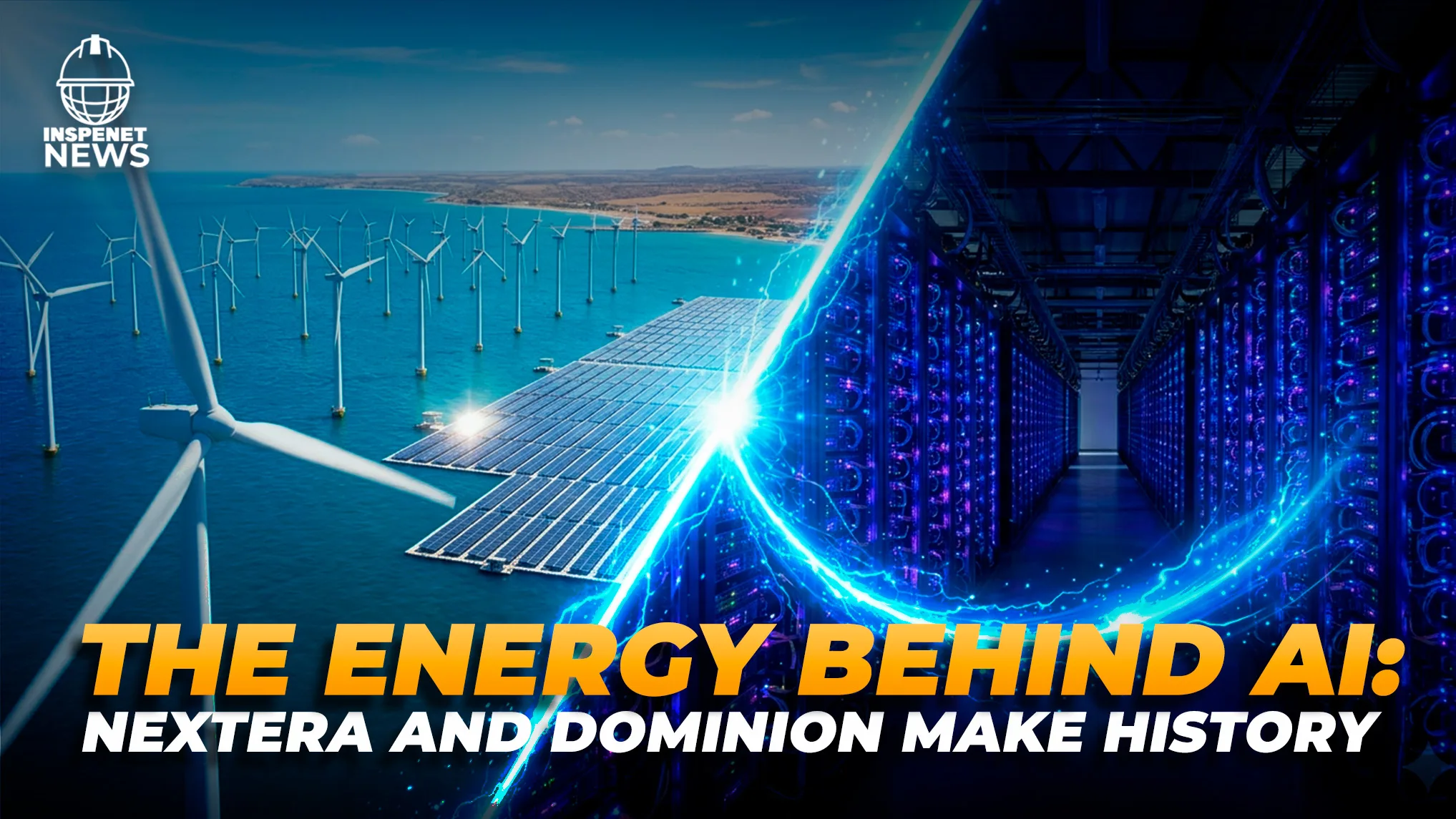
NextEra Energy to lead the biggest US electricity mega-merger
NextEra Energy announced a definitive agreement to merge with Dominion Energy in a deal valued at approximately $67 billion that will transform the U.S. electricity market. The transaction will create the world's largest regulated electric utility by market capitalization and consolidate an energy platform with a strong presence in Florida, Virginia, North Carolina, and South Carolina.
Furthermore, the resulting company will operate under the name NextEra Energy and will maintain a structure focused on regulated businesses, a segment considered strategic due to its financial stability and long-term expansion capacity.
The electricity demand generated by AI accelerates operations
Currently, the rapid growth of artificial intelligence and data centers is reshaping the global energy landscape. Large technology companies increasingly require electrical capacity to power their advanced processing, storage, and computing infrastructures.
Therefore, NextEra Energy and Dominion believe that scale will be crucial to meeting this increase in electricity consumption. The merged company will have a generation capacity of approximately 110 gigawatts from natural gas , nuclear power, renewables, and energy storage systems.
According to both companies, the goal is to expand generation capacity and modernize electricity networks without passing on higher costs to consumers in the short term.
The energy mega-merger seeks to reduce operating costs.
One of the central arguments of the agreement is the potential to improve operational efficiency through a larger corporate structure. NextEra Energy stated that the integration will optimize procurement, infrastructure construction, financing, and the operation of electrical grids.
As part of the agreement, Dominion Energy will offer $2.25 billion in credits to customers in Virginia, North Carolina, and South Carolina over the two years following the closing of the transaction.
Companies also argue that the larger scale will facilitate faster investments in electricity transmission , storm resilience, and energy expansion linked to industrial and technological growth.
NextEra Energy reinforces its leadership in energy infrastructure
With this acquisition, NextEra Energy will further solidify its position as one of the largest energy infrastructure players in North America. The company already controls Florida Power & Light and maintains a strong presence in renewable energy, battery storage, and power generation.
Furthermore, Dominion Energy provides a broad regulated distribution and generation network on the east coast of the United States, in addition to projects related to offshore wind energy and transmission systems.
The combination will allow more than 80% of the business to remain under state and federal regulation, a factor that usually offers financial predictability for investors and operators in the electricity sector.
Electricity demand and data centers drive expansion
The advancement of artificial intelligence is emerging as one of the main drivers behind this energy mega-merger . Companies anticipate that electricity consumption associated with data centers will continue to increase steadily over the next decade.
Consequently, the new company plans massive investments in generation, transmission networks, and energy backup capacity to meet the growing electricity demand in the United States.
NextEra Energy also noted that the integration will allow the use of data analytics and artificial intelligence tools to improve project planning, accelerate construction, and optimize energy operations.
How will the new company be structured?
Following the closing of the transaction, NextEra Energy shareholders will control approximately 74.5% of the combined company, while Dominion Energy shareholders will retain 25.5%.
John Ketchum will continue as president and chief executive officer of NextEra Energy, while Robert Blue will assume roles related to the regulated companies that emerged from Dominion.
Dominion Energy 's local operations in the states where it currently provides service.
The transaction still needs to pass regulatory approvals
Although the boards of directors of both companies unanimously approved the agreement, the transaction will still need to receive authorization from US regulatory bodies.
These include the Federal Energy Regulatory Commission, the Nuclear Regulatory Commission, and various state entities responsible for overseeing the electricity market.
The companies expect to complete the merger within 12 to 18 months if they successfully navigate regulatory reviews and gain shareholder approval.

News of additional interest
Saudi Arabia enters the quantum race
Aramco and the French company Pasqal inaugurated Saudi Arabia's first quantum computer and launched the first commercial quantum computing-as-a-service platform in the Middle East. The system, installed at Aramco's data center in Dhahran, will allow businesses, universities, and researchers to remotely access advanced quantum technology via a cloud-based platform.
The computer uses neutral atom technology developed by Pasqal and features 200 programmable qubits. According to the companies, the system will focus on solving complex problems related to energy, materials, and advanced industries. Envisioned applications include logistics optimization, CO₂ storage, oil well location, and drilling rig scheduling. The project also aims to foster the development of quantum specialists within Saudi Arabia.
South Korea and Japan strengthen energy alliance
South Korea and Japan agreed to expand their energy cooperation and strengthen security coordination amid growing pressure on global energy markets. During a meeting in the South Korean city of Andong, President Lee Jae Myung and Japanese Prime Minister Sanae Takaichi confirmed new plans to improve the supply of oil and liquefied natural gas between the two countries.
The agreement includes potential shared storage mechanisms and swaps of crude oil, refined products, and LNG to address disruptions in international supply chains. The leaders noted that tensions in the Middle East have heightened concerns about energy stability in Asia, a region heavily reliant on imports. Furthermore, both governments reaffirmed their cooperation on security and defense alongside the United States in the face of regional challenges such as North Korea.
Venezuela seeks to revive its oil industry
Senior Venezuelan oil officials will participate this week in an energy conference near Houston, a rare appearance in the United States following the country's recent political changes. Oil Minister Paula Henao and PDVSA executives will meet with oil companies and suppliers to promote investment and revive crude oil and gas production.
The U.S. government is promoting a plan that envisions up to $100 billion in investments to modernize Venezuela's energy infrastructure. According to officials present at the event, Venezuela needs equipment and services for drilling, production, and transportation of hydrocarbons, including valves, compressors, pipelines, and pumping systems. Representatives from international companies such as Repsol and Maurel & Prom are also participating in the discussions.
Oil falls after Trump blocks Iran trade
Oil prices retreated after Donald Trump announced the temporary suspension of a military strike against Iran to allow for renewed negotiations. Brent crude fell by about 1% as the market reacted to the possibility of reduced geopolitical tensions in the Middle East, a key region for global energy supply.
Trump indicated that the United States is keeping open the option of resuming military action if an agreement is not reached with Tehran. Meanwhile, Iran is seeking the lifting of economic sanctions and the release of international funds as part of the talks. The conflict in the region is putting pressure on the Strait of Hormuz, through which about a fifth of the world's traded oil and liquefied natural gas passes. In addition, Washington extended for 30 days a waiver that allows some countries to continue purchasing Russian oil.