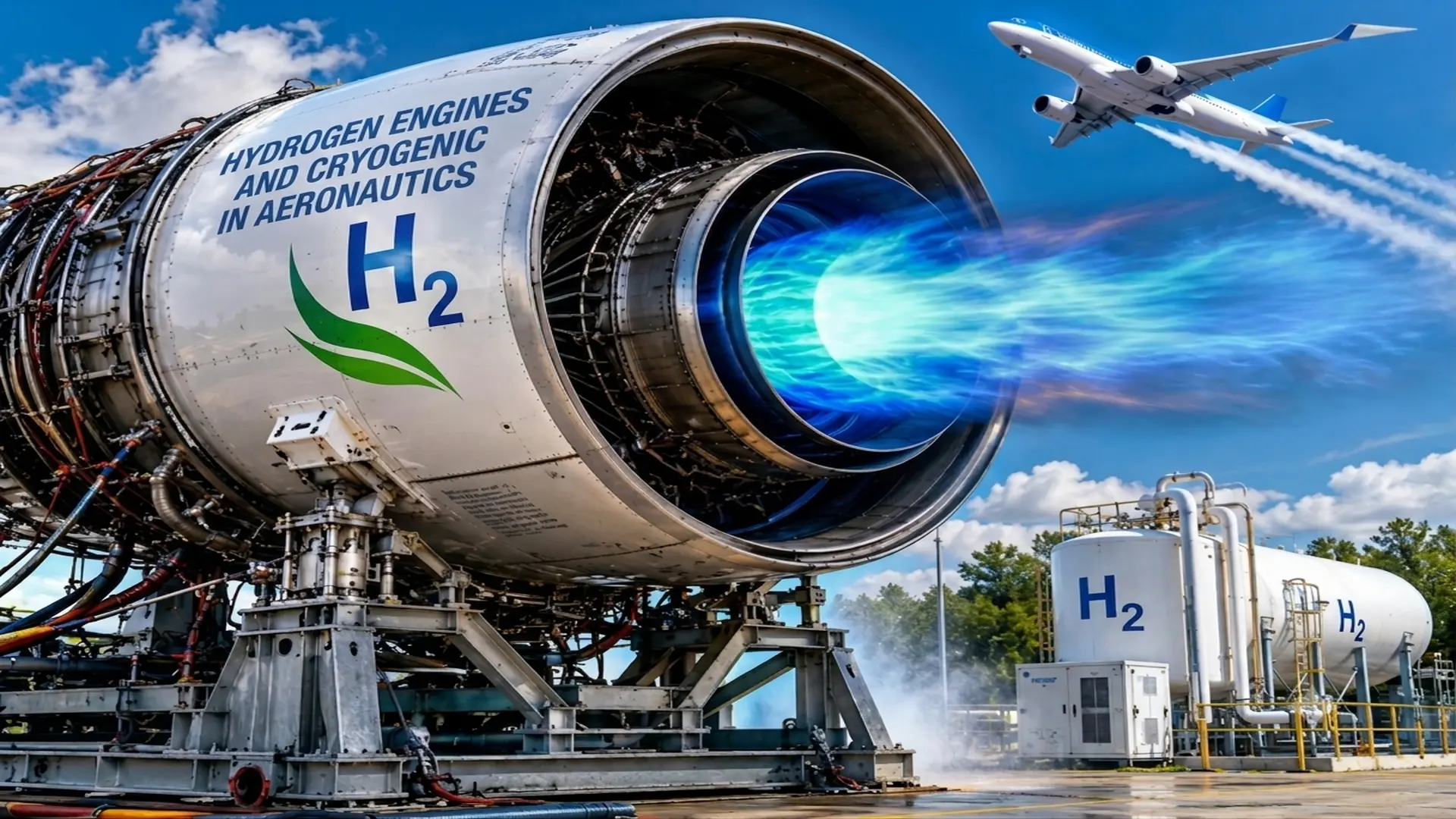
Hydrogen has stopped being a futuristic idea to become one of the most serious paths toward the decarbonization of aviation. Its potential is attractive because it promises zero CO2 emissions in flight, but its adoption requires solving complex problems of cryogenic storage, operational safety, structural integration, and aeronautical certification (Federal Aviation Administration [FAA], 2024; Airbus, 2021).
For engineering, the challenge is not only to make an airplane fly with hydrogen, but to do so in a safe, repeatable, and certifiable manner. That is where cryogenics stops being a detail and becomes the heart of the problem.
Hydrogen engines in aeronautical propulsion
Hydrogen can be used in two major architectures: direct combustion in turbines or electrochemical conversion through fuel cells (FAA, 2024). As we can see, both options are technically possible, although they still present unequal maturity depending on the type of aircraft, the mission, and the operational scale (FAA, 2024). If we look at the uses, in combustion, hydrogen allows keeping known propulsion principles, but introduces challenges of flame stability, temperature control, and NOx emissions.
Regarding fuel cells, the system is attractive for regional or auxiliary aircraft, but requires very strict electrical, thermal, and weight management (FAA, 2024; Colozza, 2002). In other words: the hydrogen engine is not designed as a “clean” version of the conventional engine, but as a new architecture with its own risk logic.
Liquid hydrogen and cryogenic storage
The main practical path to carry hydrogen on board is in liquid form, because compressed gas occupies too much volume for a commercial aircraft (Airbus, 2021; Colozza, 2002). Liquid hydrogen must be stored at approximately -253 °C, a temperature that requires the use of highly insulated tanks and containment systems capable of limiting heat ingress (Airbus, 2021). Years ago.
La NASA had already identified that the main problems of aeronautical storage include high volumetric demand, hydrogen permeation through materials, and the embrittlement of certain metals (Colozza, 2002). In simple terms, the fuel must not only be kept cold, it must also remain controlled within a structure that survives flight, maintenance, and repeated thermal cycles. In other words, the challenge in this particular case is to successfully guarantee this balance.
Cryogenic tanks and thermal management
Cryogenic tanks for aircraft must simultaneously resolve insulation, weight, durability, and structural compatibility. For example, Airbus describes double-wall solutions with vacuum and multilayer insulation. This is a configuration that reduces heat transfer but adds integration and maintenance complexity (Airbus, 2021).
On the other hand, NASA recommends that tank geometry, material selection, and insulation strategy are critical variables to minimize thermal losses and ensure that the system is viable on an aerial platform (Colozza, 2002). Thermal management is not solely about “preventing it from heating up,” but about controlling boil-off, internal pressure, and the stable delivery of fuel to the propulsion system (FAA, 2024). This means thinking of the tank as an active subsystem and not as a passive container.
Safety of fuel systems
Safety is the point where hydrogen demands the most discipline. The FAA warns, and from experience we know this to be true, that hydrogen has a wide flammability range, low ignition energy, and high flame speed, which increases the risk of fire or explosion in the event of uncontrolled leaks (FAA, 2024).
Furthermore, cryogenic systems must face risks of overpressure, valve failures, accidental release, material compatibility, and possible hydrogen embrittlement (FAA, 2024; Colozza, 2002). This forces the design of ventilation, sensors, hot zone isolation, disconnection protocols, and maintenance strategies that are much more demanding than current ones. In aviation, as in other industry sectors, safety cannot rely on “probably nothing will happen”; it must be based on redundancy, failure mode analysis, and effective containment.
Certification and standards
Certification will be the decisive filter between prototype and commercial operation. The FAA strongly insists that the current regulatory framework was not conceived for hydrogen-powered aircraft, so very specific criteria, new methods of compliance, and, of course, the additional validation of risks associated with storage, propulsion, and operational safety will currently be required (FAA, 2024).
Airbus has also reiterated that liquid hydrogen storage is an essential component of its zero-emission flight strategy, but that it requires a technical and industrial ecosystem that is still under construction (Airbus, 2021).
Looking at historical experience in aviation, we can confirm that no technology enters the market just because it is promising; it enters when it can demonstrate safety in execution processes, repeatability of tests and developments, and traceability of potential failures throughout the construction process. In this case, certification will be as important as the engine itself.
Digital innovation
The transition toward hydrogen aircraft is also driving a digital support layer. Advanced instrumentation, continuous monitoring, and automated analysis allow the detection of variations in temperature, pressure, and potential leaks before the problem escalates.
Although the reviewed literature focuses on the physical safety of the system, the industrial trend points toward integrating sensors, connectivity, and artificial intelligence to improve fuel and tank monitoring in real time (FAA, 2024). This means that the aircraft of the future will not only carry a new fuel, but also a new logic of diagnostics. Much has been said about artificial intelligence being just a tool that does not replace the engineer, because it gives them more speed to interpret signals and act before the risk becomes visible.
Challenges that will remain
Even with significant progress, important technical challenges persist. Hydrogen combustion in turbines still faces maturity barriers (FAA, 2024). NASA already warned that weight, volume, and cryogenic requirements keep storage as one of the main obstacles for large-scale aeronautical applications (Colozza, 2002). Therefore, real progress will depend on combining advanced materials, tank architecture, thermal control, sensors, and new standards. The future of hydrogen in aviation lies in the ability to articulate a complete and reliable system.
Conclusion
Hydrogen engines can redefine aeronautics, but only if the industry first solves the cryogenic problem with technical and regulatory rigor. Liquid storage, thermal management, fuel systems safety, and certification are pieces of the same puzzle that admits no shortcuts (FAA, 2024; Airbus, 2021; Colozza, 2002). The opportunity is enormous, but so is the demand. If engineering succeeds in turning the fragility of hydrogen into a robust and reliable system, aviation will undoubtedly head toward a new era of propulsion.
References
- Airbus. (2021, December 8). How to store liquid hydrogen for zero-emission flight. https://www.airbus.com/en/newsroom/news/2021-12-how-to-store-liquid-hydrogen-for-zero-emission-flight
- Colozza, A. J. (2002). Hydrogen storage for aircraft applications overview (NASA/TM-2002-211385). NASA Glenn Research Center. https://ntrs.nasa.gov/api/citations/20020085127/downloads/20020085127.pdf
- Federal Aviation Administration. (2024). Hydrogen-fueled aircraft safety and certification roadmap. https://www.faa.gov/aircraft/air_cert/step/disciplines/propulsion_systems/hydrogen-fueled_aircraft_roadmap