Table of Contents
- Digital RBI: From isolated data to risk
- PoF, CoF, and inspection effectiveness
- API 580 and 581 as the foundation of digital RBI
- Data quality and decision limits
- Critical assets in a common architecture
- IDMS: data, findings, and recommendations
- Maximum intervals and risk-based prioritization
- From inspection to AIM/APM: business value
- What an integrity suite should require
- Mobility and technical visualization
- Conclusions
- References
- Frequently asked questions (FAQs)
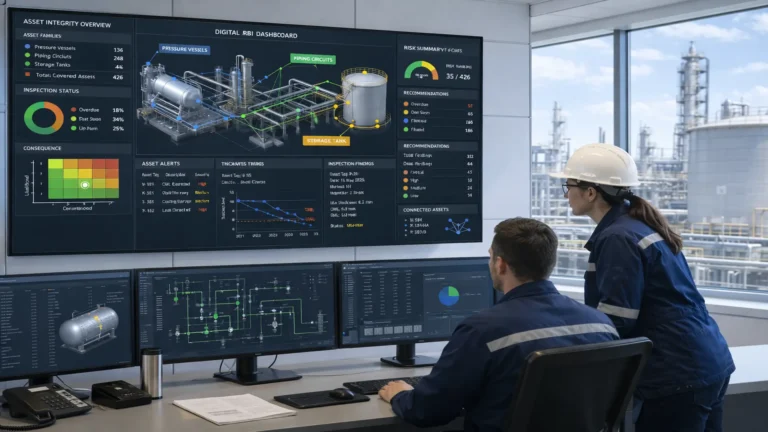
When visual inspection or thickness readings do not reflect the current risk, the information becomes isolated and loses value for decision-making. Digital RBI transforms measurements, visual findings, damage mechanisms, history, and operational impact into a technical prioritization for critical assets.
In facilities with pressure vessels, piping systems, and storage tanks, deterioration is not limited to the scope of a single standard. In this context, API 510, API 570, and API 653 apply to different types of assets, while API 580 and API 581 establish the logic to develop, implement, maintain, and quantify an RBI program focused on equipment that represents the highest risk.
Digital RBI: From isolated data to risk
Thickness measured in the field has no strategic value if it remains disconnected from the damage mechanism, corrosion rate, minimum required thickness, and consequence of failure. Its technical usefulness emerges when it supports decisions on whether an asset should be inspected, repaired, mitigated, or kept under monitoring.
In a risk-based inspection strategy, each reading must feed a broader evaluation. The technical objective is to interpret what each measurement means in relation to service, inspection history, expected degradation, inspection effectiveness, and maximum intervals allowed by the applicable code.
Through the digitalization of Risk-Based Inspection (RBI), information is no longer stored in separate files. A single measurement can update trends, modify criticality, support recommendations, and direct resources toward high-risk assets, preventing planning from relying on routines with low impact on risk reduction.
PoF, CoF, and inspection effectiveness
API 581 provides the quantitative methodology to calculate risk through the relationship between Probability of Failure (PoF) and Consequence of Failure (CoF). This calculation involves factors such as generic failure frequency, damage factor, management systems factor, and inspection effectiveness, in addition to active damage mechanisms, component condition, and uncertainty associated with inspection data.
API 580 structures the RBI program as a management practice: it defines the elements required to develop, implement, and maintain the analysis, including responsibilities, data quality, documentation, updates, reassessment, and inspection planning. Together, both practices allow identification of risk drivers, prioritization of equipment, establishment of intervals within applicable limits, and concentration of resources on assets that represent the highest risk.
In RBI, inspection does not automatically reduce risk; it reduces uncertainty about the actual condition of damage and supports decisions regarding monitoring, mitigation, repair, reclassification, or adjustment of inspection intervals.
API 580 and 581 as the foundation of digital RBI
API 510, API 570, and API 653 define how to inspect, repair, alter, and evaluate assets in service according to their nature: pressure vessels, piping systems, and storage tanks. API 510 covers in-service inspection, repair, alteration, and re-rating of pressure vessels and their pressure-relieving devices; API 570 covers inspection, classification, repair, and alteration of in-service piping systems; API 653 establishes minimum requirements to maintain the integrity of storage tanks after being placed in service.
Digital RBI integrates these criteria with the logic of API 580 and API 581 so that these critical assets are prioritized by risk, condition, degradation, and consequence. Unlike routine inspections, RBI concentrates resources on equipment with higher exposure, reduces low-value interventions, and strengthens decisions related to safety, continuity, and operating costs.
Its value lies in connecting the main families of static assets without mixing their regulatory criteria. Each code retains its scope, application limits, inspection responsibilities, and rules for repair or alteration, while risk management becomes common, comparable, and traceable.
Data quality and decision limits
An RBI analysis does not improve by digitizing incomplete data. Data quality defines the reliability of the result: materials, design conditions, pressure, temperature, flow, inspection history, repairs, service changes, and damage mechanisms must be controlled.
When information is limited, the analysis must recognize uncertainty and apply conservative criteria before modifying intervals, deferring recommendations, or reducing inspection coverage. An asset with incomplete data may require field verification, additional inspection, or review of the dominant damage mechanism.
Critical assets in a common architecture
A pressure vessel may receive product from an API 570 circuit and discharge into an API 653 tank. Fragmented evaluation prevents understanding how the same fluid, temperature, contaminant, or operating condition affects equipment subject to different codes.
In pressure vessels, API 510 requires control of thicknesses, MAWP (Maximum Allowable Working Pressure), nozzles, repairs, alterations, service changes, and associated relief devices. In piping, API 570 operates by circuits, TMLs, dead legs, injection points, CUI, and sections susceptible to deterioration.
In storage tanks, API 653 requires evaluation of bottom, shell, roof, nozzles, welds, settlement, coatings, and previous repairs. Each asset requires its own structure, even if all feed into the same prioritization logic.
Corrosion loops and process continuity
Damage mechanisms do not respect administrative boundaries. CO₂ corrosion, sulfidation, erosion, naphthenic acid, CUI, or HTHA may affect connected equipment, even if they belong to different codes.
Corrosion loops help understand degradation as a system phenomenon. Accelerated thickness loss in a line may signal the need to review the downstream vessel, associated exchanger, or the tank receiving that product.
This cross-visibility prevents asset inspection from being reduced to isolated reports. Local condition gains value when interpreted within the circuit, service, and potential consequence of failure.
IDMS: data, findings, and recommendations
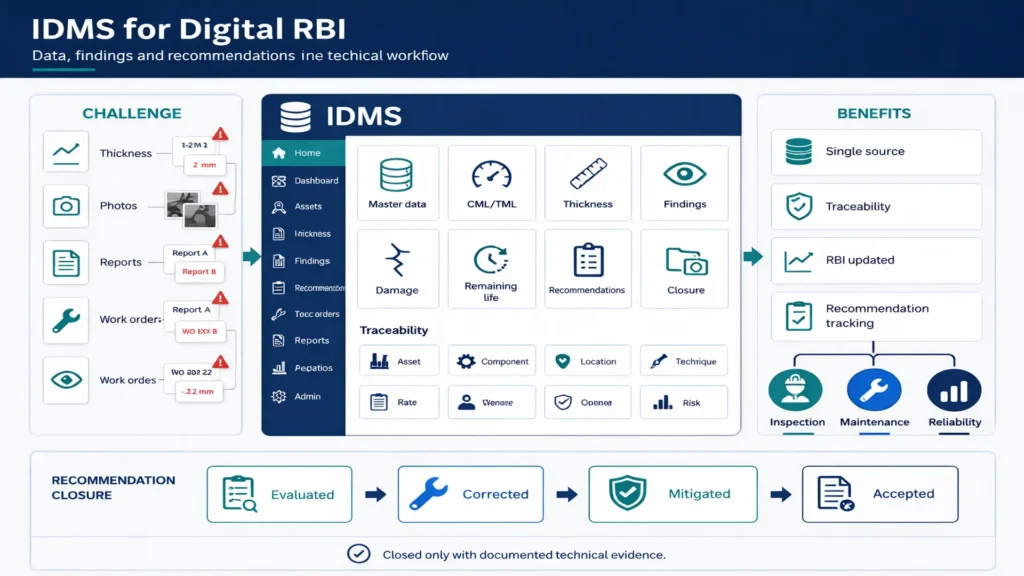
The IDMS (Inspection Data Management System) is the operational layer that transforms inspection into useful information for digital RBI. Its function is to structure master data, CML/TML, thickness readings, visual findings, damage mechanisms, remaining life, recommendations, and closure evidence within a single technical workflow.
The dispersion of measurements, photographs, reports, and work orders creates duplication, conflicting versions, and loss of traceability. An IDMS preserves traceability from finding to corrective action, linking asset, component, location, applied technique, date, responsible party, acceptance criteria, and risk priority.
With this structure, inspection, maintenance, and reliability work from a common data source, reducing duplication, improving recommendation tracking, and strengthening updates to the RBI plan. A recommendation is closed when the detected condition has been evaluated, corrected, mitigated, or accepted under documented technical criteria, with verifiable evidence and justification of residual risk when deferral exists.
Maximum intervals and risk-based prioritization
RBI does not authorize extending inspections without technical control. API 510, API 570, and API 653 establish criteria, responsibilities, and maximum allowable intervals based on asset type, condition, and applicable inspection framework. Every RBI analysis must operate within this regulatory reality.
Its value lies in adjusting planning based on risk. High-risk assets require more attention, better inspection coverage, and more timely mitigation actions. Equipment with low probability and low consequence can be evaluated with less intrusive strategies, always within permitted limits.
This prioritization avoids distributing resources uniformly across equipment that does not represent the same exposure. Organizations allocate budget, personnel, shutdown windows, and NDT toward assets where consequence of failure, uncertainty, or damage mechanisms justify greater intervention.
Proactive risk identification enables answering which asset should be inspected first, which recommendation cannot be deferred, which circuit requires greater coverage, which tank needs internal inspection, and which repair provides the greatest risk reduction.
From inspection to AIM/APM: business value
The transition toward AIM/APM occurs when inspection data ceases to be a documentary requirement and becomes information for high asset performance. AIM organizes condition, barriers, remaining life, and compliance; APM relates that condition to availability, costs, reliability, and operational risk.
Digital RBI connects technical discipline with maintenance and investment decisions. Equipment with high consequence of failure is prioritized because its condition may compromise production, safety, environment, or operational continuity.
Integration also improves shutdown planning. When API 510, API 570, and API 653 data are managed within the same architecture, organizations can group interventions, optimize access, avoid duplication, and reduce low-value intrusive inspections.
Solutions such as IntelliSuite by AsInt represent an architecture designed to integrate RBI, IDMS, AIM/APM, asset master data, and recommendations into a common workflow, reducing silos between inspection, maintenance, reliability, and operations. Its technical value lies in converting dispersed data into traceable decisions for critical asset management.
The Inspenet TV video presents IntelliSuite as a platform for digital management of mechanical inspections, with traceability from planning to recording findings.
What an integrity suite should require
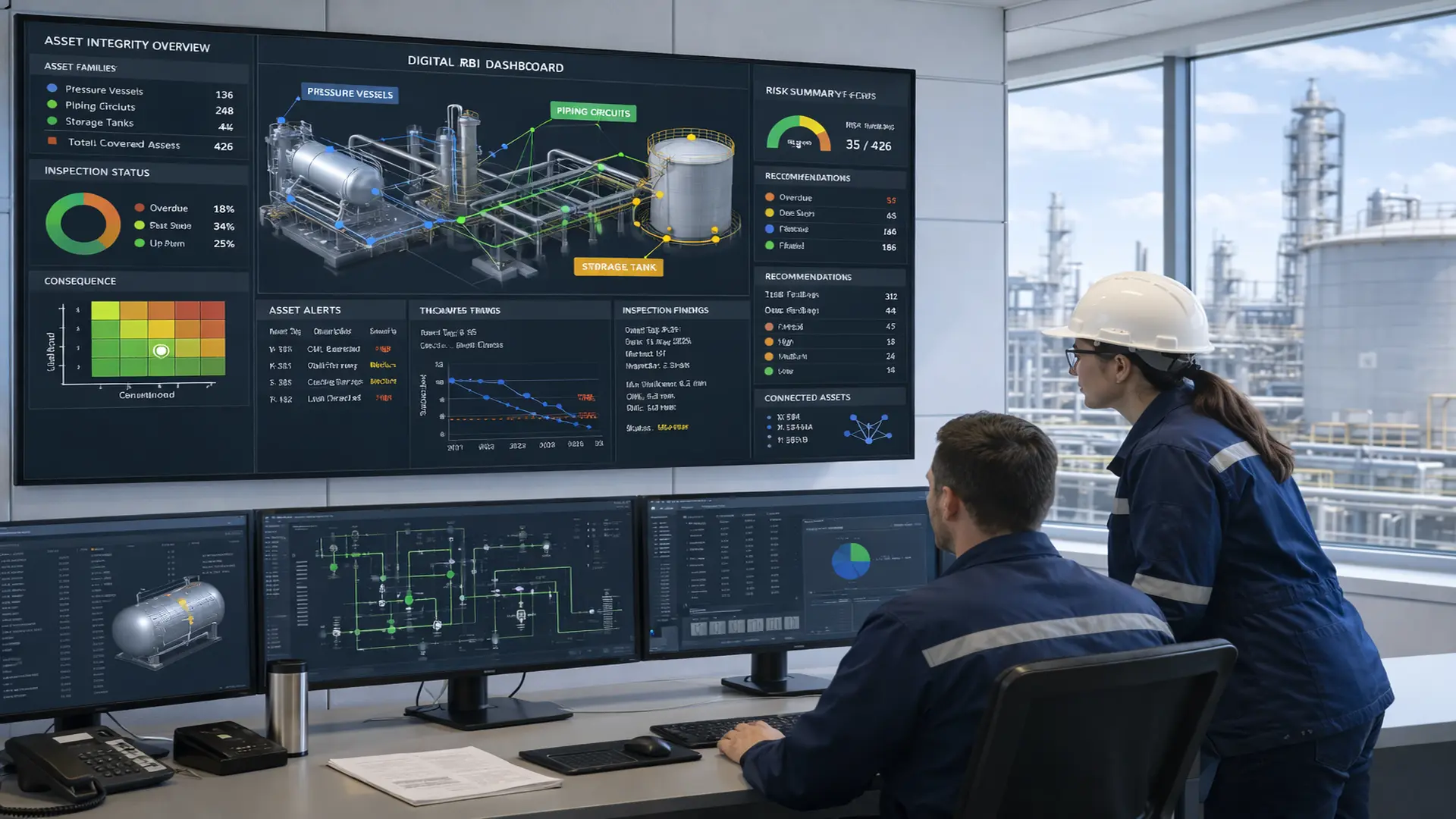
Integrity must respect the real structure of assets. The interface matters less than the quality of the technical architecture. It must handle hierarchies, components, circuits, CML/TML, reports, photographs, trends, damage mechanisms, recommendations, and links to maintenance, while performing consistent calculations. For vessels, it must retain design data, materials, pressure, temperature, and MAWP. For piping, it must manage circuits, minimum thicknesses, corrosion rates, remaining life, and service conditions.
For tanks, it must recognize bottom, shell, roof, nozzles, settlement, and API 653 conditions. An integrity platform must adapt to asset logic, applicable codes, and the inspection, maintenance, and reliability workflow.
Interoperability is another requirement. An IDMS should not become a parallel system competing with SAP, CMMS, EAM, or reliability platforms. It must communicate with them so that recommendations generate actions, and actions update history.
Mobility and technical visualization
Inspection occurs in the field: classified areas, confined spaces, elevated zones, hot lines, tank dikes, or units with limited connectivity; therefore, mobility is key. A robust platform must allow data capture, photographs, checklists, and NDT readings even without continuous connection.
Visualization also adds value. Corrosion maps, isometrics, 3D models, or digital twins help understand the distribution of deterioration. These tools enable inspection, engineering, maintenance, and management to integrate in reviewing an asset, its location, and risk priority.
Conclusions
Digital RBI gains value when it converts the real condition of an asset into a verifiable basis for deciding intervals, inspection coverage, and mitigation actions. API 510, API 570, and API 653 retain their scopes over pressure vessels, piping systems, and storage tanks, while API 580 and API 581 provide the logic to weigh risk, consequence, uncertainty, and inspection effectiveness.
The technical integration of this data enables the transition from isolated inspections to continuous degradation control. Each thickness reading, visual finding, damage mechanism, and recommendation must feed a decision: remain in service, increase coverage, repair, re-rate, mitigate, or accept documented residual risk. Thus, integrity management ceases to depend on scattered files and becomes a technical tool to protect availability, safety, and operational continuity.
References
- American Petroleum Institute. (2016). API Recommended Practice 580: Risk-Based Inspection (3rd ed.). American Petroleum Institute.
- American Petroleum Institute. (2016). API Recommended Practice 581: Risk-Based Inspection Technology (3rd ed.). American Petroleum Institute.
- American Petroleum Institute. (2014). API Standard 510: Pressure Vessel Inspection Code: In-service Inspection, Rating, Repair, and Alteration (10th ed.). American Petroleum Institute.
- American Petroleum Institute. (2016). API Standard 570: Piping Inspection Code: In-service Inspection, Rating, Repair, and Alteration of Piping Systems (4th ed.). American Petroleum Institute.
Frequently asked questions (FAQs)
What does digital RBI provide?
It integrates inspection data, risk, remaining life, and recommendations. It allows API 510, API 570, and API 653 to be managed with their own criteria but within a common integrity framework.
What does an IDMS prevent?
It prevents duplicated data, isolated reports, untracked recommendations, and loss of traceability. It also reduces errors derived from manual transcription and uncontrolled versions.
How are critical assets integrated?
It connects pressure vessels, piping systems, and tanks through common data: asset, component, measurement point, damage mechanism, risk, recommendation, action, and closure eviden
How does it prioritize maintenance and investment?
Digital RBI directs resources toward equipment that represents the highest risk. Thus, maintenance, CAPEX, and OPEX are prioritized based on real condition, criticality, remaining life, and consequence—not just schedule.