Table of Contents
- What is API 626 in LNG engineering
- Technical scope of API 626
- What changes with API 626
- LNG tank inspection under API 626
- Damage in cryogenic tanks according to API 626
- API 626 vs 653 in industrial engineering
- When to apply API 626 and not API 653?
- Practical consequences of API 626 in LNG
- Revalidation of cryogenic tanks
- Inspection best practices according to API 626
- Common mistakes when applying API 626
- Conclusions
- References
Cryogenic tanks used in LNG and refrigerated storage operate under extreme conditions that cannot be evaluated with traditional inspection approaches. In this context, API 626 emerges as a key reference for the inspection and evaluation of in-service cryogenic tanks, redefining how the integrity of these critical assets is managed. Its approach addresses historical limitations in the industry and raises new questions about the real reliability of these systems. This article examines the importance of this standard in modern LNG.
What is API 626 in LNG engineering
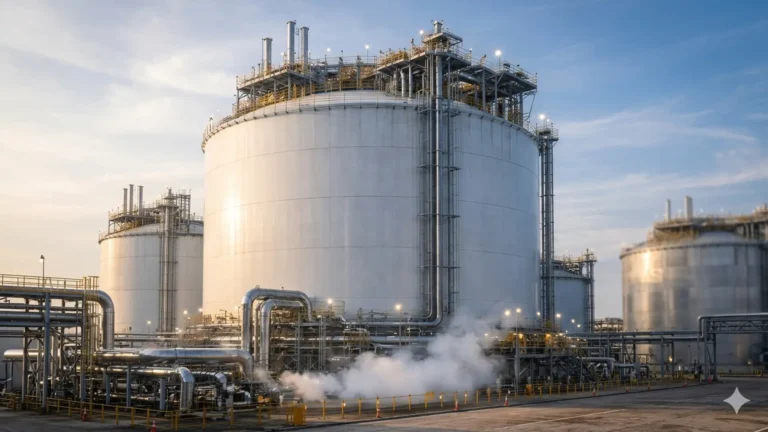
It is a recommended practice focused on the Inspection and Evaluation of Refrigerated and Cryogenic Tanks. The objective is not design, but the in-service evaluation of cryogenic assets. In this context, API 626 applies to LNG systems, ethylene, and other liquefied gases.
This is particularly important in facilities where cryogenic tanks operate under extreme thermal cycles. It establishes criteria for structural integrity, insulation, and operational performance. In modern engineering, it is highly relevant to the lifecycle management of LNG assets..
Technical scope of API 626
The scope covers a wide range of cryogenic tank configurations and designs, making it particularly well-suited for heterogeneous systems.
Among the systems covered are:
- LNG tanks
- Industrial refrigerated systems
- Full Containment Tank configurations
- Systems with Inner Tank / Outer Tank
- Installations with Perlite Insulation
- Tanks designed under API 625
- Tanks designed under API 620
- Tanks designed under EN 14620
- Proprietary EPC designs
- Single, double, and full containment systems
- Tanks with steel + concrete
What changes with API 626
The implementation of this recommended practice introduces fundamental changes in industrial inspection. Before, approaches were extrapolated from atmospheric standards.
The following are incorporated:
- Advanced thermal evaluation.
- Control of Boil-Off Gas behavior.
- Structural analysis of cryogenic tanks.
- Settlement Monitoring.
- Evaluation of embrittlement under Brittle Fracture conditions.
Each of these aspects is integrated, redefining modern LNG inspection.
LNG tank inspection under API 626
Inspection of LNG tanks under API 626 is based on non-intrusive methodologies. In practice, prioritizes in-service evaluation.
Typical activities include:
- Operational document review according
- Thermal history evaluation
- External inspection of cryogenic structures
- Boil-Off Gas monitoring
- Thermal insulation evaluation
The application reduces the need for internal interventions, optimizing cryogenic tank operation.
Damage in cryogenic tanks according to API 626
This primarily involves identifying specific damage mechanisms. These types of damage differ from those found in atmospheric tanks.
Among the most relevant:
- Brittle Fracture
- Thermal fatigue
- Corrosion under insulation
- Failures in Perlite Insulation
- Differential settlements in structures
- Degradation of Inner Tank / Outer Tank systems
API 626 vs 653 in industrial engineering
This comparison is important for understanding its application.
API 626 focuses on cryogenic tanks, while API 653 applies to atmospheric tanks under API 650.
Main differences:
- API 626: LNG and cryogenics
- API 653: hydrocarbons at ambient temperature
- API 626: advanced thermal evaluation
- API 653: corrosion and structural geometry
Main differences
| Criteria | API 626 | API 653 |
|---|---|---|
| Tank type | Cryogenic and refrigerated | Conventional atmospheric |
| Extreme temperatures | Yes | Limited |
| Thermal insulation | Yes | Not central |
| LNG | Yes | Not specific |
| Double-wall tanks | Yes | Partial |
| Embrittlement | Yes | Limited |
| LNG revalidation | Yes | Not specific |
When to apply API 626 and not API 653?
The selection depends on the type of service, thermal regime, and asset design.
API 626 should be applied in systems operating with cryogenic or refrigerated fluids such as LNG, ethylene, or liquefied industrial gases. These include advanced configurations such as Full Containment Tank, double-wall systems, and structures with Inner Tank / Outer Tank, where phenomena such as Brittle Fracture, insulation degradation, and Boil-Off Gas control occur. In these cases, inspection requires specific criteria due to differences in material interaction, thermal cycles, and extreme operating conditions.
On the other hand, API 653 applies to atmospheric tanks designed under API 650, used in the storage of crude oil, fuels, and products at ambient temperature. Its approach focuses on corrosion, settlements, and geometric evaluation of homogeneous welded structures.
The difference is conceptual: API 653 addresses standardized and homogeneous tanks, while API 626 is designed for complex, multi-code systems with high thermal criticality. In LNG terminals, is the main reference for inspection, while API 653 does not adequately cover these scenarios. Therefore, it is the preferred standard in cryogenics.
Practical consequences of API 626 in LNG
The implementation in LNG systems generates operational benefits:
- Improved reliability of cryogenic tanks.
- Reduction of Boil-Off Gas losses.
- Maintenance optimization.
- Improved energy efficiency.
- Extended service life through.
It also enables better planning of LNG inspections.
Revalidation of cryogenic tanks
Revalidation of LNG tanks under API 626 is essential for aging assets. Enables long-term structural and thermal integrity assessment.
This process includes:
- Remaining life evaluation.
- Settlement review.
- Thermal insulation inspection.
- Historical operation analysis.
Inspection best practices according to API 626
To properly implement, the following recommendations should be considered:
- RBI approach: Combine probability and consequence of failure.
- Historical database.
- Record temperatures, levels, emissions, and maintenance.
- NDT adapted to material.
- Not all techniques perform equally in stainless steel, nickel, or carbon steel.
- Specialized personnel.
- Cryogenic tank inspection requires knowledge of materials, welding, and LNG operation.
- Multidisciplinary integration.
- Operations, maintenance, process, civil, and mechanical engineering must be involved.
Common mistakes when applying API 626
- Copying API 653 frequencies without technical analysis
- Ignoring increases in Boil-Off Gas
- Not reviewing settlements
- Underestimating insulation degradation
- Evaluating only the visible shell
- Omitting Inner Tank / Outer Tank interaction
- Not documenting operational changes
Conclusions
API 626 redefines the inspection of cryogenic tanks by introducing a specialized approach for LNG systems. Unlike other standards, enables the evaluation of multi-code assets under real operating conditions. Its main value lies in filling the existing regulatory gap in industrial cryogenics. Compared to API 653, provides a more suitable framework for refrigerated systems, ensuring integrity, safety, and efficiency in modern LNG facilities.
References
- American Petroleum Institute. (2020). API Standard 620: Design and construction of large, welded, low-pressure storage tanks. API Publishing Services.
- American Petroleum Institute. (2014). API Standard 653: Tank inspection, repair, alteration, and reconstruction. API Publishing Services.
- American Petroleum Institute. (2023). API Recommended Practice 626: Inspection and evaluation of refrigerated and cryogenic tanks. API Publishing Services.
- EN 14620-1. (2019). Design and manufacture of site-built, vertical, cylindrical, flat-bottomed steel tanks for the storage of refrigerated, liquefied gases with operating temperatures between 0 °C and -165 °C. European Committee for Standardization.
- BSI. (2010). BS 7777: Flat-bottomed, vertical, cylindrical storage tanks for low temperature service. British Standards Institution.
- ASME. (2021). ASME Boiler and Pressure Vessel Code, Section VIII: Pressure vessels. American Society of Mechanical Engineers.
- CEN. (2018). EN 1473: Installation and equipment for liquefied natural gas — Design of onshore installations. European Committee for Standardization.