Table of Contents
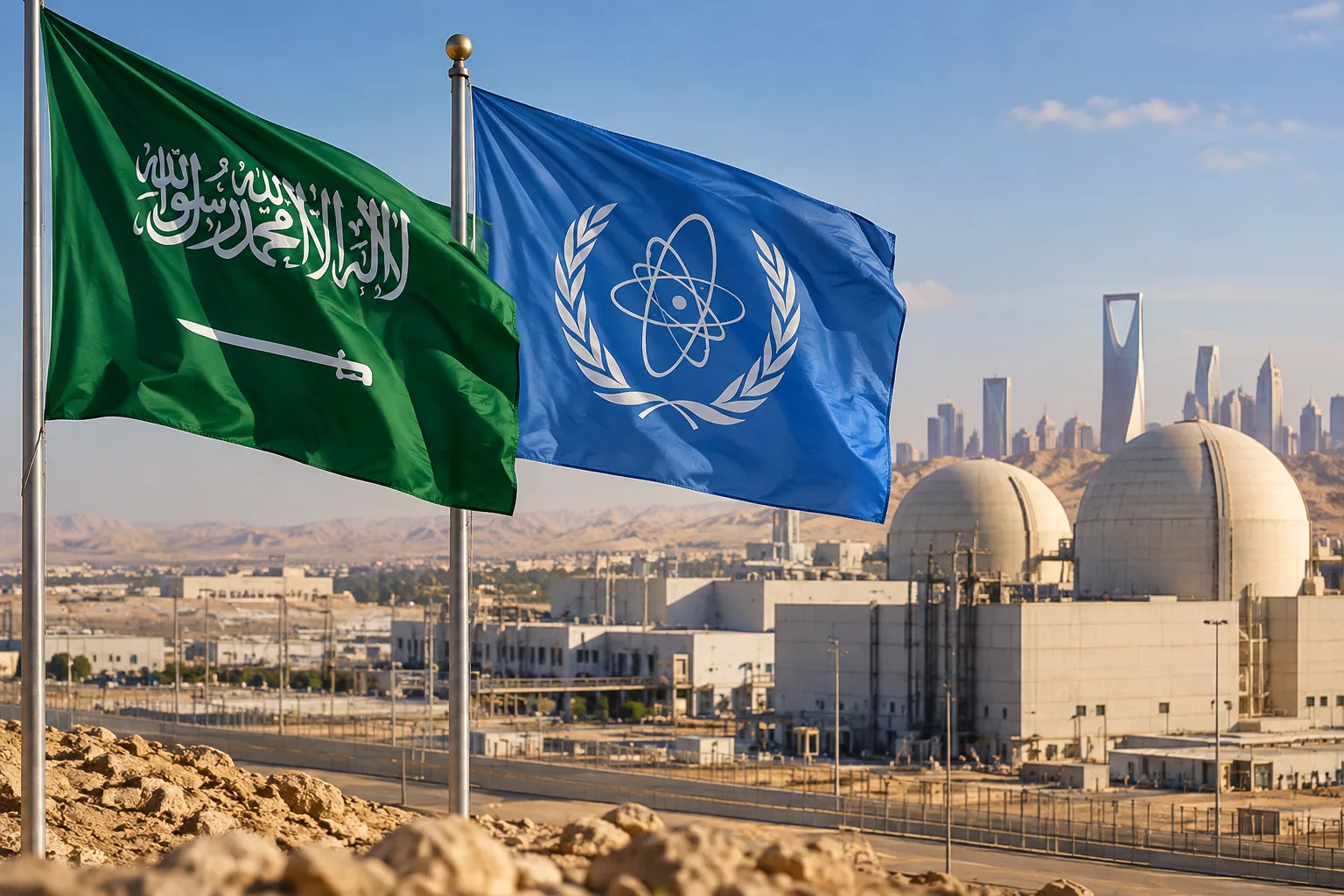
The Saudi Arabia nuclear program is moving toward a stage in which reactor development and the nuclear fuel cycle will be accompanied by enhanced international verification capabilities. The country is preparing new provisions that would allow the International Atomic Energy Agency (IAEA) to expand its monitoring of sensitive activities related to uranium enrichment, uranium conversion, and potentially nuclear fuel reprocessing.
The change is gaining relevance as Saudi Arabia develops its civil nuclear energy strategy and evaluates infrastructure that could include reactors built with U.S. technology. Beyond adding generation capacity, the challenge will be to establish a system capable of integrating technology, fuel, safety, and nuclear material traceability under international oversight mechanisms.
What will the IAEA oversee in the Saudi Arabia nuclear program?
Saudi Arabia maintains a Comprehensive Safeguards Agreement with the IAEA, but the new provisions could expand the agency’s verification powers over certain nuclear fuel cycle activities.
Rafael Grossi, Director General of the IAEA, explained that additional verification and monitoring authorizations are being prepared for processes considered sensitive. These include uranium enrichment, uranium conversion, and the reprocessing of used nuclear fuel.
The scope is significant because Riyadh does not currently plan to formally adopt the Additional Protocol, an instrument that provides the agency with broader inspection capabilities. However, Grossi indicated that the new powers envisaged for certain activities would be very similar to those available under that framework.
This approach connects with a trend observed in other new nuclear developments. For example, studies for a potential nuclear power plant in Norway incorporate non-proliferation and safeguards requirements from the early stages of evaluation.
Why does uranium enrichment require greater verification?
Enrichment modifies the concentration of the U-235 isotope present in uranium to obtain material with the characteristics required for different nuclear applications.
Its importance within the supply chain can be seen in projects such as the expansion of the Georges Besse 2 uranium enrichment plant, which will add new modules to increase Europe’s enriched uranium production capacity.
From a safeguards perspective, facilities of this type require systems capable of verifying inventories, movements, and the characteristics of nuclear material. Oversight is not limited to the reactor: it begins at earlier stages of the fuel cycle and continues throughout its use and subsequent management.
In Saudi Arabia, this dimension takes on greater importance because the civil nuclear cooperation agreement reached with the United States includes the possibility of enriching uranium and developing reactors using U.S. technology.
Conversion and reprocessing expand the technical challenge
Before enrichment, uranium must go through different processing stages. One of these is conversion, which is necessary to prepare the material in a form compatible with certain enrichment technologies.
At the other end of the cycle is reprocessing, through which certain materials can be separated from irradiated nuclear fuel. Reuters specifically notes that this process can separate plutonium from used fuel, which is why it is among the activities that would receive additional oversight capabilities.
The management of irradiated fuel is also an area of growing industrial innovation. Inspenet has analyzed how new technologies seek to recycle used nuclear fuel, incorporating safeguards-by-design principles to maintain material traceability throughout processing.
Therefore, developing an integrated nuclear program involves much more than building power plants. It requires establishing a technical architecture that progressively covers the different stages of the fuel cycle.
Reactors are only one part of nuclear infrastructure
Cooperation between the United States and Saudi Arabia opens the possibility of incorporating U.S. technology to develop future reactors.
However, a nuclear power plant requires a considerably broader industrial chain: fuel supply and fabrication, storage, safety systems, instrumentation, maintenance, used fuel management, and regulatory capabilities.
Technological developments are also transforming this chain. The United States, for example, is already testing nuclear fuel enriched to 6% in a commercial reactor, an initiative aimed at evaluating longer operating cycles and improving fuel utilization. Each advance introduces associated requirements for characterization, material control, and verification.
Oversight and traceability will be pillars of nuclear expansion
The next step will be to turn the proposed provisions into a concrete verification framework. Once the details are finalized, the agreement between Saudi Arabia and the IAEA will have to be presented to the agency’s 35-member Board of Governors.
For the Saudi Arabia nuclear program, this development could become a fundamental technical component. Nuclear expansion requires demonstrating not only the ability to build and operate facilities, but also the capacity to control and document the materials used throughout their entire cycle.
In this scenario, reactors, enrichment, fuel, and oversight are no longer independent elements. They form part of the same nuclear infrastructure, where traceability and international verification will be as important as the electricity generation capacity itself.
Source: Reuters