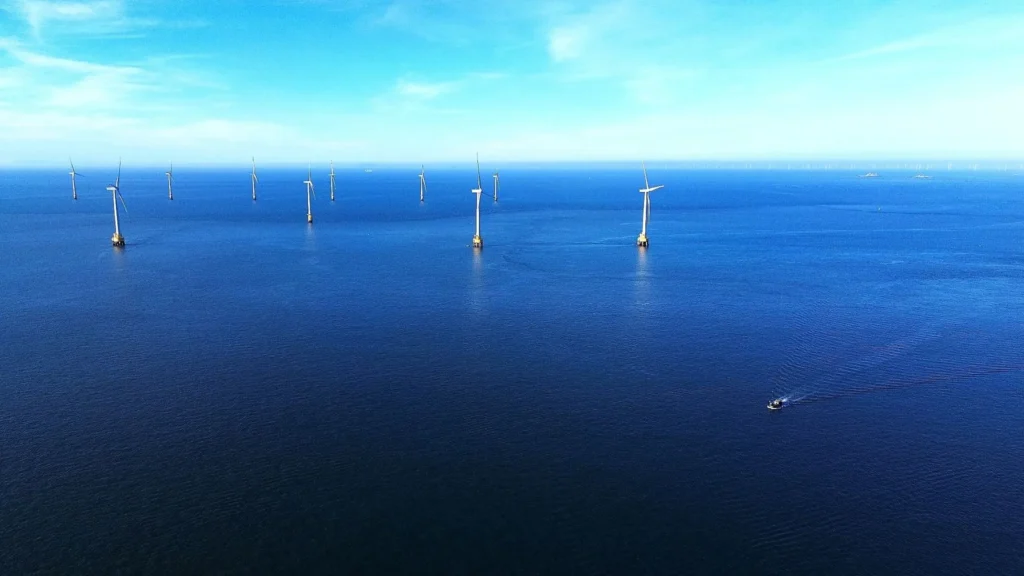
Offshore wind turbines from the Qingzhou V and VII projects have been connected to the grid by China Three Gorges Corporation (CTG), following the initial commissioning of the first five units at the complex located off the coast of Yangjiang, in China’s Guangdong province. This connection marks the beginning of the grid integration of one of China’s most important offshore installations, with a combined planned capacity of 2 GW.
The Qingzhou V and VII project begins its electrical connection
The offshore wind farms Qingzhou V and VII are located approximately 70 kilometers off the coast of Yangxi County and consist of 163 wind turbines designed to operate in deep water. The complex faces demanding maritime conditions, with depths exceeding 50 meters, requiring advanced installation, foundation, and maintenance solutions.
The connection of the first units marks the beginning of the gradual commissioning of the project’s generating capacity. During the next phases, the technical teams will continue with operational testing, verification of the electrical systems, and the progressive start-up of the remaining turbines until the total planned capacity is reached.
This advance allows for the validation of the integration between offshore generation systems, converter stations, and submarine electrical transmission infrastructure, essential elements for transporting renewable energy from remote marine areas to consumption centers.
Offshore wind turbines powered by ±500 kV HVDC transmission
One of the main technological elements of the project is the ±500 kV high voltage direct current (HVDC) transmission system. This infrastructure allows large amounts of electricity generated offshore to be transported to land via submarine cables, reducing energy losses associated with long transmission distances.
The electricity produced by the wind turbines is collected via 66 kV submarine cables and then sent to the Hai Feng Zhi Xin offshore converter station, known as the “Heart of Offshore Wind Energy.” At this facility, the energy is transformed and stepped up to the levels required for transmission to the onshore power grid.
The application of HVDC technology is fundamental to offshore wind projects large-scale projects, especially those located far from the coast, where the electrical evacuation distance represents one of the main engineering challenges.
Technology for offshore wind farms in deep waters
CTG reported that the system was designed to manage the combined generation of the Qingzhou V and Qingzhou VII projects, incorporating equipment and components developed within China, including marine foundations, wind turbines, submarine cables, and electrical conversion and transmission systems.
The development responds to the technical challenges associated with the construction of offshore wind farms in deep waters, where factors such as waves, marine corrosion, limited accessibility and extreme environmental conditions directly influence the operation and maintenance of the assets.
The integration of domestically produced manufacturing technologies also seeks to strengthen China’s capacity in developing large-scale marine renewable infrastructure and consolidate solutions applicable to future larger-scale offshore projects.
Qingzhou V and VII will supply clean energy to Guangdong-Hong Kong-Macau
When the projects reach full operation, Qingzhou V and VII are estimated to supply approximately 6 billion kWh of electricity per year to the Guangdong-Hong Kong-Macau Greater Bay Area, one of China’s most important economic regions.
According to CTG, this renewable generation will prevent approximately 5 million tons of carbon dioxide emissions annually, contributing to the reduction of emissions from the electricity system and the development of new clean energy infrastructure.
The progressive commissioning of these offshore wind farms reflects the expansion of offshore energy as a strategic alternative to increase renewable generation, especially in regions with high energy demand and limited land space.
Source: Hmt News
Photo: Shutterstock