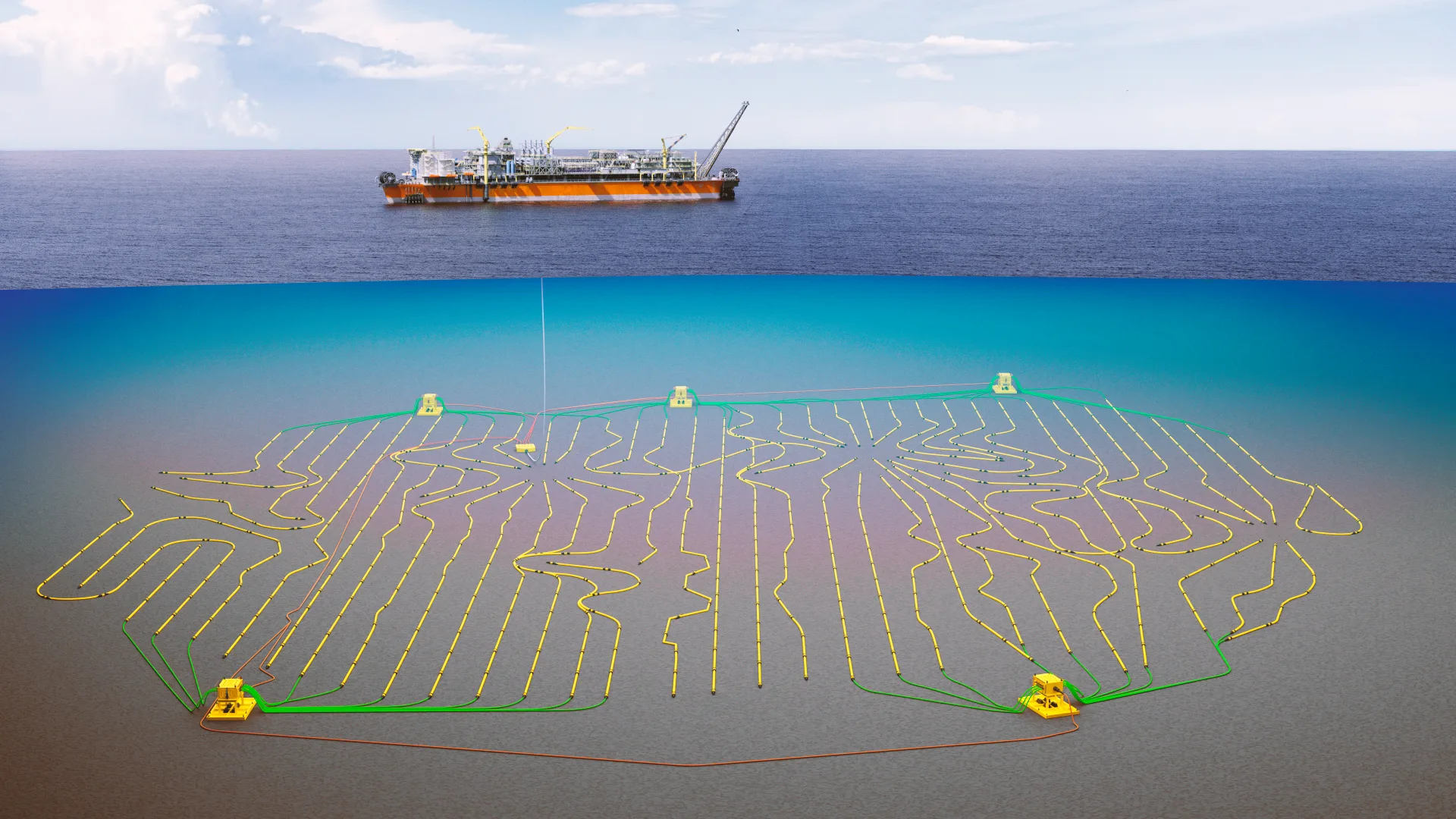
Petrobras has announced an investment of US$450 million to develop the world’s largest seismic monitoring system, which will be implemented in the Mero field, located in the Santos Basin, one of the most productive areas of the Brazilian pre-salt.
A seismic monitoring system on an unprecedented scale
The first phase of the project involves the installation of over 460 kilometers of seismographic cables, covering an area of 222 km² on the seabed, and the second phase will add an additional 316 kilometers, extending monitoring to another 140 km² of the subsea network. This deployment is carried out at an approximate depth of 2,000 meters, reflecting the technical complexity of the project.
How does the PRM system work?
The seismic monitoring system is based on PRM (Permanent Reservoir Monitoring) technology, which uses sensors installed at the bottom or structure of the well to record real-time data, continuously transmitting it to the surface for immediate analysis and remote control.
This allows for real-time observation of reservoir behavior, including the pressure, temperature, and flow rate of oil, gas, and water within the reservoir. This information is crucial for making more precise operational decisions.
Petrobras will incorporate artificial intelligence tools in collaboration with the Federal University of Rio de Janeiro, which will enable the analysis of large volumes of seismic data, leading to a better interpretation of reservoir behavior to facilitate production management.
Integration with FPSO platforms in the Mero field
The system will be connected to several floating production, storage, and offloading platforms, including the FPSO Guanabara and Sepetiba, corresponding to the initial development phases.
Subsequently, the Duque de Caxias and Alexandre de Gusmão units will be added, expanding the scope of monitoring in the field. Thanks to this integration, data will initially be processed on the platforms and, in the future, transmitted via fiber optic to onshore control centers.
An important project for Brazil’s energy future
Finally, the development of this system positions Petrobras and Brazil as leaders in innovation within the deepwater oil industry. As the Mero field continues to expand its production, these types of technological solutions will be crucial to ensure more efficient utilization of natural resources.
Source: Petrobras