Table of Contents
- Methane Regulation Drives New Standards for Energy Trade
- Methane Monitoring Gains Prominence in the Industry
- Emissions Verification Becomes a Competitive Advantage
- Energy Security and Energy Transition Seek a New Balance
- Asset Integrity Acquires a Strategic Role
- Methane Control Redefines the Energy Sector's Competitiveness
Methane regulation is becoming one of the most influential factors in international oil and gas trade over the coming years. As major markets incorporate new requirements to control emissions associated with hydrocarbon production, processing, and transport, exporters will need to demonstrate the environmental performance of their operations with greater accuracy to maintain access to strategic markets such as the European Union.
Beyond regulatory compliance, this transformation is driving investments in monitoring technologies, emissions verification systems, and asset integrity programs that seek to reduce methane leaks without compromising energy supply security.
Methane Regulation Drives New Standards for Energy Trade
The European Union is advancing the implementation of a regulatory framework that will demand higher levels of transparency regarding methane emissions associated with oil and gas imports.
Although European authorities are analyzing mechanisms to facilitate industry adaptation during the initial phase of implementation, the long-term objective remains intact: to ensure that fossil fuels traded into the European market meet increasingly strict environmental performance criteria.
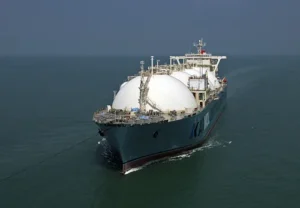
This evolution marks a significant change for producers, infrastructure operators, traders, and liquefied natural gas (LNG) exporters, who will need to integrate new monitoring and reporting processes into their operations.
Methane Monitoring Gains Prominence in the Industry
Methane emission reduction no longer depends solely on voluntary initiatives. In recent years, the development of specialized technologies has made it possible to identify and quantify leaks with a level of precision previously unattainable.
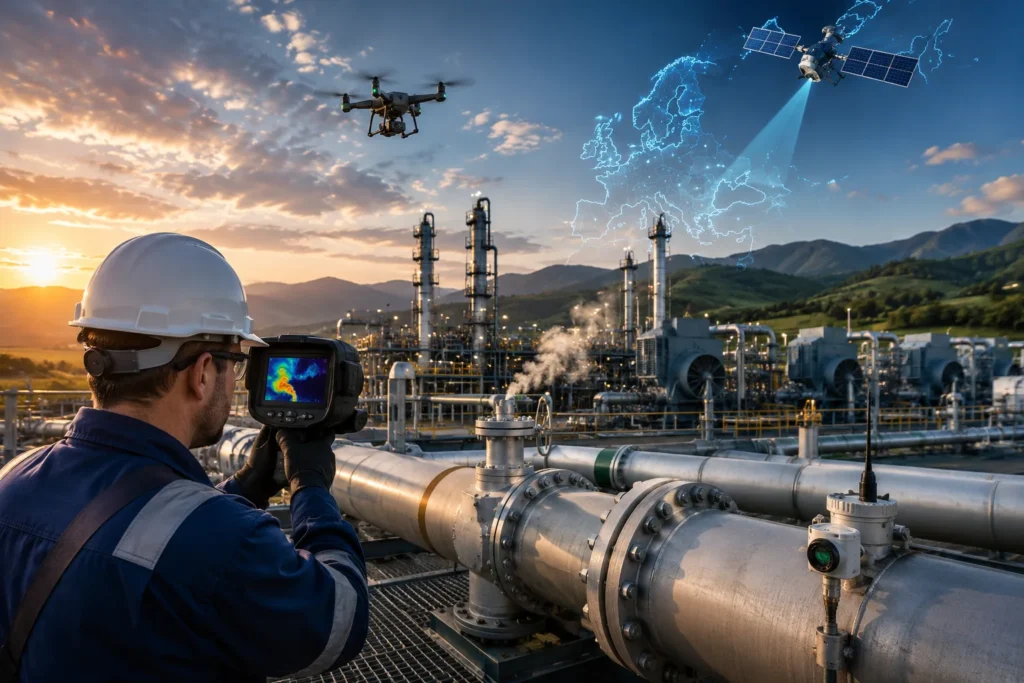
Currently, oil and gas operators are incorporating solutions such as optical gas imaging (OGI) cameras, permanent sensors, drones equipped with methane analyzers, satellite monitoring, and digital platforms capable of supervising facilities in real time.
These tools strengthen Leak Detection and Repair (LDAR) programs and enable faster response to fugitive emissions, simultaneously improving operational safety and the environmental performance of assets.
Emissions Verification Becomes a Competitive Advantage
One of the industry’s biggest challenges is not just reducing emissions, but objectively demonstrating that these reductions are actually being achieved.
Monitoring, Reporting and Verification (MRV) systems are playing an increasingly relevant role in supporting the information presented by producers and exporters to clients, regulators, and investors.
The availability of standardized methodologies, measurement protocols, and verifying bodies will be a decisive element in facilitating regulatory compliance and strengthening confidence in international energy supply chains.
In this scenario, data quality is beginning to have a strategic value comparable to that of production itself.
Energy Security and Energy Transition Seek a New Balance
The tightening of environmental requirements coincides with an international context marked by the need to guarantee energy supply.
Europe continues to diversify its supply sources while progressively reducing its dependence on certain traditional suppliers. However, this strategy also requires finding a balance between climate objectives and the availability of fuels necessary to maintain the stability of the energy system.
This challenge explains why European authorities are evaluating mechanisms to facilitate the transition to new requirements without disrupting trade flows.
Asset Integrity Acquires a Strategic Role
Methane management is no longer limited to an environmental issue. It also directly depends on the reliability of the infrastructure used to produce, process, transport, and store hydrocarbons.
Inspection programs, predictive maintenance, continuous monitoring, and mechanical integrity help reduce the risk of fugitive emissions through early detection of failures in valves, compressors, connections, tanks, compression stations, and transport systems.
For pipeline operators, processing plants, LNG terminals, and upstream producers, these practices represent a key tool for meeting new regulatory demands while preserving operational continuity.
Methane Control Redefines the Energy Sector’s Competitiveness
Methane regulation is ceasing to be an exclusively environmental requirement and is becoming a new criterion for competitiveness within the international oil and gas trade.
Companies that incorporate advanced monitoring technologies, robust asset integrity programs, and reliable verification systems will be better prepared to access markets with higher regulatory demands and respond to a growing demand for lower-emission fuels.
More than a regulatory obligation, efficient methane management is consolidating as a strategic element to strengthen the sustainability, operational security, and competitiveness of the global energy sector.
Source: WorldOil