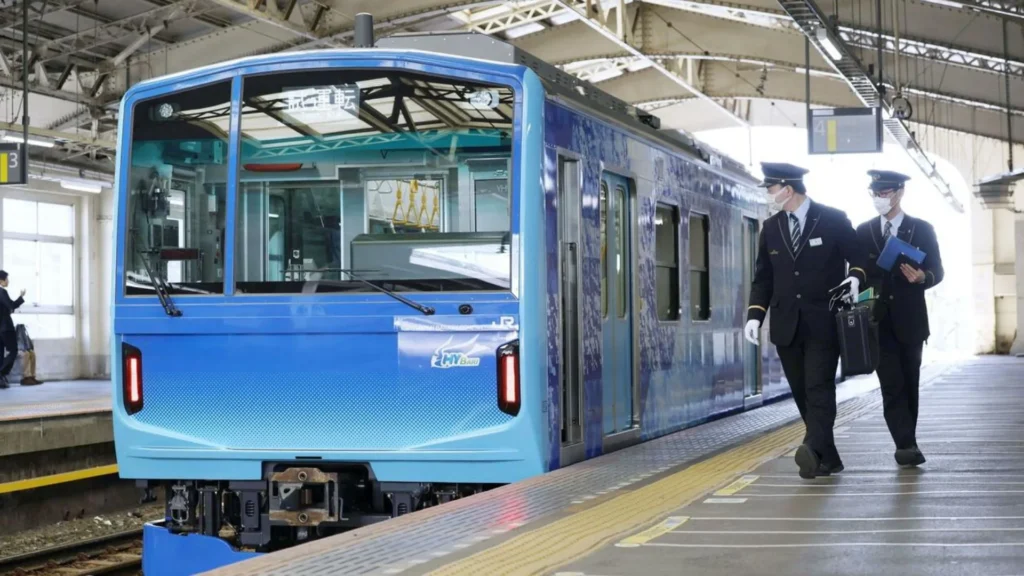
JR East will put the HYBARI hydrogen train into service at the end of fiscal year 2027 on several routes in Kanagawa Prefecture.
East Japan Railway Company, known as JR East, is preparing to launch Japan’s first hydrogen-powered hybrid train. The company plans to introduce the HYBARI train by the end of fiscal year 2027 after several years of technical testing.
The train will run on sections of the Tsurumi and Nambu lines near Tokyo. With this addition, JR East seeks to reduce the use of diesel units and expand the presence of lower-emission energy technologies on its rail network.
How the HYBARI hydrogen train works
HYBARI is a hybrid rail vehicle equipped with fuel cells and storage batteries, the system generates electricity through a chemical reaction between hydrogen stored on board and oxygen from the air.
During this process the train does not produce direct carbon dioxide emissions, the electricity generated powers the motors and can also be stored in batteries to respond to different operating conditions.
The name HYBARI stands for Hydrogen-Hybrid Advanced Rail Vehicle for Innovation, the unit belongs to the FV-E991 series and was developed to evaluate the use of hydrogen on routes where full electrification may be complex or expensive.
Furthermore, the combination of fuel cells and batteries allows for better use of available energy. The batteries can assist acceleration and receive some of the electricity recovered during braking.
A range of approximately 70 kilometers
According to project data, the hydrogen train can travel approximately 70 kilometers on a single refueling. Refueling will take place at the Kamakura Rolling Stock Depot in Nakahara, next to the Musashi-Nakahara station.
This autonomy will allow the planned routes between Tsurumi and Ogimachi on the Tsurumi line to be covered, and will also serve the section located between Shitte and Hama-Kawasaki on the Nambu branch.
JR East began demonstration testing in March 2022, since then the operator has evaluated the vehicle’s performance, system stability and its response under normal rail operating conditions.
Now the company will adapt the unit to meet the requirements of commercial service; these modifications will cover daily operation, refueling, and integration of the train with the existing infrastructure.
JR East is preparing a next-generation version
In parallel, JR East will begin developing a new hybrid hydrogen train with greater range and operational capacity. The project envisions using hydrogen stored at a pressure of 70 megapascals.
The company aims to apply this pressure for the first time in the world inside a railway vehicle; the technical objective is to achieve a range comparable to that of diesel railcars.
The project also aims to improve performance on routes with long inclines and expand the number of lines where this technology could be used. The new model is expected to enter commercial service by the end of fiscal year 2030.
JR East will also develop facilities capable of supplying high-pressure hydrogen in less time, the speed of refueling will be a crucial factor in integrating these trains into regular schedules.
Hydrogen is gaining ground in rail transport
The HYBARI project is part of JR East’s strategy to reduce its CO₂ emissions and increase the use of alternative energy sources. Fuel cell trains could replace diesel units on lines that lack overhead electrification.
However, its expansion will depend on the availability of hydrogen, the cost of the fuel, and the construction of refueling stations. It will also be necessary to ensure that the hydrogen used has a low environmental footprint during its production and transport.
Looking ahead, JR East will study the use of imported hydrogen and the potential international expansion of its rail system. The introduction of HYBARI will provide commercial data on consumption, range, maintenance, and reliability.
According to the planned schedule, Japan will incorporate its first hydrogen hybrid train into regular service in 2027. After that, the high-pressure version planned for 2030 could expand the reach of this technology both within and outside the country.
Source and photo: English.kyodonews.net