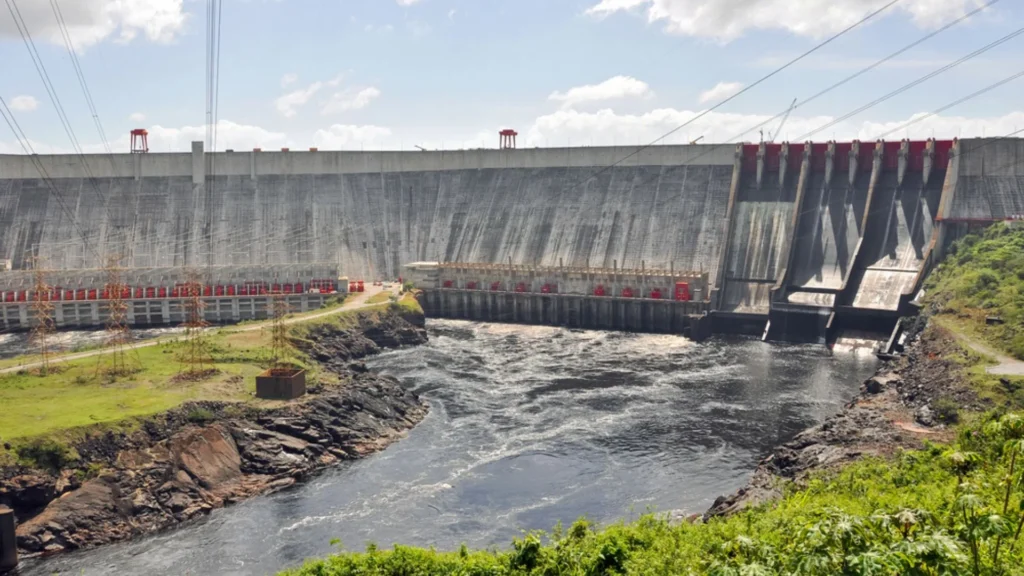
Venezuela and IMPSA signed the agreement on June 13, 2026 to complete the Manuel Piar Hydroelectric Plant, known as Tocoma, on the Caroní River in Bolívar state. The agreement provides for adding up to 2,640 MW to the National Electric System (SEN) through ten generating units, with an estimated annual output of approximately 12,100 GWh. In the short term, the first phase—14 to 19 months—aims to restore 672 MW by bringing the first two units online.
Tocoma is the last major plant in the Caroní complex, which also includes the Guri, Caruachi, and Macagua plants, and represents Venezuela’s largest effort to reverse an electricity deficit that causes daily outages in multiple regions of the country. The project began in 2006 with an operational target for 2012–2014, backed by an initial investment budgeted at US$3,061 million, but it never entered service. More than a decade of paralysis left equipment dispersed across four countries and the civil works unfinished on the Caroní.
Venezuela and IMPSA bet on restoring power capacity
The main operational challenge is not civil works, but asset management. Jorge Salcedo, president of IMPSA, confirmed to Reuters on June 9 that nearly 60% of the required electromechanical equipment has already been manufactured and remains in storage—mostly at the Mendoza plant in Argentina—along with components in the United States, Germany, and Paraguay. Turbines, generators, and auxiliary systems immobilized for years require systematic inspection, non-destructive testing, and technical requalification before proceeding with on-site installation.
“We have reached consensus on 90% of the contract’s technical and financial components,” Salcedo told Reuters days before the signing. IMPSA plans to incorporate new technology to replace obsolete or unavailable components identified in the inventory. The agreement’s financing includes bank backing with participation from the Andean Development Corporation (CAF), whose disbursement depends on the signing of the amended contract with the state power utility Corpoelec.
The mechanical integrity of long-stored assets will largely determine the feasibility of the committed schedule. Large electromechanical equipment—runners, stators, power transformers—is particularly sensitive to humidity, corrosion, and thermal cycles accumulated over years of inactivity. Rigorous application of commissioning protocols and applicable standards will be decisive in making the announced timelines achievable.
Tocoma aims to restore power capacity
Tocoma’s energy is strategic for the Guayana industrial complex, where primary aluminum, direct reduced iron, and steel plants operate. These facilities require continuous power supply to sustain electrolytic processes and arc furnaces, whose unplanned shutdown causes direct export losses and equipment deterioration. Restoring 672 MW in the short term would ease operational pressure on industries that currently operate with intermittent supply.
In early 2026, IMPSA obtained a U.S. license that cleared regulatory restrictions linked to sanctions, enabling contract negotiations. Acting president Delcy Rodríguez led the Venezuelan delegation at the signing and has identified reliable access to electricity as a government priority. Reuters reported that Caracas and Washington are also negotiating the release of Venezuelan funds blocked abroad to finance high-impact energy projects.
The agreement with IMPSA simultaneously activates EPC disciplines for electromechanical installation, commissioning of large turbines, and nationwide energy security management. For Venezuela’s engineering industry, the reactivation of Tocoma will represent the largest commissioning operation in decades. The schedule, foreign-currency availability, and the spare-parts supply chain will be the critical variables to monitor in the coming months.
Source: Sahm
Photo: Shutterstock