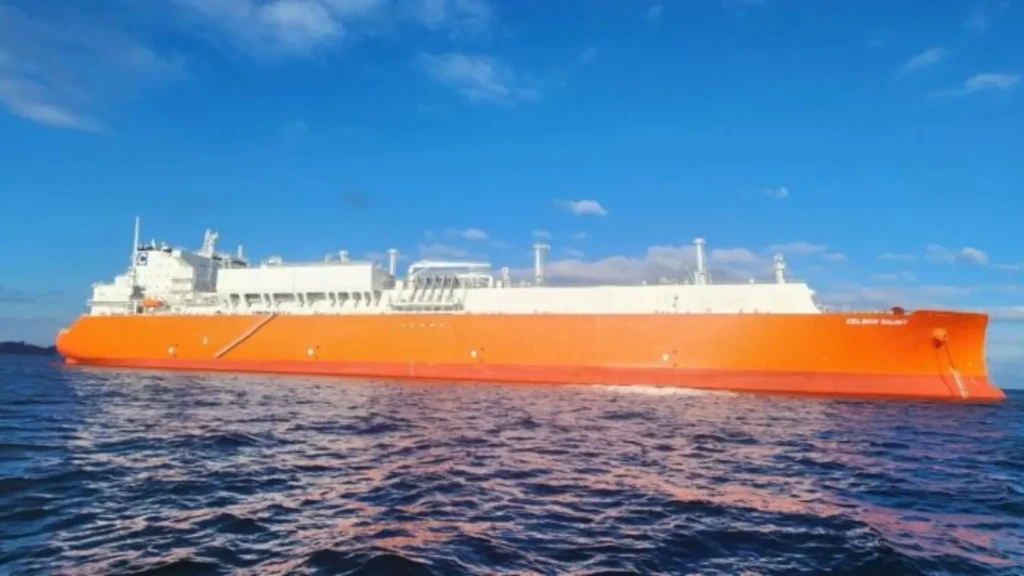
Exmar will supply and operate a floating storage and regasification unit in Abidjan with the aim of strengthening the natural gas supply from Ivory Coast.
Exmar agrees to deploy an FSRU in Abidjan
The Belgian shipping company Exmar signed multi-year agreements with Côte d’Ivoire Energies (CI-Energies) and Société Nationale d’Opérations Pétrolières de la Côte d’Ivoire (Petroci) to supply and operate a floating storage and regasification unit (FSRU) in the port of Abidjan.
The facility will have a storage capacity of 152,000 cubic meters and will allow the country to receive shipments of liquefied natural gas (LNG). Imports are scheduled to begin during the third quarter of 2027.
According to Exmar, the project will generate an estimated annual EBITDA of approximately $21.3 million. For the company, the contract represents a further expansion of its floating LNG infrastructure business and strengthens its presence in West Africa.
This project underscores our floating infrastructure solutions as a competitive and rapidly marketable solution for ensuring strategic energy supply. We look forward to forging a strong partnership with the Petroci and CI Energies teams, which we hope to strengthen in the future, Exmar stated.
Petroci will manage LNG imports
Petroci will be responsible for acquiring the LNG on the international market, the shipments will be sent to the FSRU, where the fuel can be stored and subsequently regasified before being delivered to CI-Energies.
This scheme will allow the incorporation of imported gas into energy system of Ivory Coast as a complement to domestic production. A significant portion of the supply will be used to support electricity generation.
The floating terminal will thus provide an additional and flexible source of natural gas at a time when the country’s energy consumption continues to rise. This growth is linked to economic and demographic expansion, as well as the development of sectors such as mining.
The demand for natural gas and electricity in Ivory Coast is growing with the country’s economic development, Petroci noted, referring to the importance of the project.
The company believes that the FSRU will contribute to diversifying supply sources and improving security of supply, complementing both domestic production and existing gas infrastructure.
The FSRU seeks to strengthen the security of gas supply
The project also responds to the need for larger volumes of gas to meet the growing demand for electricity and strengthen the country’s energy security.
For CI-Energies, a stable supply of natural gas will be fundamental to guaranteeing electricity generation. The combination of domestic production and LNG imports seeks to ensure sufficient fuel in the short, medium and long term.
The FSRU will allow LNG to be received from LNG carriers, stored, and converted back into gas before being fed into the energy system. This model offers a more flexible alternative to building a conventional onshore regasification terminal.
In this way, Ivory Coast will be able to supplement its national resources when domestic production is not enough to meet demand.
Exmar expands its activity in floating LNG infrastructure
The agreement in Abidjan adds to other recent moves by Exmar within the floating LNG infrastructure market. The company also recently received a LNG carrier that will be converted into a floating transshipment unit (FTU), intended for the growing market of supplying LNG as fuel for ships.
With the Ivory Coast project, Exmar adds a new regasification operation to its portfolio and expands its presence in West Africa, a region seeking new alternatives to guarantee the supply of natural gas and support the growth of its energy demand.
Source: Offshore Energy
Photo: Exmar