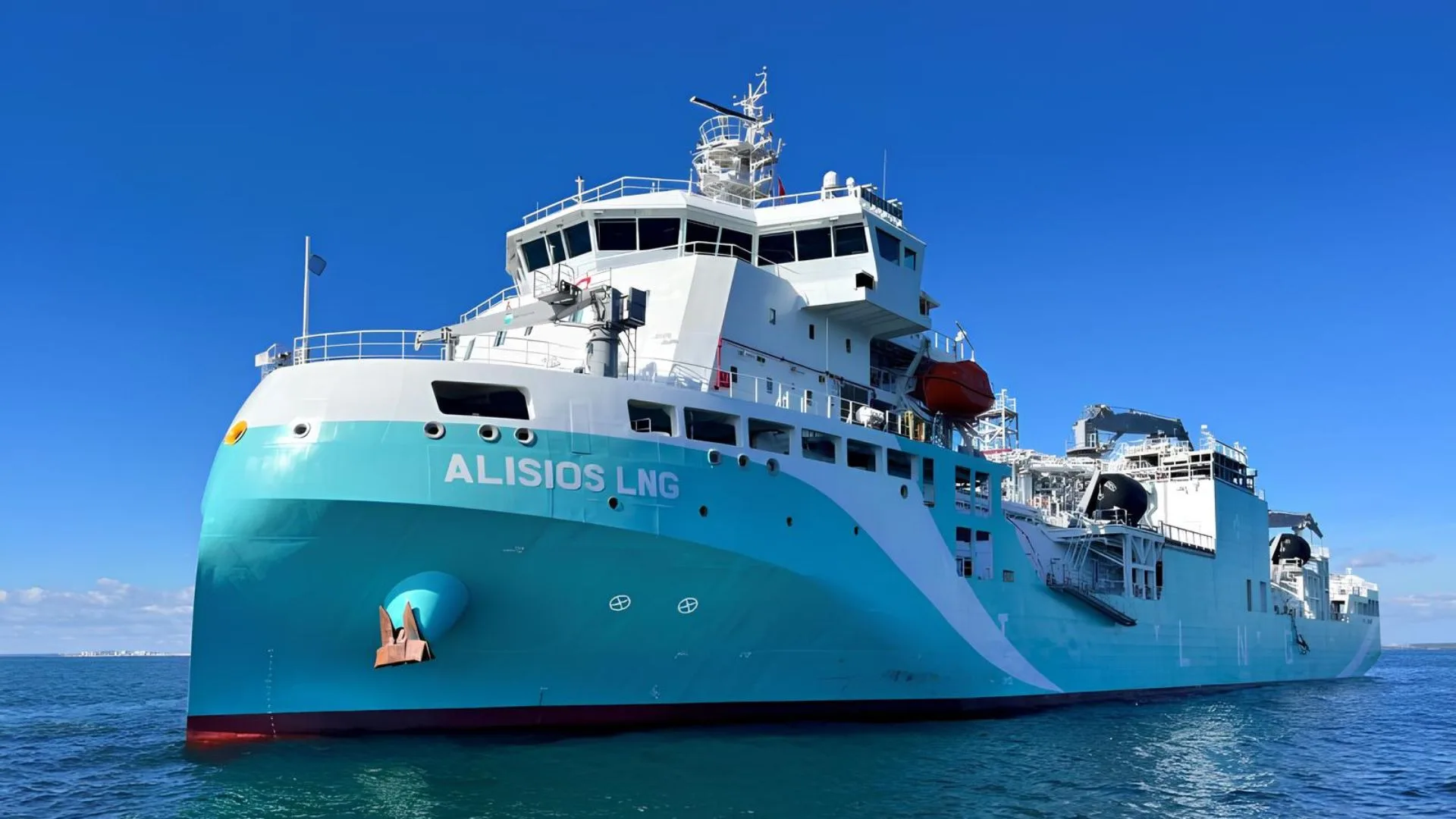
The Alisios LNG vessel was officially presented at the Port of Huelva. Promoted by Enagás and chartered by Axpo Iberia, the vessel will begin commercial operations in the south of the Iberian Peninsula to accelerate the decarbonization of maritime transport. The vessel will supply Liquefied Natural Gas (LNG) and liquefied biomethane (bio-LNG), considered key fuels for the energy transition in the maritime logistics sector.
A strategic alliance with industrial impact
The initiative is the result of a public-private partnership backed by state and regional authorities, such as the Secretary of State for Transport, José Antonio Santano, and the Andalusian Deputy Minister of Industry, Cristóbal Sánchez. Enagás, through its subsidiary Scale Green Energy, owns the vessel, while Axpo will be in charge of its commercial operation, consolidating its role as a major player in the small-scale LNG bunkering market.
The Alisios LNG has a storage capacity of 12,500 m³, allowing it to efficiently supply both LNG and bio-LNG. Equipped with advanced control systems and technology to keep the fuel in optimal condition, the vessel is designed to operate in various port environments, ensuring maneuverability and efficiency in its supply operations.
Infrastructure ready and long-term vision
This vessel joins a strategic fleet that includes other Enagás units such as Levante LNG, Mistral LNG, and Haugesund Knutsen. Spain’s seven regasification plants (Barcelona, Huelva, Cartagena, El Musel, Bilbao, Sagunto, and Mugardos) are already adapted to supply both LNG and bio-LNG, positioning Spain as a key logistics hub in Southern Europe for sustainable fuel supply.
A future powered by LNG and bio-LNG
The growth of LNG bunkering in Spain has been remarkable, with activity quadrupling between 2023 and 2025. In 2025, loadings increased by 64%, confirming the high demand for alternative fuels.
According to industry estimates, the use of LNG as a marine fuel could reduce CO2 emissions in Spain by nearly two million tons by 2030, the equivalent of replacing more than one million internal combustion vehicles with electric ones.
Source: Axpo