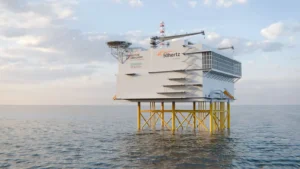
Ecowende begins publishing environmental data from Hollandse Kust West VI, a 760 MW offshore wind farm designed to study how offshore infrastructure can coexist with the North Sea ecosystem.
Ecowende has made publicly available the first environmental datasets collected at Hollandse Kust West VI, its 760 MW offshore wind farm located in the Dutch sector of the North Sea.
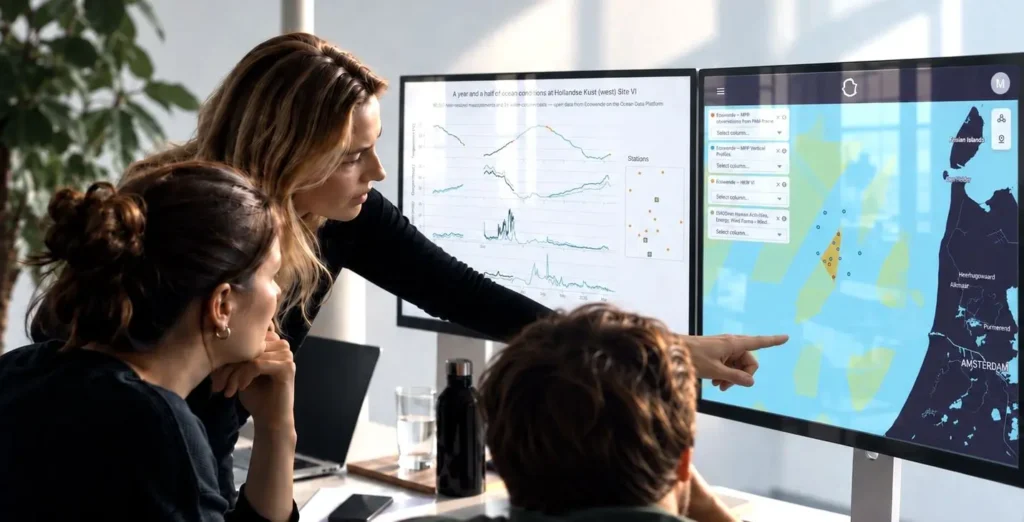
The information is distributed via HUB Ocean’s Ocean Data Platform and originates from systems specifically installed to monitor underwater conditions at the site.
The records include oxygen, chlorophyll, pH, temperature, turbidity, and salinity. Some measurements come from multiparameter probes installed on passive acoustic monitoring (PAM) structures, while monitoring campaigns incorporate vertical profiles capable of recording conditions at different depths of the water column.
Ecowende states that the data is organized under FAIR principles: findable, accessible, interoperable, and reusable, so that it can be combined with other oceanographic databases.
The objective is to enable researchers and specialists to analyze the environmental evolution of the area during the construction and operation of the wind farm.
The Wind Farm Incorporates a Second Layer of Monitoring
Two PAM structures installed in the northern and southern zones of Hollandse Kust West VI have collected continuous measurements near the seabed since August 2024. Vertical profiles complement these observations by providing information on the distribution of environmental variables throughout the water column.
This strategy allows for observing the environment at different scales. Measurements near the bottom taken by Ecowende provide information on conditions immediately associated with the structures’ location, while vertical profiles help identify variations between the surface and the bottom.
This differentiation is important for offshore installations. Variables such as temperature, salinity, oxygen, and turbidity are not constant throughout the entire water column and can experience variations associated with depth, currents, mixing, and weather conditions.
Having continuous measurements and vertical profiles allows for building a much more complete environmental reference than a single campaign.
The project is also reaching a decisive stage. Hollandse Kust West VI already has all 52 monopile foundations installed and the inter-array cables completed. The first turbine was installed in May, and the wind farm began supplying electricity to the Dutch grid in July.
300,000 Tons to Control Erosion
Another relevant component is erosion protection around the foundations. In July, Van Oord completed the installation of approximately 300,000 tons of scour protection .
The primary function of this system is to protect the seabed around the foundations from erosion caused by currents and the interaction of water flow with the structures. In Hollandse Kust West VI, however, the protection also forms part of the project’s ecological approach.
The incorporation of materials and geometries capable of providing additional surfaces and shelters can locally modify the available habitat for certain species.
This turns the area around the foundations into a space that can be studied not only from the perspective of structural integrity but also from the evolution of the ecosystem.
Ecowende: From Environmental Statement to Verifiable Data
The publication of the data introduces a significant difference in how the impact of offshore wind farms is assessed. Stating that an installation is “ecological” is an assertion; having open environmental data series allows independent researchers to study what is actually happening at the site.
The PAM systems began collecting continuous information in August 2024, before the wind farm became operational. This creates a temporal reference that can be used to compare environmental conditions during different stages of the project.
This continuity will be especially important when Hollandse Kust West VI reaches full operation, scheduled for the end of 2026. The data can help compare conditions observed during construction with those recorded during the operational phase.
SOURCE and PHOTO: https://www.offshorewind.biz/