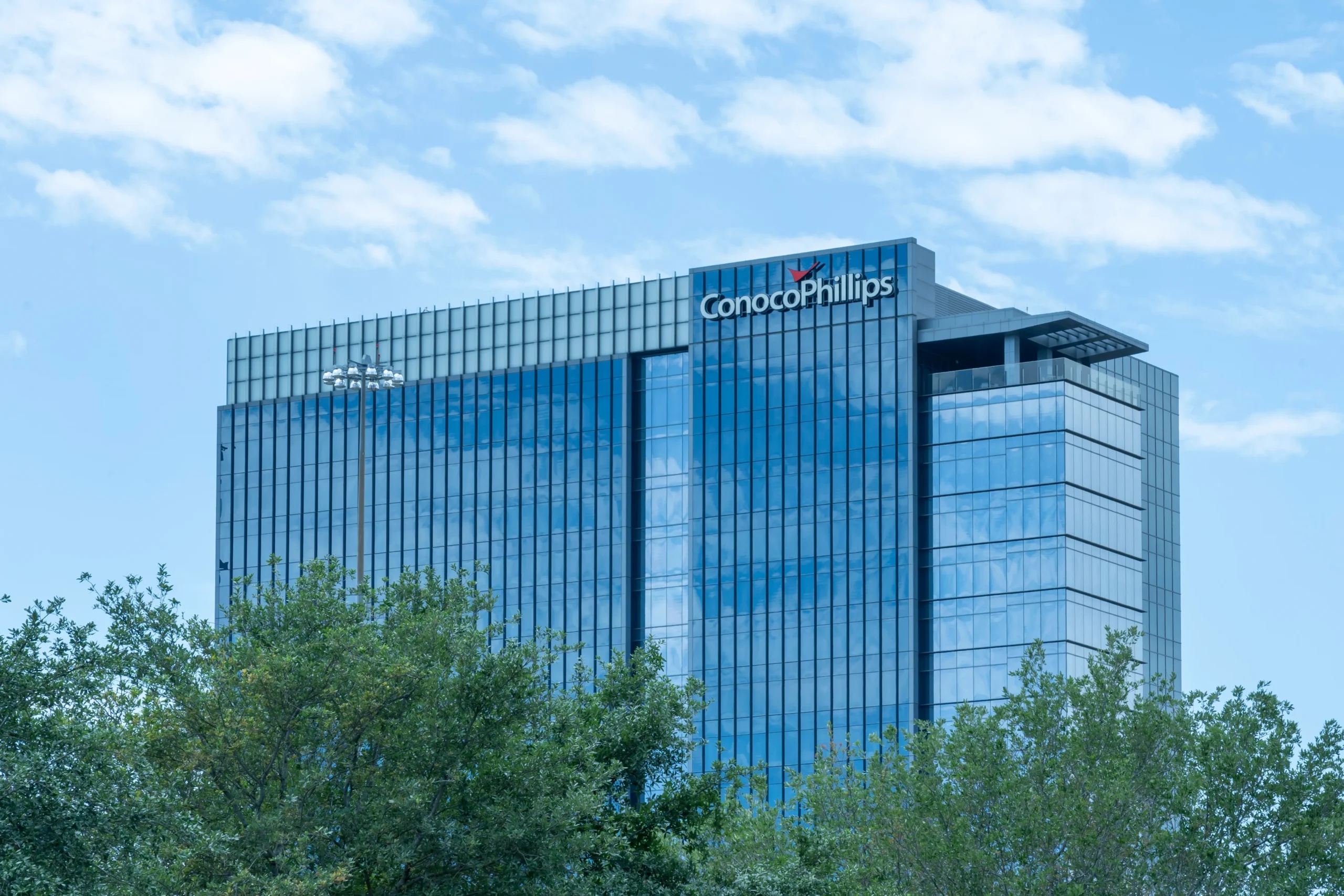
US producer ConocoPhillips lowered its 2026 production forecast after the disruption of its liquefied natural gas (LNG) operations in Qatar, affected by the conflict with Iran.
Impact of the conflict on LNG supply
Specifically, the company decided to temporarily exclude volumes from Qatar, where it participates as a partner in an export plant operated alongside QatarEnergy, one of the world’s largest LNG producers.
Attacks on energy facilities in the region have paralyzed nearly one-sixth of the country’s export capacity, valued at approximately $20 billion annually. Furthermore, repairs are estimated to take between three and five years, introducing uncertainty into the global energy market.
Adjustment in production and forecasts
As a result, ConocoPhillips now projects 2026 production of between 2.29 and 2.325 million barrels of oil equivalent per day, down from its previous estimate.
The company also anticipates that production for the current quarter will be between 2.185 and 2.215 million barrels per day. This adjustment includes a reduction of approximately 20,000 barrels per day directly related to the exclusion of Qatar, along with an additional impact from increased royalties at its Surmont project in Canada.
Although operations in Qatar represented about 4% of total production in 2025, their interruption has strategic implications due to the weight of LNG in the international market.
Financial results under pressure
On the other hand, the company also reported a decline in its financial results during the first quarter. Net income fell to $2.18 billion compared to $2.85 billion in the same period of the previous year.
This decline was accompanied by a 6% decrease in the average realized price, which stood at $50.36 per barrel equivalent, influenced by the weakness in gas prices.
In line with this scenario, ConocoPhillips shares registered a drop of nearly 2.5% before the market opened.
Investment and prospects in an uncertain environment
Regarding investment, the company anticipates annual capital expenditures of between $12 billion and $12.5 billion. This range reflects both increased activity in the Permian Basin and the uncertainty stemming from the situation in the Middle East.
In the short term, the evolution of the conflict and the recovery of infrastructure in Qatar will be determining factors for the stability of LNG production and its impact on the global energy balance.
Source: Conocophillips
Photo: Shutterstock