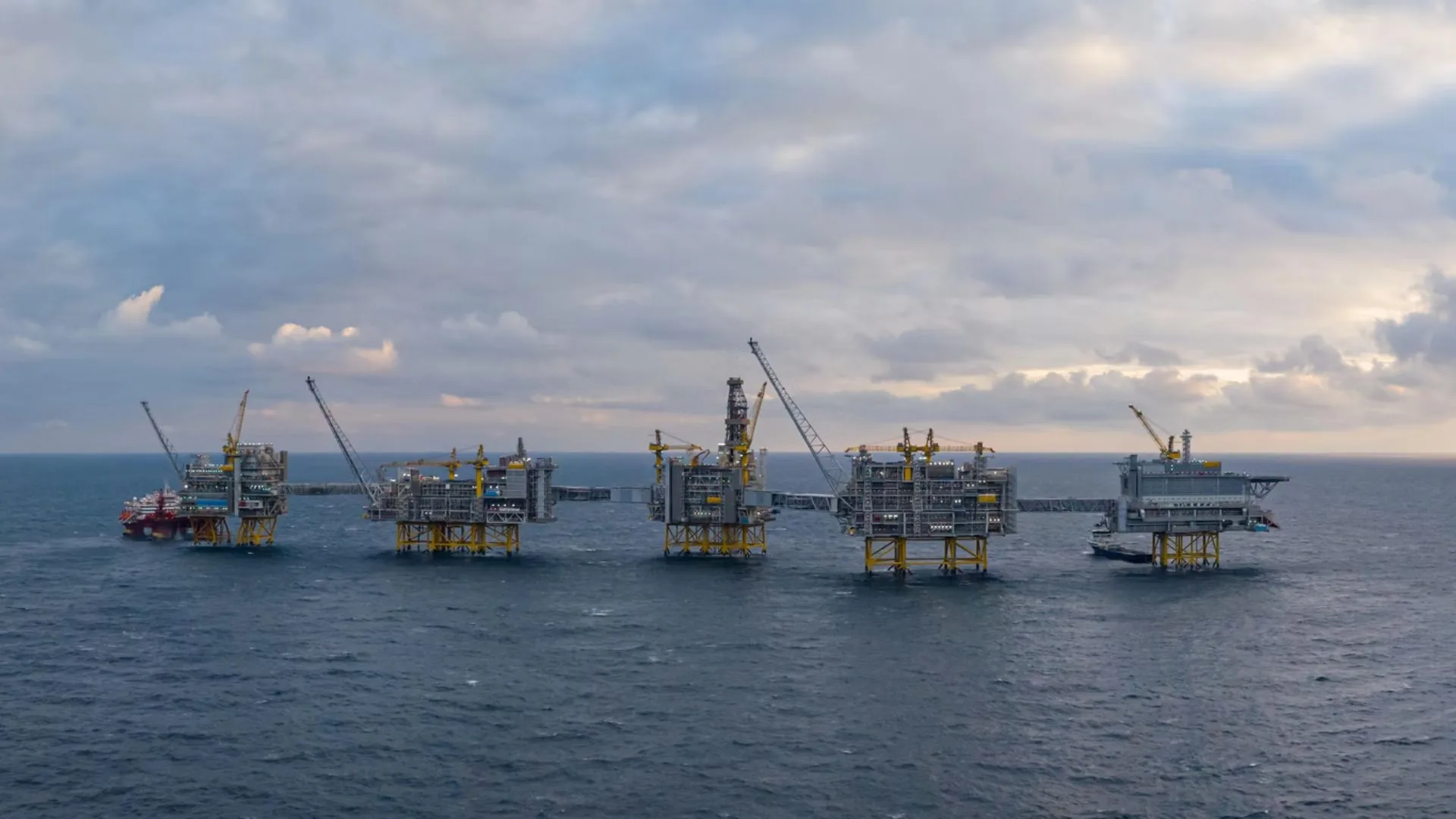
Aker BP Johan Sverdrup completed a redetermination process that increases the company’s stake in the North Sea field, granting it an additional 2.2 million barrels of oil equivalent over the next two years.
Aker BP Johan Sverdrup Adjusts Stake After Redetermination
The Johan Sverdrup field partners concluded a formal process that adjusted Aker BP’s stake from 31.5733% to 31.7163%, an increase of 0.143 percentage points. The process, initiated in January 2025, reallocates historical investments among partners based on updated field production data. As a result, Aker BP will receive an additional 2.2 million barrels of oil equivalent over the next two years.
The reallocation involves a payment of approximately NOK 300 million (about USD 30 million before tax) to the other field partners. The operator is Equinor, with a 42.6% stake, followed by Petoro AS with 17.36% and TotalEnergies EP Norge with 8.44%.
Aker BP Johan Sverdrup: The Lowest-Cost Asset in the North Sea
Johan Sverdrup produced approximately 755,000 barrels per day in April 2026, representing nearly 40% of Norway’s total oil production. The field operates on shore-based electrical power, which reduces its operational emissions and cost per barrel. Its high production profile and low carbon intensity make it a benchmark in the global offshore industry.
“Johan Sverdrup is a core asset in our portfolio due to its low operating costs and extended lifespan,” Aker BP executives have stated in previous communications to investors. The field completed its second development phase in December 2022, delivered on time and within budget despite pandemic restrictions.
Impact on Aker BP Johan Sverdrup’s Portfolio
For Aker BP, Johan Sverdrup is the cornerstone of its low-cost production profile on the Norwegian continental shelf. The 2.2 MMboe increase represents additional barrels with one of the lowest operating costs in the sector. The company is one of the largest independent producers in the North Sea, and every marginal gain in this field has a direct effect on its margins.
Redetermination processes are standard contractual mechanisms in fields with multiple partners, activated when cumulative production differs from original projections. The operational context in Norway remains relevant for European production. A Norwegian offshore strike impacted North Sea supply in previous months, highlighting the market’s sensitivity to disruptions in high-producing fields.
Aker BP Johan Sverdrup in the Norwegian Crude Oil Landscape
The field’s scale positions it as a strategic asset in North Sea hydrocarbon production. With reserves extending for several decades, Johan Sverdrup supplies low-cost barrels that sustain Norway’s competitiveness against producers in the Persian Gulf. Aker BP maintains a strategy focused on high-production, low-carbon intensity assets on the Norwegian continental shelf, where operational stability is crucial for annual results.
“Every additional barrel from Johan Sverdrup is a barrel with one of the lowest production costs in our portfolio,” summarizes the company’s capital allocation logic in recent communications to investors. Inspenet has published analyses on ADNOC’s operations on the energy route to Asia that share this focus on low-operating-cost assets. The increased stake in Aker BP Johan Sverdrup reinforces this long-term strategy.