
Vopak accelerates its entry into electricity storage in the Netherlands
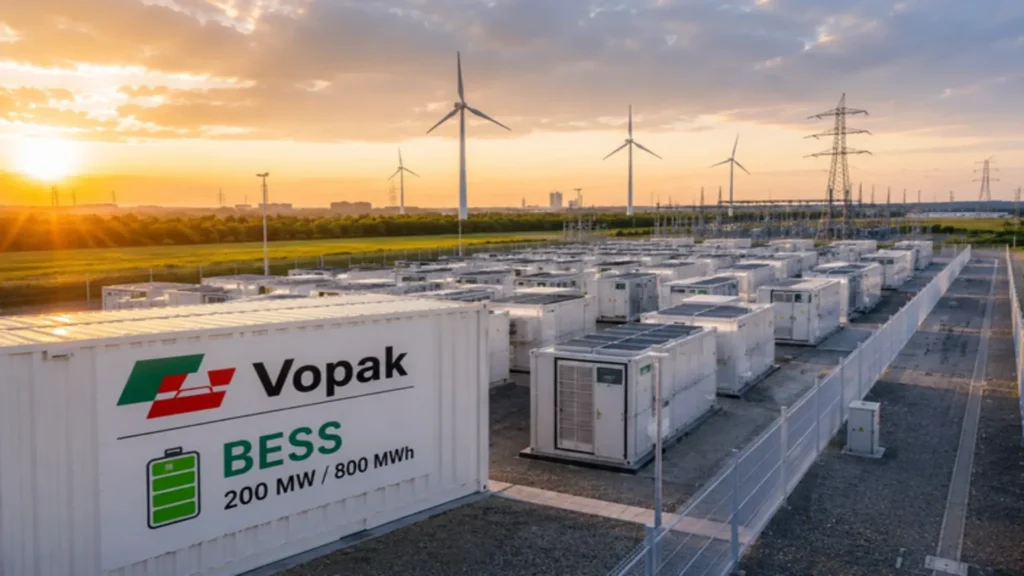
Royal Vopak is advancing its energy transition strategy with a 200 MW, 800 MWh battery storage project in Oosterhout, the Netherlands. This initiative follows the acquisition of a 79% stake in Green Energy Storage, a Dutch company specializing in large-scale BESS systems .
With this transaction, Vopak strengthens its presence in energy infrastructure beyond its traditional business of terminals for liquids, gases, and chemicals. The total investment, which includes the acquisition of the stake in GES and the development of the asset, amounts to €230 million.
A storage system to relieve the electrical grid
The storage system will have a power output of 200 MW and an energy capacity of 800 MWh, equivalent to four hours of discharge. Its function will be to absorb electricity during periods of high renewable generation and return it to the electrical grid during periods of peak demand.
In this way, the project will help reduce congestion on the Dutch grid, one of the biggest challenges for integrating solar and wind energy in the country. The installation will be connected to the high-voltage grid and will operate as a flexibility asset to balance supply and demand.
Greenchoice will contract out some of the capacity
Greenchoice will contract 50% of the system's capacity through an eight-year tolling agreement. This type of contract allows for reserving electrical storage capacity without directly assuming full ownership of the asset.
The project also has prior agreements with TenneT, the high-voltage grid operator in the Netherlands. These mechanisms will allow BESS to participate in active congestion management through flexible connection schemes.
Vopak gains importance in the energy transition
Vopak is incorporating GES as a platform for growth in the large-scale battery market. The company acquired 79% of the company and plans to buy the remaining 21% over the next two years.
This acquisition adds to the group's technical expertise in the development, permitting, construction, and operation of BESS systems . For Vopak, the transaction represents a natural extension of its critical infrastructure experience into electrical energy storage .
The project will begin operations in 2028
According to the planned schedule, construction will begin in the coming weeks and commercial operation is scheduled for the first half of 2028. Once operational, the Oosterhout storage system will be one of the largest BESS projects under development in the Netherlands.
Finally, Vopak's progress shows how large energy infrastructure operators are beginning to play a more visible role in the European electricity storage market, driven by the need for more flexible networks and greater renewable penetration.
News of additional interest
Surventis was created after the purchase of BASF's business.
Carlyle has completed the acquisition of BASF's global coatings business in a transaction valued at €7.7 billion. The acquisition creates Surventis, an independent company focused on automotive coatings and surface treatments. The transaction has received all necessary regulatory approvals and is part of BASF's strategy to concentrate its investments in other areas of its portfolio while retaining a 40% stake in the new company.
Surventis will begin operations with a global presence in the automotive paint, automotive repair, and industrial application solutions segments. The new structure aims to boost business growth with Carlyle's financial backing while ensuring continuity of service for customers in sectors such as manufacturing, energy, and infrastructure.
Eni and Mercuria create energy trading firm
Eni and Mercuria have agreed to create a Geneva-based joint venture to manage the international trade of crude oil, refined fuels, biofuels, natural gas, LNG, and LPG. The new company will be equally owned by both firms and will operate independently once it obtains the necessary regulatory approvals. In addition to trading, it will also manage logistics assets related to energy transport and storage.
The alliance will combine Mercuria's commercial expertise with Eni's production and international presence to expand its operational capacity in energy markets. The company will coordinate terminal shipments and other logistical resources to respond more quickly to supply and demand conditions in a highly volatile environment.
Production slows biofuel targets in the US
The United States' biofuel targets for 2026 are facing challenges because renewable diesel and sustainable aviation fuel plants are producing below the levels projected by authorities. This shortfall has reduced the generation of regulatory credits needed to meet the federal program's objectives and is increasing pressure on the sector during the second half of the year.
The main causes include uncertainty surrounding the rules for tax incentives for clean fuels, the impact of changes in energy prices, and the limited availability of raw materials. Added to this are operational challenges at biorefineries, which are still seeking to improve their performance and achieve higher utilization levels.
The US is considering changing radiological safety rules.
The U.S. Nuclear Regulatory Commission (NRC) has submitted a proposal to update radiation protection standards for nuclear facility workers and the public. The initiative opens a 45-day public comment period and proposes replacing the ALARA principle with a system based on exposure limits and risk management tailored to the specific conditions of each facility.
The regulatory authority maintains that the change aims to modernize the regulatory framework and facilitate the development of new nuclear projects without reducing safety levels. However, the proposal has generated debate among specialists, as some believe the modification could increase radiation exposure, while others argue that it will allow for more efficient regulation in line with technological advancements.